
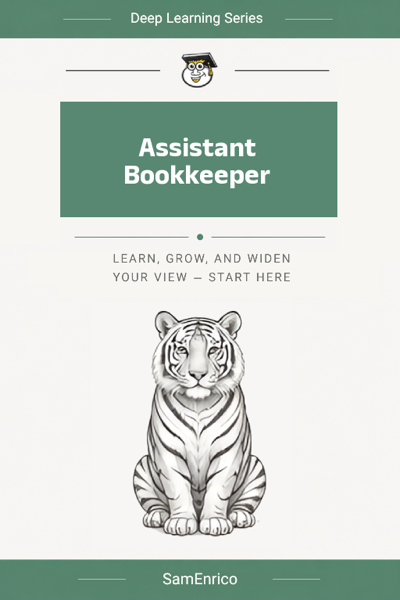
Non-FictionInformativeEducational
Assistant Bookkeeper eBook
A Coursebook on Assistant Bookkeeper
by Rizzo Ming
A Coursebook on Assistant Bookkeeper
Formats
Free sample
Chapter 1: The Ledger You Inherit--The first time you open a company’s accounting records, you are not looking at numbers. You are looking at decisions. Every invoice issued, every payment received, every supplier bill logged, and every bank reconciliation signed off represents a choice made by someone who came before you. Some of those choices were wise. Some were rushed.
Some were simply wrong. And now, as the new assistant bookkeeper, you inherit them all—the good, the bad, and the unreconciled.This is the reality of entry-level bookkeeping. No one hands you a perfectly clean set of books on your first day. Instead, you receive a handover email with seventeen attachments, a login to accounting software that no one has fully explained, and a stack of filing that dates back three years. Your predecessor may have left detailed notes.
More likely, they left abruptly, and the only thing waiting for you is a suspense account with a balance no one can explain.This chapter exists to prepare you for that moment. Before we teach you how to post a journal, calculate VAT, or reconcile a bank statement, we must first answer three foundational questions: What exactly does an assistant bookkeeper do? Where do you fit within the finance team? And what ethical principles will guide you when no one is watching?By the end of this chapter, you will not only understand the role. You will understand why the role matters—and why getting it right protects not just the company’s money, but its reputation, its legal standing, and its future.1.1 The Assistant Bookkeeper: More Than Data Entry Let us begin with a definition that will save you years of confusion.
The assistant bookkeeper is the entry-level professional responsible for recording the day-to-day financial transactions of a business under the supervision of a senior bookkeeper, accounts manager, or financial controller. You are the person who ensures that every pound, dollar, or euro that moves into or out of the business is captured accurately, classified correctly, and stored in a way that can be retrieved for reporting, audit, or tax purposes.However, the job title “assistant bookkeeper” means different things in different organisations. In a small firm with five employees, you might be the only finance person, reporting directly to the owner. In a large company with a finance department of fifty people, you might handle only one specific task—perhaps processing supplier invoices or reconciling the petty cash—while a team of specialists handles everything else. Understanding these variations is essential because it determines how you present yourself in job interviews and how you prioritise your learning.Distinguishing the Assistant Bookkeeper from Related Roles Three job titles frequently appear alongside assistant bookkeeper, and they are not interchangeable.
Knowing the difference will help you target the right roles and avoid accepting a position for which you are overqualified or underprepared.Accounts Assistant: This role is often more administrative than technical. An accounts assistant might file paperwork, scan invoices into a document management system, answer supplier phone calls, and assist with basic data entry. While some accounts assistants perform light bookkeeping, the role typically emphasises clerical efficiency over accounting knowledge. If a job description mentions photocopying, filing, or answering phones prominently, you are looking at an accounts assistant position, not a bookkeeping role.Financial Clerk: This is the most task-specific of the three roles. A financial clerk might spend eight hours per day processing purchase orders, or matching delivery notes to invoices, or logging expense claims.
The work is repetitive and process-driven, with little need to understand the broader accounting cycle. Financial clerks are essential in large organisations, but the role offers limited exposure to full-cycle bookkeeping.Assistant Bookkeeper: In contrast, the assistant bookkeeper is expected to understand double-entry accounting, maintain ledgers, post journals, reconcile bank accounts, and assist with period-end adjustments. You are not merely processing transactions—you are understanding them. This role is the traditional entry point for professionals pursuing qualifications such as the AAT (Association of Accounting Technicians) in the UK or the Certified Bookkeeper designation internationally.One way to remember the difference: an accounts assistant supports the office; a financial clerk executes a single process; an assistant bookkeeper supports the ledgers.1.2 The Accounting Cycle: From Source Document to Trial Balance Every transaction in a business follows a predictable journey from its origin to its final resting place in the financial statements. This journey is called the accounting cycle, and as an assistant bookkeeper, you will touch every stage of it.Understanding the cycle gives you context for every task you perform.
When you enter a supplier invoice, you are not just typing numbers into a screen—you are beginning a process that will eventually appear on the profit and loss statement and influence the tax return filed with HMRC or the IRS.Stage One: Source Documents Every financial transaction begins with a source document. This is the original evidence that a transaction occurred. Common source documents include:Sales invoices: Issued to customers when you sell goods or services on credit Purchase invoices: Received from suppliers when you buy goods or services on credit Receipts: Evidence of cash or card payments received Bank statements: Records of all transactions passing through the company’s bank account Credit notes: Issued or received when goods are returned or prices are adjusted Till rolls: From physical point-of-sale transactions Expense claim forms: Submitted by employees seeking reimbursement for business-related purchases Your job begins with these documents. You must collect them, verify their completeness, and ensure they are authorised by the appropriate person before any transaction is recorded.Stage Two: Books of Prime Entry Rather than recording every transaction directly into the main ledger, bookkeepers use books of prime entry (also called daybooks or journals) to summarise transactions by type. This approach saves time and reduces errors.The common books of prime entry are:Sales daybook: Records all sales invoices issued Purchase daybook: Records all supplier invoices received Sales returns daybook: Records credit notes issued to customers Purchase returns daybook: Records credit notes received from suppliers Cash book: Records all receipts and payments of cash and bank transactions Petty cash book: Records small, irregular cash expenses The journal: Records non-standard transactions such as corrections, depreciation, and period-end adjustments Chapters 4 through 7 of this book will teach you how to operate each of these daybooks.Stage Three: Posting to the Ledgers Once transactions are recorded in the daybooks, you post them to the ledgers.
The nominal ledger (also called the general ledger) contains all the main accounts that appear on the financial statements—sales, purchases, wages, rent, utilities, assets, liabilities, and capital. The sales ledger contains individual customer accounts. The purchase ledger contains individual supplier accounts.Posting means transferring the totals from the daybooks into the appropriate ledger accounts. For example, at the end of each week, you might post the total of all sales invoices from the sales daybook to the sales account in the nominal ledger. Meanwhile, each individual customer’s transactions are posted to their account in the sales ledger, so you can see at a glance who owes what.Stage Four: The Trial Balance At the end of each accounting period—typically monthly—you extract a trial…
This is the end of the free sample. Get the eBook to keep going. Buy now
About this book
Details
- Author
- Rizzo Ming
- Publisher
- SamEnrico
- Language
- English
- Genre
- Non-Fiction, Informative, Educational
- Released
- 2026-06-03
- Pages (approx.)
- 145
- Available as
- eBook, Audiobook

Read better in the ZLOADR app
Your eBooks on your phone or tablet. Sign in with your SamEnrico account and start reading.
More by Rizzo Ming
 Cleopatra Son Caesarion RuleRizzo Ming$11.99
 Stress Liver Health GuideRizzo Ming$11.99
 OCD Career Break GuideRizzo Ming$11.99
 The Colorectal Cancer Screening GuideRizzo Ming$11.99
 Parental Addiction Teen EsteemRizzo Ming$11.99
 The Birth of the Wheel: How Skateboarding Conquered the World (1950-1980)Rizzo Ming$11.99
 How to Start a Boarding School Accommodation Business (Beginners Guide)Rizzo Ming$11.99
 Health Impact Pitch GuideRizzo Ming$12.99
 Facebook Ad Approval ProcessRizzo Ming$12.99
 The Breeder's Guide to American Cream HorsesRizzo Ming$11.99
You may also like
 Hong Kong Handover 1997Dunn Johnnie$11.99
 Zumba For Postnatal Recovery CourseNeal Christian$11.99
 Zumba for BeginnersLadner Nikia$11.99
 YouTube Comment Mining GuideHumes Pandora$12.99
 Worry Box MeditationCarlin Rudy$11.99
 Workplace Stress MeditationNguyen Lynn$11.99
 Workplace Stress and Sleep RepairHawley Ivory$11.99
 Workplace Perfectionism CureDelaney Jeffry$11.99
 Workplace Injustice Anger GuideWallen Isabelle$11.99
 Work Addiction and Burnout LinkGreenwood Ester$11.99
 Women in Yoga and WellnessBeattie Galina$11.99
 Women in Stand Up ComedyChun Evangeline$11.99