
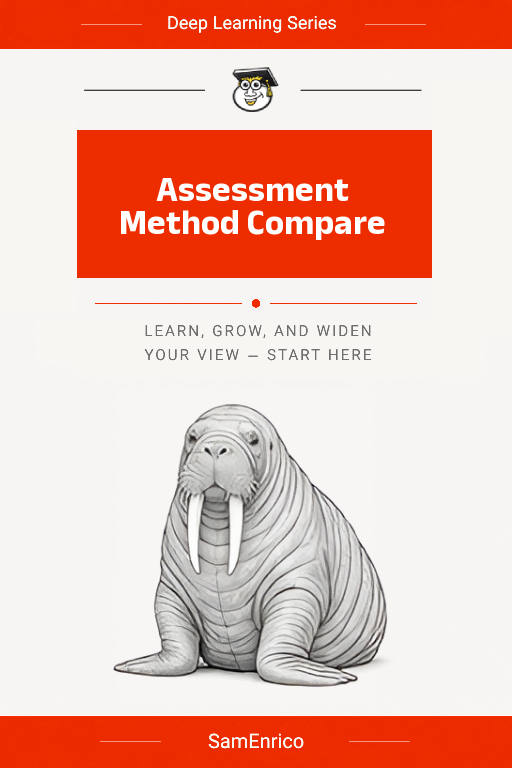
Non-FictionStudent's ShortcutAssessment
Assessment Method Compare eBook
Compare final exam weighting (UK), continuous asse
Compare final exam weighting (UK), continuous assessment (US), and hybrid models (Australia).
Formats
Free sample
Chapter 1: The Grading Triad--–- Three students. Three countries. Three radically different ways to measure the same year of learning.In a small flat in Manchester, England, seventeen-year-old Priya is memorizing the dates of every British monarch since 1066. Her entire A-Level History grade—and therefore her chance of studying at Oxford—rests on a three-hour exam she will take in nine months. She has no homework points to cushion a bad day.
No extra credit. No resubmissions. If she wakes up with a fever on exam day, or her mind goes blank during the second essay, or the proctor’s phone rings and distracts her at a critical moment, her year of work collapses into a single snapshot. Priya knows this. She has been told, repeatedly, that this is fair.
Everyone takes the same exam. Everyone is judged by the same standard. What could be more objective?Eight thousand kilometers away in Columbus, Ohio, seventeen-year-old Marcus is checking his grade on Canvas, his school’s learning management system. He has a B+ in English, but he can still pull it up to an A- if he submits the extra credit reflection by Friday. His grade is a composite of twenty-three separate assignments: daily reading quizzes, two drafts of a research paper, participation in class discussions (three points per day, capped at fifty points per quarter), a group project, peer reviews, and a final exam worth only fifteen percent of his total.
Marcus has learned to play the game. He knows which assignments are worth the most points. He knows that showing up and speaking once per class is worth the same as doing the reading deeply. He knows that a single bad week won’t ruin his semester. But he also knows that some of his classmates—the ones whose parents check their grades nightly, who have quiet rooms to study in, who don’t work twenty hours a week at a grocery store—have a running start.
The system feels fair because everyone has the same opportunities to earn points. But Marcus isn’t sure it actually is fair.Fifteen thousand kilometers away in Sydney, Australia, seventeen-year-old Amara is putting the finishing touches on her History Extension research project. She has spent twelve weeks investigating a single question: how did the memory of the Gallipoli landing shape Australian national identity between 1915 and 1930? She has analyzed primary sources, interviewed a historian, and written a four-thousand-word research essay. This project is worth fifty percent of her final grade.
The other fifty percent will come from a three-hour external exam in November, written and marked by the state education authority. Amara likes the balance. She has time to think deeply. She can get feedback from her teacher on drafts. But she also knows that the exam will test her ability to write quickly under pressure, to recall specific evidence without her notes, and to perform on a single day.
She has two very different skills to develop. She has two chances to succeed. But she also has twice the work.Three students. Three systems. Three different answers to the same fundamental question: what should a grade actually mean?This book argues that the answer is not found by declaring one model superior to the others, but by understanding what each model is designed to do, who it serves, who it fails, and how the pieces can be reassembled into something better.
We begin with a map of the terrain.The United Kingdom: The Exam as the Final Arbiter The British model of assessment, codified in the GCSEs (taken at sixteen) and A-Levels (taken at eighteen), rests on a simple and seductive premise: the best way to compare students from different schools, different teachers, and different backgrounds is to give them all the same test under the same conditions and mark their responses anonymously.This is not a new idea. The British civil service exams of the mid-nineteenth century, designed to select colonial administrators based on merit rather than patronage, established the template. By the mid-twentieth century, the Ordinary and Advanced Level examinations had become the gatekeepers of British education. The 1988 Education Reform Act nationalized this system, creating the GCSE and tying school funding and inspection to exam results. Today, A-Levels remain the primary currency of university admissions not just in the United Kingdom but in much of the Commonwealth.The attractions of this model are real and should not be dismissed as mere traditionalism.First, procedural objectivity.
When a student’s exam script is marked by a stranger who does not know their name, their race, their gender, their socioeconomic background, or their classroom behavior, certain forms of bias are minimized. The teacher who unconsciously grades the polite, well-dressed student more generously cannot affect the exam score. The student who argued with the teacher in February is not penalized in June. This kind of objectivity is rare in human judgment, and it is genuinely valuable.Second, national standardization. An A in A-Level Mathematics means the same thing in a deprived coastal town as it does in a wealthy London suburb.
This comparability is essential for university admissions, which must sort tens of thousands of applicants from schools with vastly different resources. Without a common examination, universities would have to rely on teacher-generated grades, which research consistently shows are vulnerable to inflation, leniency, and unconscious bias.Third, cost-effectiveness. Marking a three-hour exam for a hundred thousand students requires a well-organized system, but it is far cheaper per student than evaluating portfolios, conducting oral defenses, or monitoring project-based assessments across multiple years.Fourth, motivation for revision. The high stakes of a single exam can produce intense, focused studying. Students who might coast through the year if they knew they could recover with homework points instead confront the reality that the exam matters.
For some students, this pressure is productive.But the weaknesses of the exam-only model are equally real and significantly more severe.Teaching to the test is the most commonly cited problem. When a school’s funding, a teacher’s reputation, and a student’s future all hinge on exam scores, the curriculum narrows. Teachers skip the fascinating but non-testable side topic. They drill exam technique—how to spot the mark scheme’s keywords, how to allocate time across questions, how to write a conclusion that sounds confident even if you are not—at the expense of genuine intellectual exploration. A history student might become very good at writing five-paragraph essays about causation while never learning that historians disagree about what causation even means.Test anxiety is a second and more insidious problem.
For a significant subset of students—those with generalized anxiety disorders, panic disorders, ADHD, dyslexia (particularly when timed), or chronic illnesses that can flare unpredictably—the exam does not measure knowledge. It measures stress tolerance. These students may know the material perfectly well but perform poorly because their sympathetic nervous system overreacts to the high-stakes environment. The exam’s procedural objectivity cannot see this. It sees only the wrong answer.The cram-and-forget cycle is the third weakness.
Cognitive science research is clear: students who cram for a final exam lose most of the content within six weeks. The exam incentivizes…
This is the end of the free sample. Get the eBook to keep going. Buy now
About this book
Details
- Author
- Okeefe Jeraldine
- Publisher
- SamEnrico
- Language
- English
- Genre
- Non-Fiction, Student's Shortcut, Assessment
- Released
- 2026-05-30
- Pages (approx.)
- 155
- Available as
- eBook, Audiobook

Read better in the ZLOADR app
Your eBooks on your phone or tablet. Sign in with your SamEnrico account and start reading.
More by Okeefe Jeraldine
 Mindful Listening PracticeOkeefe Jeraldine$11.99
 Solntsevskaya Bratva GuideOkeefe Jeraldine$11.99
 One Month Spending Fast CourseOkeefe Jeraldine$11.99
 Sugar Addiction in Recovery from AlcoholOkeefe Jeraldine$11.99
 Dream Career Guidance JournalOkeefe Jeraldine$11.99
 The Last Waltz: A Love Story in the Shadows of WarOkeefe Jeraldine$11.99
 The Kite That Soared: Ancient Southeast Asia's First Flight PioneersOkeefe Jeraldine$11.99
 Local Manufacturing AdvantageOkeefe Jeraldine$12.99
 JourneymanOkeefe Jeraldine$11.99
 Understanding Congenital Adrenal Hyperplasia, LipoidOkeefe Jeraldine$17.99
 How to Start a Motors for Aircraft Business (Beginners Guide)Okeefe Jeraldine$11.99
You may also like
 Hong Kong Handover 1997Dunn Johnnie$11.99
 Zumba For Postnatal Recovery CourseNeal Christian$11.99
 Zumba for BeginnersLadner Nikia$11.99
 YouTube Comment Mining GuideHumes Pandora$12.99
 Worry Box MeditationCarlin Rudy$11.99
 Workplace Stress MeditationNguyen Lynn$11.99
 Workplace Stress and Sleep RepairHawley Ivory$11.99
 Workplace Perfectionism CureDelaney Jeffry$11.99
 Workplace Injustice Anger GuideWallen Isabelle$11.99
 Work Addiction and Burnout LinkGreenwood Ester$11.99
 Women in Yoga and WellnessBeattie Galina$11.99
 Women in Stand Up ComedyChun Evangeline$11.99