
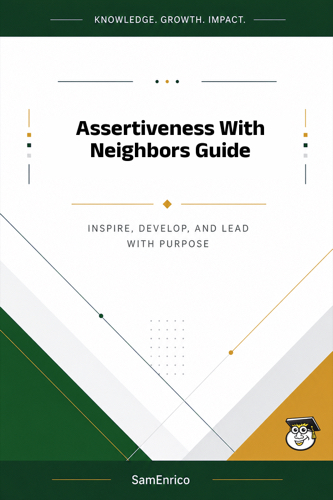
Non-FictionSelf-HelpNeighborsDisputes
Assertiveness With Neighbors Guide eBook
Address noise, property lines, and parking dispute
Address noise, property lines, and parking disputes without warfare.
Formats
Free sample
Chapter 1: The Three Gates–- You are standing at your kitchen window at 11:47 PM. The bass from your neighbor’s subwoofer is vibrating the water in your glass. Your jaw is clenched. Your heart is pounding. You have two options running through your mind: go over there and say something you will regret, or do nothing and fume for the next three hours.
Both options feel terrible. One makes you an aggressor; the other makes you a doormat.There is a third option. It is called assertiveness, and it has almost nothing to do with being loud, dominant, or intimidating. Assertiveness is the ability to state your needs clearly and calmly while respecting the other person’s humanity. It is the narrow path between passive suffering and aggressive warfare.
This book is about finding that path, walking it, and staying on it even when every instinct is screaming at you to escalate or retreat.Most neighbor disputes fail not because the noise is too loud or the encroachment is too egregious. They fail because we treat neighbors as temporary obstacles to be eliminated rather than permanent stakeholders in our daily environment. You cannot move every time a conflict arises. You cannot afford a lawyer for every misplaced fence post. You cannot call the police for every barking dog.
What you can do is build mental infrastructure. You can install psychological gates that every impulse must pass through before it becomes an action.This chapter introduces those gates. They are not abstract philosophy. They are practical, teachable, repeatable filters that separate reactive impulse from assertive action. Master these three gates, and you will never again start a conversation you cannot finish without damage.
You may not win every dispute, but you will never lose your dignity, your calm, or your standing as the reasonable person on the block.Gate Zero: The Principle That Underlies Everything Before we walk through the three formal gates, there is a foundational principle that must be stated once, memorized, and applied to every single interaction in this book. Call it Gate Zero.Assume ignorance, not malice.This is not naive optimism. This is strategic humility. The overwhelming majority of neighbor conflicts arise not from deliberate cruelty but from obliviousness, different schedules, different standards of cleanliness, different tolerances for noise, or simple lack of information. Your neighbor probably does not know that their subwoofer vibrates your bedroom.
They probably do not know that their tree branches are scraping your roof. They almost certainly do not know that their guest’s car has been blocking your driveway for three hours.When you assume malice, your tone becomes accusatory. You say, “Why are you doing this to me?” When you assume ignorance, your tone becomes informative. You say, “I don’t think you realize something that’s affecting me.” The first invites a defensive war. The second invites a collaborative problem-solving conversation.
The difference is not semantic; it is chemical. Your voice softens. Your shoulders relax. Your neighbor’s defenses stay down.Gate Zero will appear throughout this book. Every script, every template, every strategy assumes that your neighbor is not a villain but an unaware human being.
This assumption will be wrong occasionally. Some neighbors are genuinely malicious. We will address those high-conflict personalities in Chapter 8. But starting with malice as the default assumption guarantees conflict. Starting with ignorance as the default assumption allows you to pivot to stronger measures only when proven necessary.Write this down.
Put it on your refrigerator. Assume ignorance, not malice.Gate One: The Emotional Trap The first gate is the hardest because it requires you to override your own biology. Here is what happens inside your body when you perceive a threat from your neighbor. Your amygdala, an ancient part of your brain designed to detect predators, activates. It does not distinguish between a saber-toothed tiger and a neighbor’s barking dog at 1 AM.
To your amygdala, both are threats. In response, your adrenal glands flood your bloodstream with cortisol and adrenaline. Your heart rate increases. Your muscles tense. Your peripheral vision narrows.
Your prefrontal cortex—the part of your brain responsible for reasoning, impulse control, and long-term planning—is partially suppressed.You are now in a state of physiological readiness for physical combat. This is the emotional trap. You feel an overwhelming urge to act immediately, to punish, to confront, to win. But you are not equipped to act wisely in this state. Your reasoning is offline.
Your empathy is suppressed. Your memory for past successful negotiations is inaccessible. You are, for all practical purposes, a more dangerous version of yourself.The solution is deceptively simple and ruthlessly difficult to execute. It is called the Ten-Minute Rule.When you feel the adrenaline surge—the clenched jaw, the racing heart, the hot face—do nothing for ten minutes. Not one thing.
Do not text. Do not knock on the door. Do not write a note. Do not call your spouse to vent. Do nothing.
Set a timer if you need to. During those ten minutes, you are allowed to feel the emotion. You are allowed to label it silently to yourself. “I feel invaded.” “I feel disrespected.” “I feel powerless.” Labeling the emotion activates your prefrontal cortex and begins to calm the amygdala. But you are not allowed to act.After ten minutes, reassess.
In the vast majority of cases, the urgency will have passed. The dog may have stopped barking. The music may have ended. The car may have moved. You will realize that your initial impulse—to storm over there, to call the police, to leave an angry note—would have been disproportionate to the actual provocation.
In the cases where the noise continues after ten minutes, you are now acting from a calmer, more strategic place. Your prefrontal cortex is back online. You can choose an assertive response rather than an aggressive reaction.The Ten-Minute Rule prevents approximately eighty percent of unnecessary escalations. It is the single highest-leverage habit you can develop. It costs nothing.
It takes no special training. It only requires the willingness to pause. But pausing is exactly what your adrenaline-fueled brain does not want to do. That is why it is a gate. You must consciously choose to walk through it.Gate Two: The Entitlement Gap The second gate requires you to distinguish between two very different things: your legal rights and your personal preferences.
These are not the same. Confusing them is the source of endless, unnecessary conflict.Your legal rights are what you can enforce through a court, a police officer, or a government agency. They are written down in municipal codes, state laws, HOA covenants, and lease agreements. They have specific language. They have thresholds.
A noise ordinance typically prohibits sound above a certain decibel level between certain hours. A property line is defined by a recorded survey. A parking regulation specifies how long a vehicle can remain on a public street. These are objective, measurable, enforceable.Your personal preferences are what you wish were true. You wish your neighbor would not mow his lawn at 7 AM on Sunday.
You wish she would not let her children play in the front yard where you can hear them. You wish…
This is the end of the free sample. Get the eBook to keep going. Buy now
About this book
Details
- Author
- Hamrick Chana
- Publisher
- SamEnrico
- Language
- English
- Genre
- Non-Fiction, Self-Help, Neighbors, Disputes
- Released
- 2026-06-08
- Pages (approx.)
- 139
- Available as
- eBook, Audiobook

Read better in the ZLOADR app
Your eBooks on your phone or tablet. Sign in with your SamEnrico account and start reading.
More by Hamrick Chana
 1031 Exchange Vacation HomeHamrick Chana$11.99
 The Shame Resilience EQ CourseHamrick Chana$11.99
 Vein Visibility Self EsteemHamrick Chana$11.99
 The EQ for Human Resources GuideHamrick Chana$11.99
 The Battle of Crécy: Longbows vs. Chivalry (1346)Hamrick Chana$11.99
 Marketing Automation ManagerHamrick Chana$11.99
 How to Start a On-line Publishing N.e.c. Business (Beginners Guide)Hamrick Chana$11.99
 Touchless Invoice Processing PlaybookHamrick Chana$12.99
 Strategy Meeting Pre Read GuideHamrick Chana$12.99
 Understanding Malignant Hyperthermia Susceptibility Type 2Hamrick Chana$17.99
You may also like
 Hong Kong Handover 1997Dunn Johnnie$11.99
 Zumba For Postnatal Recovery CourseNeal Christian$11.99
 Zumba for BeginnersLadner Nikia$11.99
 YouTube Comment Mining GuideHumes Pandora$12.99
 Worry Box MeditationCarlin Rudy$11.99
 Workplace Stress MeditationNguyen Lynn$11.99
 Workplace Stress and Sleep RepairHawley Ivory$11.99
 Workplace Perfectionism CureDelaney Jeffry$11.99
 Workplace Injustice Anger GuideWallen Isabelle$11.99
 Work Addiction and Burnout LinkGreenwood Ester$11.99
 Women in Yoga and WellnessBeattie Galina$11.99
 Women in Stand Up ComedyChun Evangeline$11.99