
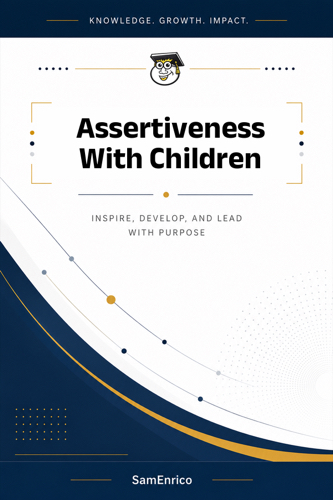
Assertiveness With Children eBook
Sets firm, loving limits with kids without yelling
Sets firm, loving limits with kids without yelling or permissiveness.
Formats
Free sample
Chapter 1: The Myth of Instant Obedience--All behavior is communication. This single sentence, repeated in parenting books and pediatric offices for decades, has been so thoroughly hollowed out by overuse that it no longer lands as truth. It lands as a platitude. Parents hear it and nod while thinking, That’s nice, but my child just threw a wooden block at the baby’s head. What exactly is that communicating?
And why should I care about the message when I need the throwing to stop right now?These are fair questions. They deserve an answer that is not a platitude.Let me give you a different starting point. One that will make or break every single technique in this book. Here it is: When a child is emotionally flooded—truly upset, defiant, melting down, or screaming—their brain has physically, neurologically, and temporarily lost access to the very structures required for logic, reason, impulse control, and obedience. This is not an opinion.
This is not a gentle parenting fantasy. This is a fact of human neurobiology, confirmed by decades of research into brain development and stress physiology.If you take nothing else from this chapter, take this: you cannot reason with a child whose reasoning brain is offline. And you cannot command obedience from a child who is physically incapable of following commands. The parent who yells at a melting-down child is not dealing with defiance. They are demanding that a child perform a neurological impossibility.
That is like screaming at a television with a broken power cord, demanding that it turn on. The television is not being stubborn. It is broken. In that moment, the child is not being bad. They are flooded.This chapter will teach you what that flood looks like, why it happens, and—most critically—what to do before you attempt any correction, consequence, boundary, or teaching moment.
The answer, counterintuitively, is often nothing. Or rather, the answer is to stop doing what you are doing and shift your entire strategy from behavior change to state change. You cannot change a child’s behavior until you change their internal state. Connection is not a reward you give after compliance. Connection is the prerequisite without which compliance is neurologically impossible.The Anatomy of a Meltdown: Why Your Child Isn't Giving You a Hard Time Let us begin with a scene that every parent knows by heart.
You are in a grocery store. Your child is three, or five, or seven. They have asked for a sugar cereal in a bright box. You have said no. Something shifts behind their eyes.
First comes the whine, then the stiffening of the body, then the full-throated scream that seems to suck all the oxygen out of the aisle. Strangers turn to look. Your face flushes. And in that moment, two competing stories fight for dominance in your mind.The first story, the one you probably grew up with, says: Your child is manipulating you. They are trying to get what they want through bad behavior.
If you give in, you will raise a spoiled brat. If you are firm enough, they will learn. This story has a seductive simplicity. It casts the parent as the sheriff of a small frontier town, and the child as a clever but unruly outlaw who must be shown who is boss.The second story, the one popularized by modern parenting books, says: Your child is not giving you a hard time; they are having a hard time. They are overwhelmed, tired, hungry, or overstimulated.
Your job is to hold space for their feelings. This story is kinder, but it often leaves parents feeling like passive doormats, nodding sympathetically while their child screams in the cookie aisle.Both stories are incomplete. Both are wrong in ways that matter.The truth is neurobiological. When your child screamed in that grocery store, their brain underwent a specific, predictable, and measurable event. It is called flipping the lid, a term coined by Dr.
Dan Siegel to describe what happens when the downstairs brain—the primitive, survival-oriented region including the amygdala and brainstem—overrides the upstairs brain—the prefrontal cortex, which handles impulse control, emotional regulation, empathy, planning, and rational thought.Here is what that looks like in real time. Your child hears “no” to the cereal. That “no” is registered by the amygdala, the brain’s smoke detector, as a threat. Not a physical threat, but a threat to their desire, their autonomy, their sense of control. The amygdala sounds an alarm.
Cortisol and adrenaline surge. Blood flows away from the upstairs brain and toward the muscles and limbs. The upstairs brain, now starved of resources, literally goes offline. Your child cannot access their ability to think, to reason, to consider consequences, to remember that you love them, or to choose a different behavior. They are, for all practical purposes, operating from their reptile brain.
They can fight, flee, freeze, or faint. That is the entire menu.This is not a tantrum. It is a neurological hijacking.And here is the part that most parenting advice gets catastrophically wrong: You cannot teach, correct, reason, threaten, or consequence your way through a flipped lid. The upstairs brain is not listening. It is not there.
Explaining why the cereal is unhealthy is like reading a lease agreement to someone having a panic attack. Yelling is like adding gasoline to a fire—it raises the child’s threat perception even higher, flooding their system with more cortisol and pushing the upstairs brain even further offline. Even logical consequences, delivered in a calm voice, will be processed by the child’s downstairs brain as another threat. They will not hear, “If you don’t stop screaming, we are leaving the store.” They will hear a growl, a predator, a reason to scream louder.This is the single greatest trap in parenting: trying to solve a neurological problem with a behavioral solution. It does not work.
It has never worked. And it is the primary reason that otherwise loving, intelligent parents find themselves screaming at small children in parking lots, wondering where they went wrong.You did not go wrong. You just did not know about the lid.The Executive Pause: The Ten-Second Intervention That Changes Everything Before we discuss what to do with a flooded child, we must discuss what to do with a flooded parent. Because here is the uncomfortable truth that no parenting book wants to admit: when your child flips their lid, your amygdala is also sounding an alarm. You also experience a cortisol surge.
Your upstairs brain is also at risk of going offline. This is not a failure of your character. This is your biology, doing exactly what it evolved to do. Your child screams, and your brain interprets that scream as a threat to your social standing (the staring strangers), your identity as a good parent, your schedule, your sanity, and perhaps even your physical safety if the screaming triggers old trauma. The threat is perceived, and the downstairs brain takes over.This is why parents yell.
Not because they are bad people, not because they lack self-control in a moral sense, but because their upstairs brain…
This is the end of the free sample. Get the eBook to keep going. Buy now
About this book
Details
- Author
- Willey Raymon
- Publisher
- SamEnrico
- Language
- English
- Genre
- Non-Fiction, Self-Help / Parenting
- Released
- 2026-06-10
- Pages (approx.)
- 159
- Available as
- eBook, Audiobook

Read better in the ZLOADR app
Your eBooks on your phone or tablet. Sign in with your SamEnrico account and start reading.
More by Willey Raymon
 Skinny Shaming Childhood RecoveryWilley Raymon$11.99
 Franchising Your Local Brand Across Borders Competitive AnalysisWilley Raymon$11.99
 Cocaine and Memory LossWilley Raymon$11.99
 Alien Abduction National ParksWilley Raymon$11.99
 Memory Palace Exam MethodWilley Raymon$11.99
 Boredom and GamblingWilley Raymon$11.99
 The Nairobi Stock Exchange Scandal: How Phone Records Exposed a Billion-Dollar FraudWilley Raymon$11.99
 The Copycat Killer Who Changed Canada’s Witness Protection LawsWilley Raymon$11.99
 A Collector's Handbook to the Darracq 4-litreWilley Raymon$11.99
 How to Produce a SprayWilley Raymon$11.99
 Profit Margin Shrinkage from Rate HikesWilley Raymon$12.99
 Freemium A/B Testing GuideWilley Raymon$12.99
You may also like
 Loneliness for ParentsTaggart Margart$11.99
 Validating Children's EmotionsHeck Sherril$11.99
 Child Nightmare GuideLevesque Arnulfo$11.99
 Parenting Stress PartnershipAndres Charis$11.99Parenting Stress PartnershipAndres Charis$11.99
 Self Talk for ParentingMcclain Porsche$11.99
 Road Rage and KidsBryan Audrey$11.99
 Parenting Stress Couple AngerSchmidt Kathryn$11.99
 Parent Time Management GuideLucero Dario$11.99
 Parent Resilience GuideDanielson Alla$11.99
 EQ for ParentsLandry Tanisha$11.99
 Self Talk for KidsQualls Sheridan$11.99