
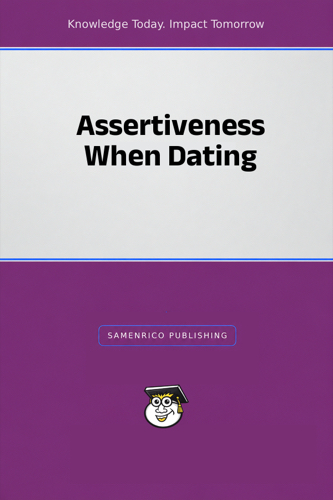
Assertiveness When Dating eBook
Teaches stating preferences, setting physical boun
Teaches stating preferences, setting physical boundaries, and ending dates early.
Formats
Free sample
Chapter 1: The Pleaser’s Funeral--–- You are about to do something uncomfortable. You are going to bury a version of yourself that you have likely spent decades perfecting. This version of you is polite, accommodating, and deeply afraid of disappointing anyone. This version of you has said “I don’t care” when you absolutely cared. This version of you has laughed at jokes that weren’t funny, agreed to second dates you dreaded, and stayed quiet when your body was screaming for you to speak.
This version of you is not a bad person. In fact, this version of you probably thinks of itself as a very good person. But here is the truth that will either liberate you or make you close this book: being a people-pleaser is not kindness. It is a survival strategy. And it is ruining your chances at real love.The Diagnosis: How to Spot the Pleaser in the Mirror Let us begin with an uncomfortable question.
When was the last time you wanted something different from what your date wanted—and you said nothing? Not because you genuinely did not care, but because saying what you truly wanted felt too risky. Perhaps you worried they would think you were demanding. Perhaps you feared they would lose interest. Perhaps you simply did not want to feel the momentary awkwardness of stating a preference.
If any of this resonates, you are not alone. The pleaser mindset is not a character flaw. It is a learned response, often cultivated in childhood, reinforced by culture, and weaponized by a dating environment that rewards “low maintenance” behavior.The pleaser seeks short-term acceptance at the expense of long-term satisfaction. On a first date, this looks like saying “anything is fine” when asked where you want to eat. On a third date, it looks like tolerating physical touch that feels too fast.
In a relationship, it looks like agreeing to plans you secretly resent. The pleaser’s calculus is simple: momentary discomfort of speaking up is worse than the slow erosion of self-trust. But here is what the pleaser does not see—every time you hide your true preference, you train your date to ignore you. And you train yourself to disappear.Let us run a quick diagnostic. Answer these seven questions honestly.
Do not rationalize. Do not explain. Just answer yes or no.One. Have you ever said “I’m fine” when you were not fine, specifically to avoid making your date feel bad?Two. Have you ever stayed on a date longer than you wanted because leaving felt rude?Three.
Have you ever agreed to a second date while secretly hoping they would cancel?Four. Have you ever tolerated unwanted physical contact because you did not want to “make it weird”?Five. Have you ever laughed at a joke you found offensive or unfunny?Six. Have you ever changed your answer after someone pushed back on your preference?Seven. Have you ever felt relieved when a date ended badly because it meant you did not have to reject them?If you answered yes to three or more of these, the pleaser pattern is active in your dating life.
This is not a moral failing. It is a behavioral pattern. And patterns can be rewired.The Two Drivers of Pleasing: Social Approval vs. Discomfort Avoidance Before we go further, we need to understand why you please. Not everyone pleases for the same reason.
In fact, there are two distinct psychological drivers that often get confused. Understanding which one operates in you will determine how you break the pattern.The first driver is social approval seeking. This is the pleaser who says yes because they desperately want to be liked. Their internal monologue sounds like: “If I say what I really want, they might think I’m difficult. If they think I’m difficult, they might leave.
If they leave, I will be alone.” This driver is rooted in attachment anxiety—a fear that rejection is always imminent unless you perform agreeableness. The social approval pleaser is not primarily avoiding discomfort; they are chasing acceptance. Their dopamine hit comes from the look of relief on their date’s face when they say “whatever you want.”The second driver is discomfort avoidance. This pleaser says yes not because they crave approval, but because they cannot tolerate the awkward pause, the potential conflict, or the feeling of saying no. Their internal monologue sounds like: “I just don’t want to deal with the tension.
It’s easier to go along. The discomfort of speaking up is worse than the discomfort of staying silent.” This driver is rooted in low frustration tolerance—an inability to sit with momentary unease. The discomfort avoidance pleaser is not chasing a reward; they are fleeing a punishment. Their relief comes from the absence of conflict, not the presence of connection.These two drivers often overlap. Many people have both.
But they are not the same. The social approval pleaser needs to learn that being liked is not the same as being loved. The discomfort avoidance pleaser needs to learn that temporary awkwardness is not danger. Your homework before the next section is to ask yourself: In my last three dating interactions, was I chasing approval or fleeing discomfort? Write down your answer.
Be honest. No one is grading you.Here is the radical reframe that applies to both drivers: indirectness is not kindness. It is actually unfair to the other person. When you hide your true preferences, you rob your date of the chance to know the real you. If they only like your pleaser persona, any relationship built on that foundation is a lie.
You have not protected them from discomfort. You have prevented them from making an informed choice about who you are. That is not generosity. That is a bait-and-switch.The Lie of “Low Maintenance”Modern dating culture has glorified the “low maintenance” person. You see this on dating app profiles: “I’m easygoing,” “I’m down for anything,” “No drama.” These phrases are not neutral descriptors.
They are weapons wielded against assertiveness. When someone says they are looking for a “low maintenance” partner, what they are really saying is: “I want someone who will not inconvenience me with their preferences.” The low maintenance ideal is the pleaser’s trap dressed up as a virtue.Let us name this lie clearly. There is no such thing as a person without preferences. You have preferences about food, time, touch, conversation, pacing, and a thousand other variables. The question is not whether you have preferences.
The question is whether you express them or suppress them. The “low maintenance” person has not eliminated their preferences. They have simply learned to swallow them. And swallowing preferences does not make them disappear. It turns them into resentment.Resentment is the pleaser’s currency.
Every time you say “I don’t care” when you do care, you deposit a small coin into the resentment bank. Every time you tolerate unwanted touch, another coin. Every time you stay on a bad date, another coin. Eventually, the bank overflows. The resentment does not vanish.
It spills out in passive-aggressive comments, sudden withdrawals, or explosive fights over something small. The person who “never complained” suddenly…
This is the end of the free sample. Get the eBook to keep going. Buy now
About this book
Details
- Author
- Escalante Leda
- Publisher
- SamEnrico
- Language
- English
- Genre
- Non-Fiction, Self-Help, Dating
- Released
- 2026-06-09
- Pages (approx.)
- 130
- Available as
- eBook, Audiobook

Read better in the ZLOADR app
Your eBooks on your phone or tablet. Sign in with your SamEnrico account and start reading.
More by Escalante Leda
 Career Transition for IntrovertsEscalante Leda$11.99
 Curse Of The Child Star MythEscalante Leda$11.99
 Fiverr Order Management WorkbookEscalante Leda$11.99
 UK VAT Penalties and Appeals First Month GuideEscalante Leda$11.99
 Scott Peterson Interrogation TapesEscalante Leda$11.99
 Letting Go Of ResentmentEscalante Leda$11.99
 Couples Therapy Stress GuideEscalante Leda$11.99
 Citation Rules Exam Prep ManualEscalante Leda$11.99
 The Puppet Masters of Wall Street: How the Fed Secretly Shaped the 2008 CrisisEscalante Leda$11.99
 Storm Over the Dunes: The Art of War in the DesertEscalante Leda$11.99
 The Glass Ceiling: How One Leak Exposed the World’s Most Secretive CompanyEscalante Leda$11.99
 Stockholders Equity WorkbookEscalante Leda$12.99
You may also like
 Tinder Compulsive Swiping HelpPicard Lanie$11.99
 Meditation for Date AnxietyDiaz Clara$11.99
 Assertive Communication for DatingShore Susannah$11.99
 Tinder Swipe Comparison GuideRangel Audry$11.99
 Spouse Loss Dating GuideLiu Jeane$11.99
 Sober Dating While RecoveringParham Chang$11.99
 Assertiveness In Romance GuideBarrera Darcy$11.99
 The Stress Free Date Night PlanFields Gustavo$11.99
 The Attraction Body Language GuideHadden Easter$11.99
 Nonverbal Cues In First Dates HandbookEmbry Fredda$11.99
 Name Memory for DatingMarx Aracely$11.99
 Forgiveness for GhostingMojica Chandra$11.99