
Non-FictionSelf-HelpConflict Resolution
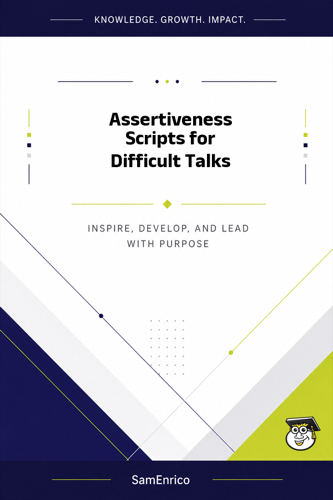
Assertiveness Scripts for Difficult Talks eBook
Use proven phrase templates to handle criticism, r
Use proven phrase templates to handle criticism, requests, and boundary violations.
Formats
Free sample
Chapter 1: The Whisper Before the Shout--–- The call ended three minutes ago. You’ve already replayed it seventeen times. Why didn’t I just say…? The perfect response arrived, as it always does, somewhere between the end of the conversation and the beginning of the regret. You had the right.
You had the need. You even had the opportunity. What you didn’t have was the phrase.You are not alone in this silence. Millions of people go through their days saying “yes” when they mean “no,” offering apologies when they’ve done nothing wrong, and swallowing feedback that desperately needs to be spoken. They tell themselves the problem is confidence, or personality, or some immutable lack of “being the kind of person who speaks up.” But after decades of research across clinical psychology, negotiation theory, and communication science, a different truth has emerged.The problem is almost never your personality.
The problem is the script—or rather, the lack of one.This book exists because of a simple, powerful, and liberating fact: assertiveness is not a character trait. It is a collection of phrases. And phrases can be learned, practiced, and deployed like tools from a well-organized toolbox. You do not need to become a different person. You need to memorize, then internalize, a set of verbal templates for the situations that currently leave you wordless.The 3 A.M.
Committee There is a name for the voice that supplies the perfect retort three hours after the conversation ended. Researchers call it the “3 A.M. Committee”—that ruthless, brilliant, and entirely useless inner editor who shows up when the audience has already gone home. The Committee knows exactly what you should have said: “Actually, I won’t be able to take on that project.” Or “When you interrupt me, I feel dismissed.” Or simply “No.”The Committee is not the problem. The Committee is your ally.
It proves that you already possess the intelligence and emotional awareness to recognize what went wrong. The problem is that the Committee does not show up during the conversation. It shows up after, when the stakes have vanished and your nervous system has finally downshifted from fight-or-flight back to normal operation.What would happen if the Committee arrived on time? What if you had the right phrase not three hours later, but three seconds later—right when the conversational door opened?That is what this book teaches. Every chapter provides script after script for the situations that make your throat tighten and your mind go blank.
You will learn what to say when your boss takes credit for your work, when your mother lays a guilt trip, when a stranger asks an invasive question, and when you need to ask for something you deserve but fear requesting.The Vocabulary Gap Most people believe they lack assertiveness because they lack confidence. This is backwards. Confidence is not the cause of assertive speech; it is the consequence. You do not speak up because you feel confident. You feel confident because you have spoken up—successfully—enough times that your brain has rewired its expectations.But how do you get the first successful repetition when every previous attempt has ended in shame, silence, or escalation?
You borrow the words of people who have already figured it out. You use what communication researchers call “scripting”: the practice of adopting proven phrase templates until they become automatic.Consider how you learned to drive a car. No one handed you the keys and said “be confident.” They gave you specific, repeatable instructions: check the mirror, signal, turn the wheel, press the gas. Over time, the instructions became instinct. Assertiveness works the same way.
You do not need to invent the language of boundaries any more than you need to invent the rules of the road. You need a driver’s manual for difficult conversations. This book is that manual.The Four Toxic Beliefs That Keep You Quiet Before we give you new words, we must clear out the old ones. Every person who struggles with assertiveness carries a set of internal beliefs that act as a veto button, shutting down speech before it reaches the lips. These beliefs are rarely conscious.
They operate below the level of awareness, like a computer program running in the background. But they are not permanent. They are learned, and they can be unlearned.Let us name them. See which ones live in you.Belief 1: “I must be liked by everyone.”This belief feels noble. It feels like kindness.
But it is not kindness—it is hostage-taking. When you require universal approval to feel safe, you hand the remote control of your life to anyone who happens to be in the room. The person who needs everyone to like them cannot set a boundary, because boundaries, by definition, disappoint someone. The person who needs everyone to like them cannot ask for what they deserve, because asking risks a “no” that feels like a rejection of their entire being.The truth is simpler and more brutal: you will be disliked. Not because you are unlikable, but because no two people want the same thing from you.
Your boss wants overtime. Your partner wants presence. Your friend wants attention. Your child wants patience. You cannot satisfy all of these demands simultaneously, and the attempt to do so will not make everyone like you—it will make you exhausted, resentful, and quiet.Belief 2: “It’s selfish to say no.”This belief confuses selfishness with self-preservation.
Selfishness is taking more than your share. Selfishness is prioritizing your wants over others’ needs. But saying no to a request that would drain you, overextend you, or violate your values is not selfish. It is responsible. It is the only way to ensure that when you do say yes, your yes means something.Consider the airline safety briefing: secure your own oxygen mask before helping others.
This is not selfishness. It is physics. You cannot assist a single person if you have passed out from lack of air. Similarly, you cannot show up for anyone—your family, your colleagues, your community—if you have said yes so many times that you have nothing left to give. The word “no” protects your capacity for meaningful “yeses.”Belief 3: “If I assert myself, they will leave me.”This belief is the most painful because it is often rooted in real experience.
Many people who struggle with assertiveness were raised in environments where speaking up was punished—not necessarily with violence, but with withdrawal of love, silent treatment, or criticism. Their nervous system learned a devastating equation: assertion equals abandonment.The adult truth is more complex. Yes, some people will leave when you start setting boundaries. Those people were not in a relationship with you; they were in a relationship with your compliance. Their departure is not a loss; it is a clarity.
And the people who stay? They are the ones who respect you enough to hear your no and remain. You cannot lose a relationship that was actually a hostage situation. You can only escape one.Belief 4: “I should already know how to do this.”This belief is the sneakiest because it masquerades as…
This is the end of the free sample. Get the eBook to keep going. Buy now
About this book
Details
- Author
- Langley Eddie
- Publisher
- SamEnrico
- Language
- English
- Genre
- Non-Fiction, Self-Help, Conflict Resolution
- Released
- 2026-06-08
- Pages (approx.)
- 139
- Available as
- eBook, Audiobook

Read better in the ZLOADR app
Your eBooks on your phone or tablet. Sign in with your SamEnrico account and start reading.
More by Langley Eddie
 Financial Trauma Recovery CourseLangley Eddie$11.99
 Metabolic Syndrome Treatment GuideLangley Eddie$11.99
 Teresa of Ávila Interior Castle HandbookLangley Eddie$11.99
 Car Crash Dream Interpret GuideLangley Eddie$11.99
 The Whispering Tides of Atlantis: Lost Coral Cities and the Secrets They GuardLangley Eddie$11.99
 The Silk Road in Paddles: Sven Hedin's Forgotten Canoe Expedition Through Central AsiaLangley Eddie$11.99
 Gun CollectingLangley Eddie$11.99
 Kanban for Coinbase StartupsLangley Eddie$12.99
 AI Art Redbubble AnalyticsLangley Eddie$12.99
 Understanding Eosinophilic FasciitisLangley Eddie$17.99
 How to Start a Deeds Preparation Business (Beginners Guide)Langley Eddie$11.99
You may also like
 Hong Kong Handover 1997Dunn Johnnie$11.99
 Zumba For Postnatal Recovery CourseNeal Christian$11.99
 Zumba for BeginnersLadner Nikia$11.99
 YouTube Comment Mining GuideHumes Pandora$12.99
 Worry Box MeditationCarlin Rudy$11.99
 Workplace Stress MeditationNguyen Lynn$11.99
 Workplace Stress and Sleep RepairHawley Ivory$11.99
 Workplace Perfectionism CureDelaney Jeffry$11.99
 Workplace Injustice Anger GuideWallen Isabelle$11.99
 Work Addiction and Burnout LinkGreenwood Ester$11.99
 Women in Yoga and WellnessBeattie Galina$11.99
 Women in Stand Up ComedyChun Evangeline$11.99