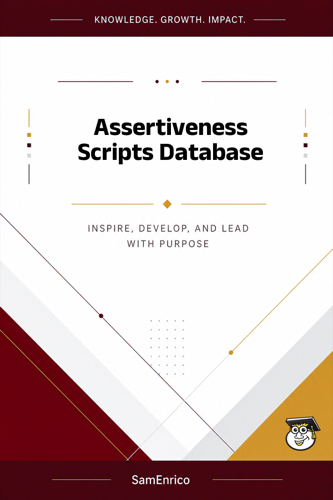
Assertiveness Scripts Database eBook
Provides ready to use phrases for common situation
Provides ready to use phrases for common situations from returns to boundary setting.
Formats
Free sample
Chapter 1: The Amnesia of Stress--–- You are standing at a return counter. The item is defective. The receipt is in your pocket. The policy is on your side. The clerk looks at you, waiting.
And then—nothing. Your mind goes blank. You hear yourself say, “Oh, okay, I guess I’ll just…” and you walk away. Later, in the parking lot, the perfect script arrives: “Actually, the manufacturer’s warranty supersedes your store policy, and I’d like a full refund.” You are brilliant thirty seconds too late.This is not a failure of courage. It is not a failure of self-esteem.
It is not because you are shy, weak, or conflict-avoidant by nature. This is a neurological event. And once you understand it, you can stop fighting yourself and start working with the hardware you were given.Every year, millions of people lose thousands of dollars in unreturned items, accept jobs they did not want, lend money they could not afford, and stay silent during conversations that needed to happen—all because of a predictable, repeatable brain mechanism. The good news is that the same mechanism that causes the freeze also provides the solution. The bad news is that most assertiveness books teach the exact opposite of what your brain needs.Let us begin with a simple experiment.
Read the following sentence out loud: “I need a refund. The item is defective. Here is my receipt.”Easy, right? You could say those words without any anxiety at all while sitting alone in your living room. Now imagine saying the exact same sentence to a tired, skeptical clerk with a line of impatient customers behind you.
The words do not change. Your brain does.What happens between the living room and the return counter is not a personality flaw. It is a chemical flood. Your amygdala—an ancient part of your brain designed to detect threats—does not know the difference between a saber-toothed tiger and a store clerk with a bad attitude. Both trigger the same response: cortisol spikes, your prefrontal cortex (the thinking part) goes offline, and your verbal fluency collapses.
You are not being weak. You are being human.This chapter will teach you why scripts work when confidence fails, how to use the single most effective assertiveness framework ever developed (the DESC model), and why the two most common assertiveness techniques—The Broken Record and Fogging—are not gimmicks but neurological shortcuts. By the end of this chapter, you will understand exactly why your brain freezes and exactly how to bypass that freeze every single time.The Myth of Confidence Most assertiveness books operate on a seductive but flawed premise: if you could just feel more confident, you would speak up. Therefore, they spend hundreds of pages teaching you to visualize success, affirm your worth, and “believe in yourself.” This is not entirely useless. Confidence is nice.
But it is also slow, unreliable, and completely inaccessible in the moment of panic.Here is the problem with confidence-based approaches. Confidence is a feeling. Feelings are generated by your limbic system. Your limbic system is the same system that floods you with cortisol when you feel threatened. In other words, the part of your brain that would generate the feeling of confidence is the same part that has already been hijacked by fear.
You are asking a flooded engine to start.This is why rehearsed scripts work. A script bypasses your emotional state entirely. It is not a feeling. It is a sequence of words you have pre-decided, pre-practiced, and pre-loaded into a different part of your brain—the basal ganglia, which handles habitual actions like riding a bike or typing on a keyboard. When your amygdala floods, your basal ganglia keeps working.
You do not forget how to ride a bike just because you are nervous. You do not forget your phone number. And with rehearsal, you will not forget your assertiveness scripts.Consider the research on stress and performance. In study after study, individuals who rehearse specific phrases under low-stress conditions perform dramatically better under high-stress conditions than individuals who simply try to “feel confident.” The reason is neurological: rehearsal moves the script from working memory (which shuts down under stress) to procedural memory (which stays online). You are not trying to be brave.
You are trying to be automatic.This book will never ask you to “just be confident.” It will ask you to memorize, practice, and deploy scripts. That is not a shortcut. It is the science of performance under pressure.The DESC Framework: One Tool to Rule Them All Over the past forty years, dozens of assertiveness models have been developed. Some have four steps. Some have five.
Some have seven. Most are forgotten within a decade. One model has survived because it works across every context—from returning a defective toaster to asking for a raise to setting a boundary with a parent. That model is DESC, which stands for Describe, Express, Specify, Consequences.Do not be fooled by the simplicity. The power of DESC is not in its individual letters but in its sequence.
Each step prepares the next. Skip a step, and the whole script collapses. Use the steps out of order, and you sound aggressive or passive. Use them correctly, and you sound like someone who knows exactly what they want and exactly what will happen next.Let us break down each step in detail.Describe: The first step is to describe the situation using only observable facts. No evaluation.
No interpretation. No “you always” or “you never.” Just what a camera would see or a recorder would hear. For example: “You arrived at 8:45 AM for a meeting scheduled at 8:30 AM.” Not “You were late again.” Not “You don’t care about my time.” Just the fact.Why is this so important? Because the moment you add evaluation, the other person’s defensiveness activates. Their amygdala floods.
Now you have two flooded brains trying to solve a problem. That does not work. But when you stick to observable facts, you keep their prefrontal cortex online. You give them a chance to agree with you. “Yes,” they might say, “I did arrive at 8:45.” Now you are on the same side of the table.Express: The second step is to express your feelings or interests using “I” statements.
Not “You made me angry.” That is an accusation disguised as a feeling. Instead: “I feel frustrated when meetings start late because I lose time I had planned for other work.” Notice the structure: I feel [emotion] when [observable fact] because [interest].This step is where most people go wrong. They either suppress their feelings entirely (which leads to resentment) or they explode (which leads to aggression). The DESC version is neither. It names the emotion without blaming the other person for causing it.
Your frustration is yours. It is valid. But it is not their fault. It is the situation’s fault. You and they can solve the situation together.Specify: The third step is to make a clear, actionable request.
This is the step that most people omit entirely. They describe, they express, and then they stop, hoping the other…
This is the end of the free sample. Get the eBook to keep going. Buy now
About this book
Details
- Author
- Patten Peggie
- Publisher
- SamEnrico
- Language
- English
- Genre
- Non-Fiction, Self-Help, Script Library
- Released
- 2026-06-10
- Pages (approx.)
- 116
- Available as
- eBook, Audiobook

Read better in the ZLOADR app
Your eBooks on your phone or tablet. Sign in with your SamEnrico account and start reading.
More by Patten Peggie
 Memory Sport TrainingPatten Peggie$11.99
 Wholesaling Offer FormulaPatten Peggie$11.99
 Freelance Income SecrecyPatten Peggie$11.99
 Pet Loss Memory Box GuidePatten Peggie$11.99
 Accident Replay NightmaresPatten Peggie$11.99
 The Senior ED GuidePatten Peggie$11.99
 Acupuncture Points GuidePatten Peggie$11.99
 The Rio Card Kings: How Prohibition Fueled Latin America's First Credit Fraud EmpirePatten Peggie$11.99
 A Collector's Handbook to the Alfa Romeo Gt (17Patten Peggie$11.99
 How to Produce Facial Moisturizer With SunscreenPatten Peggie$11.99
 FIFO vs LIFO GuidePatten Peggie$12.99
 Co-Founder Success Story Analysis HandbookPatten Peggie$12.99