
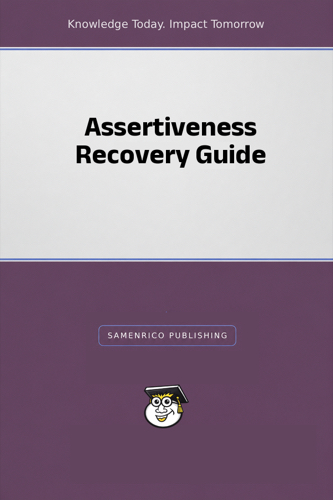
Assertiveness Recovery Guide eBook
Heal from a lifetime of passivity with daily coura
by Currie Rey
Heal from a lifetime of passivity with daily courage-building practices.
Formats
Free sample
Chapter 1: The Mask of Agreeability--–- The first time Rachel said “yes” when she meant “no,” she was seven years old. Her mother had asked if she wanted to stay with the grandparents for the weekend—a question dressed as a choice, but Rachel had already seen her mother’s packed suitcase. The real question was not “Do you want to?” but “Will you be difficult?” Rachel said yes. She smiled. She hugged her mother goodbye.
And somewhere in the back of her seven-year-old throat, a small muscle tightened—the first brick in a wall she would spend the next thirty years building.–- That muscle would clench again at sixteen, when she told a boy she “didn’t mind” that he’d forgotten her birthday. It would flare at twenty-four, when she assured her boss that working through her vacation was “no problem.” And at thirty-seven, sitting in a therapist’s office after a panic attack that had landed her in urgent care, Rachel would finally name the thing she had been carrying for three decades: the inability to say no. Not a preference for harmony. Not an excess of kindness. A cage.–- This book is for everyone who has felt that clench in their throat.
For the people who have built successful careers, loving families, and active social lives—all while secretly resenting most of the requests they agreed to. For the ones who are known as “so nice” and “so reliable” and “so easy to work with,” and who have begun to realize that those compliments taste like defeat. You are not broken. You are not weak. You have learned a specific survival strategy, and like all survival strategies, it worked once.
But the world has changed, the danger has passed, and the strategy has become the prison.The Cultural Lie of Niceness–- We live in a culture that worships niceness. From childhood, we are told that “good” people share, that “kind” people don’t make waves, that “mature” people put others first. The message is so pervasive that it feels like gravity: Of course you should say yes. Of course you should help. Of course your needs come after everyone else’s.–- But here is the truth that no greeting card will tell you: chronic niceness is not a virtue.
It is a survival strategy learned in environments where asserting a need was punished—either overtly or through the quiet withdrawal of love, approval, or safety. And like any survival strategy, it comes with a cost.–- Consider the research on “agreeableness” as a personality trait. Psychologists have long known that highly agreeable people—those who score high on measures of cooperation, trust, and compliance—report lower lifetime earnings, fewer promotions, and higher rates of burnout than their less agreeable peers. A 2018 study of over 3,500 professionals found that the most agreeable employees earned an average of 18% less than their least agreeable counterparts, even when controlling for education, experience, and job title. The researchers called it the “agreeableness penalty.”–- But the cost is not just financial.
Chronic passivity—the behavioral expression of excessive agreeableness—correlates with higher rates of depression, anxiety disorders, and autoimmune conditions. The body keeps score. Every suppressed “no” becomes a whispered “yes” to resentment. Every appeased demand becomes a small betrayal of the self.The Mask of Agreeability Defined–- The Mask of Agreeability is the central concept of this chapter and of this book. It is the social armor worn to keep others comfortable at the expense of one’s own needs.
It is not a choice—not in the moment. It is a reflex, honed over thousands of repetitions, that activates before conscious thought can intervene.–- The mask has several telltale features:–- Premature accommodation: You say yes before you have considered whether you actually want to. The question lands, and your mouth opens before your brain has finished processing. “Sure,” you hear yourself say, and then the resentment begins to bloom.–- Emotional monitoring: You scan the faces of others for signs of disapproval, disappointment, or anger. Your internal state is calibrated to theirs.
When they are comfortable, you are safe. When they are not, you are in danger.–- Post-event rumination: After an interaction, you replay it endlessly, searching for moments where you might have offended, disappointed, or inconvenienced someone. You apologize in your head. You rehearse better responses. You carry the interaction with you for hours or days.–- The phantom “no”: You have a rich internal life of preferences, boundaries, and refusals that never reach your lips.
In your imagination, you are assertive. In reality, you are silent.–- These features are not character flaws. They are the architecture of a nervous system that learned, early and often, that self-assertion is dangerous.The Passivity Pyramid–- To understand how passivity operates in daily life, we need a diagnostic tool. The Passivity Pyramid maps the progression from subtle self-abandonment to catastrophic explosion. Most passive people live at the bottom two levels, but everyone who wears the Mask of Agreeability eventually visits the apex.–- Level One: Silent Suffering (The Base)–- Silent suffering is the daily grind of passivity.
It is saying “fine” when you are not fine. It is staying at a party for an extra hour because you don’t want to be the first to leave. It is eating food you don’t like because you don’t want to seem picky. It is agreeing to a meeting time that doesn’t work for you. At this level, the cost is low per incident—a few minutes of discomfort, a small twinge of resentment—but the incidents multiply.
By the end of a typical week, a passive person has abandoned themselves dozens of times.–- Level Two: Passive Resentment (The Middle)–- When silent suffering accumulates without release, it transforms into passive resentment. This is the internal monologue of complaint that never becomes external action. “I can’t believe she asked me to cover her shift again.” “He knows I hate it when he leaves dishes in the sink.” “They always assume I’ll do the extra work.” At this level, the passive person has become angry, but the anger has nowhere to go. It circulates internally, poisoning the host. Passive resentment is metabolically expensive—it raises cortisol, disrupts sleep, and erodes relationships from the inside out.–- Level Three: Explosive Burnout (The Apex)–- Explosive burnout is the sudden, often disproportionate outburst that follows months or years of silent suffering and passive resentment.
The passive person finally snaps—not over the big thing, but over something small. A misplaced coffee cup. A minor request. A casual comment. And in that moment, all the suppressed fury of the past years erupts.
The explosion damages relationships, shocks people who thought the passive person was “so nice,” and leaves the passive person flooded with shame and confusion. “Where did that come from?” they ask themselves. The answer is: from the bottom of the pyramid.–- The tragedy of the Passivity Pyramid is that explosive burnout reinforces passivity. After an outburst, the passive person is so flooded with guilt that they double down on…
This is the end of the free sample. Get the eBook to keep going. Buy now
About this book
Details
- Author
- Currie Rey
- Publisher
- SamEnrico
- Language
- English
- Genre
- Non-Fiction, Self-Help, Recovery
- Released
- 2026-06-06
- Pages (approx.)
- 132
- Available as
- eBook, Audiobook

Read better in the ZLOADR app
Your eBooks on your phone or tablet. Sign in with your SamEnrico account and start reading.
More by Currie Rey
 Body Scan for PainCurrie Rey$11.99
 The Gradual Taper MethodCurrie Rey$11.99
 Napping for Jet Lag RecoveryCurrie Rey$11.99
 Complicated Grief Parent LossCurrie Rey$11.99
 MyFitnessPal ComparisonCurrie Rey$11.99
 Asynchronous First MetricsCurrie Rey$11.99
 Alibaba Currency Hedging GuideCurrie Rey$11.99
 Moral Injury in Crisis LeadershipCurrie Rey$11.99
 Golden Shadows: The Untold Legacy of the First Black Olympic ChampionCurrie Rey$11.99
 The Last Waltz of Vienna: A Love Letter Through WarCurrie Rey$11.99
 Raven's Deception: The Trickster and the First LightCurrie Rey$11.99
 Growing GlottiphyllumCurrie Rey$11.99
You may also like
 Hong Kong Handover 1997Dunn Johnnie$11.99
 Zumba For Postnatal Recovery CourseNeal Christian$11.99
 Zumba for BeginnersLadner Nikia$11.99
 YouTube Comment Mining GuideHumes Pandora$12.99
 Worry Box MeditationCarlin Rudy$11.99
 Workplace Stress MeditationNguyen Lynn$11.99
 Workplace Stress and Sleep RepairHawley Ivory$11.99
 Workplace Perfectionism CureDelaney Jeffry$11.99
 Workplace Injustice Anger GuideWallen Isabelle$11.99
 Work Addiction and Burnout LinkGreenwood Ester$11.99
 Women in Yoga and WellnessBeattie Galina$11.99
 Women in Stand Up ComedyChun Evangeline$11.99