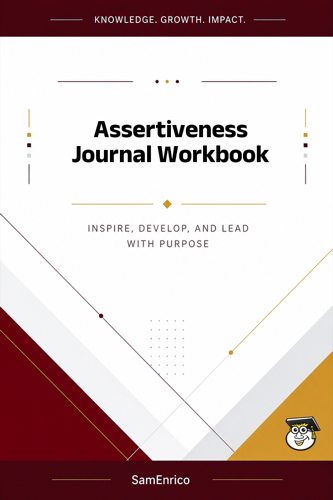
Assertiveness Journal Workbook eBook
Track daily assertive attempts, wins, and learning
Track daily assertive attempts, wins, and learning opportunities with prompts.
Formats
Free sample
Chapter 1: The Cartography of Silence--You are about to do something that most people will never do in their entire lives: you are going to draw a map of where your voice disappears. Not where you choose to be quiet because the moment calls for listening. Not where you strategically hold back because timing matters. You are going to map the places where your voice vanishes without your permission—where you wanted to speak, needed to speak, deserved to speak, and yet nothing came out. Or worse, something came out that was not yours at all: an apology you did not owe, a yes you did not mean, a joke that buried your real feelings.Before you learn a single technique for speaking up, before you practice saying no, before you rehearse that difficult conversation you have been avoiding for months or years, you must first take inventory of where you actually stand right now.
This chapter is not about fixing anything. It is about seeing. And seeing clearly is the first and most essential act of change, the foundation upon which every assertive skill you will learn in the next eleven weeks must be built.Most assertiveness training fails because it starts with solutions. It hands you scripts and strategies before you have diagnosed the problem. That is like a doctor prescribing medication without running a single test—a lucky guess at best, and at worst, a way to convince you that nothing works.
You might get lucky with a script or two, but more likely you will apply the wrong tool to the wrong situation and conclude that assertiveness simply does not work for someone like you. That conclusion is a lie, but it is a seductive one. It lets you off the hook. It says, "I tried. It didn't work.
I am just not built that way."Here is the truth: you were not built to be silent. You were taught to be silent. And what was taught can be unlearned. But unlearning requires a clear-eyed assessment of what exactly you learned in the first place. This chapter asks you to do the opposite of what your instincts will tell you.
For the next seven days, you will not try to change a single thing about how you communicate. You will not practice new phrases. You will not set goals for speaking up. You will simply observe, record, and reflect. You will gather data on yourself with the same neutral curiosity a scientist brings to a microscope or a cartographer brings to uncharted land.By the end of this week, you will have something far more valuable than a set of scripts.
You will have a personalized map of your assertiveness terrain, complete with your most common traps, your most frequent fears, the precise moments where your voice disappears, and the hidden needs that your silence is trying to protect. You will also have something even more precious: permission to stop pretending that you already know what is wrong and start learning what is actually true.Let us begin.The Three Pillars of This Workbook Before you open your journal, before you write a single word, you need to understand the three categories that will structure every single daily prompt for the next twelve weeks. These pillars are the architecture of this entire system. Learn them now because you will be using them every day, and they will become as natural to you as breathing.The Attempt An attempt is any effort to speak or act assertively, regardless of the outcome. You could stumble over your words.
Your voice could shake. Your palms could sweat. The other person could say no, roll their eyes, walk away, or argue with you for twenty minutes. None of that matters for the attempt category. If you tried, you record an attempt.The purpose of tracking attempts is to shift your focus from perfection to frequency.
Most unassertive people do not fail at assertiveness because they do it poorly. They fail because they never try at all. The voice that never speaks cannot be improved. The boundary that is never set cannot be respected. The request that is never made cannot be granted.
Attempts are the raw material of change, the ore that must be mined before it can be refined into gold. Without attempts, there is no progress. There is only the endless loop of silent resentment and explosive regret.So you will track every single try, no matter how messy, no matter how small. A single sentence in a meeting counts. An email asking for clarity counts.
A two-second pause before answering counts as an attempt to gather yourself. You will learn to celebrate the try, not the triumph.The Win A win is different from an attempt. A win is an assertive moment where two conditions are both met: you successfully expressed your legitimate rights, and you did not violate the rights of anyone else in doing so.Notice carefully what this definition does and does not require. The win does not require the other person to agree with you. It does not require them to like what you said.
It does not require a positive outcome. The other person can say no, can be angry, can walk away, and you can still have a win. Because the win is not about controlling their response. The win is about the quality of your own behavior. Did you speak clearly?
Did you stay calm? Did you respect yourself without attacking the other person? Did you hold your ground without bulldozing theirs? If yes, that is a win. The outcome belongs to the other person.
The win belongs to you.Throughout this workbook, you will be encouraged to collect wins like coins in a jar. They do not have to be dramatic. A small, calm request for what you need is a win. A direct no delivered without apology or over-explanation is a win. A single sentence spoken in a meeting when you would normally stay silent is a win.
Saying "I need to think about that before I answer" instead of giving an immediate yes you will regret—that is a win. Wins train your brain to recognize that assertiveness is possible for you. They build self-efficacy, the psychological term for the belief that you can successfully execute the behavior required to produce a desired outcome. And they accumulate. One win today, two wins tomorrow, and before you know it, assertiveness stops feeling like a performance and starts feeling like simply being yourself.The Learning Opportunity A learning opportunity is any moment where you were not assertive.
That includes passivity (staying silent when you had something to say), aggression (exploding, attacking, blaming, or intimidating), and passive-aggression (sarcasm, silent treatment, deliberate forgetting, backhanded compliments, or any indirect expression of anger).Notice the language here: learning opportunity, not failure. This reframing is not positive thinking fluff. It is not about putting a happy face on your mistakes. It is strategic, grounded in decades of research on mindset and behavior change. When you label something a failure, your brain treats it as evidence to stop trying.
Failure triggers shame, and shame triggers withdrawal. The neural message is clear: do not do that again, and more importantly…
This is the end of the free sample. Get the eBook to keep going. Buy now
About this book
Details
- Author
- Olivarez Jani
- Publisher
- SamEnrico
- Language
- English
- Genre
- Non-Fiction, Self-Help, Journaling, Tracking
- Released
- 2026-06-09
- Pages (approx.)
- 148
- Available as
- eBook, Audiobook

Read better in the ZLOADR app
Your eBooks on your phone or tablet. Sign in with your SamEnrico account and start reading.
More by Olivarez Jani
 Burnout Prevention For StartupsOlivarez Jani$11.99
 Presentation Audience AnalysisOlivarez Jani$12.99
 Pre Talk Anticipation JournalOlivarez Jani$11.99
 Anger After Partner's GamblingOlivarez Jani$11.99
 The Sibling Rivalry Self Worth RecoveryOlivarez Jani$11.99
 The Last Scribe of AlexandriaOlivarez Jani$11.99
 Understanding Macrocephaly Mesodermal Hamartoma SpectrumOlivarez Jani$17.99
 Consumer Goods Distribution GuideOlivarez Jani$12.99Presentation Audience AnalysisOlivarez Jani$12.99
 Lead Automation Robotics TechnicianOlivarez Jani$11.99
 How to Start a Channel Islands and Isle of Man Banking Institutes Business (Beginners Guide)Olivarez Jani$11.99