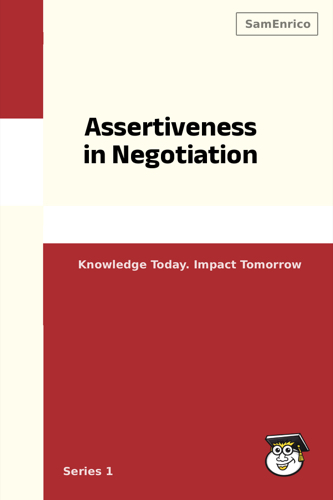
Assertiveness in Negotiation eBook
Ask for what you want while preserving relationshi
by Ashe Jeramy
Ask for what you want while preserving relationships using this practical guide.
Formats
Free sample
Chapter 1: The Broken Binary--You have been lied to about what it takes to get what you want.The lie comes wrapped in common sense. It arrives in the voice of well-meaning mentors, in the pages of popular business books, in the offhand comments of colleagues who have "been around the block." The lie sounds like this: You have to choose. You can either be liked, or you can be effective. You can either preserve the relationship, or you can get what you want. You cannot do both.This binary—nice versus tough, relationship versus results, empathy versus assertiveness—is the single greatest obstacle to successful negotiation.
And it is almost entirely wrong.Not partially wrong. Not wrong in some contexts but right in others. Fundamentally, structurally, demonstrably wrong. The most effective negotiators in the world do not choose between these poles. They transcend them.
They have discovered what I call the middle path: a way of advocating for your interests fiercely while treating the other party with deep respect. A way of asking for what you want that actually strengthens relationships rather than straining them. A way of saying no that leaves the other person feeling heard rather than dismissed.This book exists to teach you that path. But before we can build the skills, we have to dismantle the lie. We have to understand why the binary feels so true, why it fails so consistently, and what becomes possible when you finally break free of it.The Prison of Either-Or Imagine a negotiation that happens thousands of times every day, in offices and living rooms across the world.
A manager needs a project completed. An employee is already over capacity. The manager asks for a Friday deadline. The employee knows, with bone-deep certainty, that Friday is impossible without working through the weekend.What happens next follows a predictable script.The passive response: "Sure, I'll make it work." The employee says yes. The weekend is sacrificed.
The family is disappointed. The employee resents the manager for asking, resents themselves for agreeing, and spends the next three weeks in a fog of exhaustion and bitterness. The project gets done, but something important has broken. The manager has no idea anything is wrong because the employee never said anything was wrong. The next time an unreasonable deadline appears, the pattern repeats.The aggressive response: "That's impossible.
You always do this. I can't keep working nights and weekends because you can't plan." The employee is not wrong about the timeline, but the delivery ensures that the conversation is no longer about deadlines. It is about tone, about respect, about professionalism. The manager becomes defensive. The relationship deteriorates.
Even if the employee gets an extension, they have lost something valuable: the manager's goodwill, the benefit of the doubt, the willingness to go to bat for them in the future.The passive-aggressive response: "Fine. Whatever." The employee says the words without saying them, the sigh and eye roll communicating everything the mouth refuses to say. The manager knows something is wrong but cannot quite put a finger on it. The employee will later complain to coworkers, miss the deadline "accidentally," or deliver work that is technically complete but obviously rushed. The relationship erodes slowly, invisibly, like a foundation settling into contaminated soil.Notice what all three responses share.
None of them get the employee what they actually want: a reasonable deadline, a preserved relationship, and a sense of self-respect. None of them represent a real choice. They are all reflexes, conditioned responses to the perceived threat of saying what needs to be said.There is a fourth response. It is not a compromise between passivity and aggression. It is a different category entirely."I hear that you need this by Friday.
I want to be transparent with you. Based on my current workload, that timeline would require me to work through the weekend, and I learned from the last time I did that that my quality drops significantly by Monday. What I can do is deliver the first phase by Friday and the complete project by Wednesday. Would that work for you? Or is there something else on my plate we could move to free up time?"This is the assertive response.
It is calm. It is clear. It advocates for the employee's interests while fully acknowledging the manager's constraints. It does not attack. It does not apologize.
It opens a negotiation rather than shutting one down.Most people cannot deliver this response because their brain is locked in the broken binary. They believe they must choose between being effective and being liked. They believe that asking for what they want is fundamentally aggressive, and that preserving relationships is fundamentally passive. They have never seen a model of assertiveness that holds both together.This chapter exists to provide that model.Where the Binary Comes From The broken binary did not appear out of nowhere. It has deep roots in our biology, our psychology, and our culture.
Understanding those roots is the first step to pulling them out.Biologically, your brain is wired to treat social conflict as a survival threat. Thousands of years ago, being rejected from your tribe could mean death. You could not hunt alone, you could not defend yourself alone, you could not raise children alone. Your brain evolved to prioritize social belonging over almost everything else, because social belonging was the difference between life and death.That wiring is still inside you. When you anticipate a difficult conversation, your amygdala—the brain's threat-detection center—activates.
Your heart rate increases. Cortisol floods your system. Your prefrontal cortex, responsible for complex reasoning and impulse control, begins to shut down. You are literally less intelligent in moments of perceived social threat. This is not a metaphor.
This is measurable physiology.Your brain does not distinguish between being rejected by your tribe and being rejected by your manager. It responds to both with the same fight, flight, freeze, or fawn response. And those responses map directly onto the broken binary. Fight is aggression. Flight and freeze are passivity.
Fawn—the appeasement response—is passive-aggression, saying yes while meaning no to keep the peace.Psychologically, most of us learn the broken binary from an early age. Children who ask directly for what they want are sometimes praised for being confident, but more often labeled as bossy, demanding, or too much. Girls receive this message more intensely than boys, but boys receive it too. By the time we reach adulthood, most of us have internalized a simple rule: asking for what you want is risky. It might make someone angry.
It might make you look selfish. It might lead to rejection.Culturally, the broken binary is reinforced everywhere we look. Movies and television shows celebrate the aggressive negotiator who pounds the table and gets the deal. Business books lionize the tough leader who makes the hard decisions without regard for feelings. Even the language we use—"winning" and "losing," "battle" and "war"—frames negotiation as a zero-sum conflict where one person's gain is another person's loss.But here is the truth that the movies and the business books leave out.
The aggressive negotiator might win the battle, but they lose the war. They get the deal, but they lose the…
This is the end of the free sample. Get the eBook to keep going. Buy now
About this book
Details
- Author
- Ashe Jeramy
- Publisher
- SamEnrico
- Language
- English
- Genre
- Non-Fiction, Self-Help, Negotiation Skills
- Released
- 2026-06-07
- Pages (approx.)
- 133
- Available as
- eBook, Audiobook

Read better in the ZLOADR app
Your eBooks on your phone or tablet. Sign in with your SamEnrico account and start reading.
More by Ashe Jeramy
 Kapalabhati Insomnia GuideAshe Jeramy$11.99
 HIIT Plateau Breaking GuideAshe Jeramy$11.99
 Flutist Breath and BrillianceAshe Jeramy$11.99
 The Noise Control GuideAshe Jeramy$11.99
 Curtain Call: The Phantom of the LyceumAshe Jeramy$11.99
 10 Ways to Use Galactose (Recipe Book)Ashe Jeramy$11.99
 Healthcare Retention PlaybookAshe Jeramy$12.99
 Directory Free to PaidAshe Jeramy$12.99
 The Breeder's Guide to Guinea Hog PigsAshe Jeramy$11.99
 Game Balance AnalystAshe Jeramy$11.99