
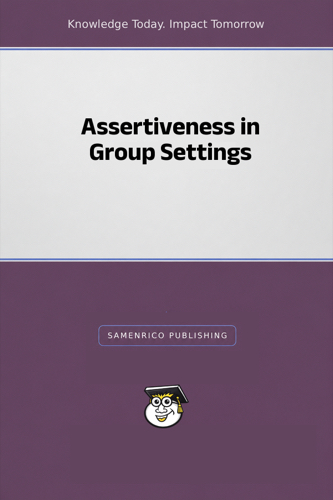
Assertiveness in Group Settings eBook
Speak up in meetings and social circles without do
Speak up in meetings and social circles without dominating.
Formats
Free sample
Chapter 1: The Two Monsters--You are about to discover something uncomfortable about yourself.Not because you are broken. Not because you lack confidence. But because almost no one has ever taught you the actual rules of speaking up in groups.Here is what you were probably taught: be yourself, speak your mind, and good things will follow.Here is what actually happens: you either say nothing and hate yourself afterward, or you say too much and hate how everyone looks at you. There is a name for this gap between your intention and your impact. I call it the Accidental Diminisher effect, and it is the single most common reason smart people fail to lead conversations.Let me show you what I mean.The Meeting That Changed Everything Four years ago, I was sitting in a conference room on the thirty-second floor of a glass tower in downtown Chicago.
Twelve people. One whiteboard. Two hundred thousand dollars on the line. The question was simple: should we invest in a new customer support platform or patch the existing one for another year?I had done the research. I knew the numbers.
I had spent twenty hours comparing vendors, calculating total cost of ownership, and projecting productivity gains. My recommendation was clear: buy the new platform.I said nothing.Not because I was shy. I am not shy. I can give a keynote speech to five hundred people without breaking a sweat. But in that room, with the VP of Operations glaring at anyone who spoke for more than thirty seconds, and the senior engineer who had built the existing system sitting right across from me, I felt my throat close.
My heart pounded. My face flushed. I told myself I was waiting for the right moment.The moment never came.Someone else made a half-baked argument for patching the existing system. The VP nodded. The senior engineer shrugged.
The group moved on. And I sat there, gripping my pen so hard the plastic creaked, watching two hundred thousand dollars get flushed down the toilet of groupthink.Walking out of that meeting, I did the thing I always did. I ran the post-meeting shower argument in my head. I thought of the perfect thing I should have said. I imagined myself speaking calmly, citing the data, changing everyone's mind.
Then I went back to my desk and did nothing different the next time.That was the moment I realized I had a problem. Not a personality problem. A skill problem.The Ghost and The Bulldozer Over the next two years, I interviewed more than three hundred professionals about their experience speaking up in meetings. Executives. Nurses.
Software engineers. Teachers. Lawyers. Nonprofit directors. The stories were different, but the patterns were identical.
Almost everyone falls into one of two traps.I call the first trap The Ghost.The Ghost is not shy. Shyness is a fear of social judgment that exists across all situations. The Ghost is situational. The Ghost can be loud and funny at happy hour but silent in staff meetings. The Ghost can run a team of fifteen people but cannot ask a question in an all-hands.
The Ghost has opinions, data, and experience, but leaves meetings with all of it still trapped inside their head.The Ghost tells themselves comforting lies. "Someone else will bring it up." (They won't.) "I need to listen more before I speak." (You have listened enough.) "My idea is not fully formed yet." (It never will be.) Underneath these lies is a deeper truth: the Ghost is afraid. Not of public speaking. The Ghost can speak. The Ghost is afraid of being wrong, of being dismissed, of speaking up and having the room go quiet, of saying something obvious and being silently judged as stupid.I know this because I was the Ghost for fifteen years.The second trap is The Bulldozer.The Bulldozer is the person who talks too much, interrupts, repeats themselves, and somehow makes every conversation about their own experience.
If you are The Bulldozer, you probably do not know it. In your own head, you are passionate. You are engaged. You are helping. You are just making sure your point gets across because you care so much about getting it right.Here is the truth about The Bulldozer, and it is going to sting: you are not passionate.
You are anxious.The Bulldozer is driven by the same fear that drives The Ghost. The difference is the strategy. The Ghost copes with fear by withdrawing. The Bulldozer copes with fear by overwhelming. If I keep talking, no one can question me.
If I fill every silence, no one can expose me. If I interrupt, I never have to hear a challenge I cannot answer.I have been The Bulldozer too. In my twenties, I dominated every meeting I entered. I thought I was a leader. My colleagues thought I was exhausting.
I did not find this out until a mentor pulled me aside and said, "You know, sometimes the smartest thing you can say is nothing at all." I was mortified. I had no idea I was doing it.The Accidental Diminisher Here is the crucial insight that separates this book from every other communication guide you have ever read.You rarely intend to shut others down.The Ghost intends to be thoughtful. The Bulldozer intends to be helpful. Neither one wakes up in the morning thinking, "I cannot wait to make my team dumber today." But intention is not impact. The result of both traps is the same: people feel smaller around you, ideas die on the vine, and the group's collective intelligence drops.I call this The Accidental Diminisher effect.A Diminisher is someone who makes the group less than the sum of its parts.
Liz Wiseman, whose work on multipliers and diminishers inspired this framework, studied hundreds of leaders and found that Diminishers drain intelligence from every room they enter. They are not evil. They are not malicious. They are simply unaware of how their behavior lands on others.The Ghost diminishes by subtraction. By withholding their perspective, they rob the group of data, diversity of thought, and the creative friction that produces breakthrough ideas.
The Ghost is not harmless. The Ghost is expensive. Every silent meeting where the quietest person has the best idea is a meeting where money is being left on the table.The Bulldozer diminishes by addition. By over-talking, interrupting, and pivoting every topic back to themselves, they crowd out other voices. The Bulldozer does not need to silence anyone directly.
They just need to talk long enough that everyone else gives up trying to enter the conversation.Here is what both The Ghost and The Bulldozer have in common: they are both trying to feel safe. The Ghost seeks safety in invisibility. The Bulldozer seeks safety in control. Neither one realizes that true safety in groups comes from neither hiding nor dominating, but from contributing precisely the right amount at precisely the right time.The Case of The Bottled Water Executive In the early 1980s, Pepsi Co was soda. That was the whole business.
Sugar, carbonation, marketing. A mid-level manager named Craig Weatherup noticed something strange in the data: people were buying bottled water…
This is the end of the free sample. Get the eBook to keep going. Buy now
About this book
Details
- Author
- Goebel Candida
- Publisher
- SamEnrico
- Language
- English
- Genre
- Non-Fiction, Self-Help, Group Dynamics
- Released
- 2026-06-07
- Pages (approx.)
- 145
- Available as
- eBook, Audiobook

Read better in the ZLOADR app
Your eBooks on your phone or tablet. Sign in with your SamEnrico account and start reading.
More by Goebel Candida
 LBO Exit Multiple SensitivityGoebel Candida$11.99
 Reverse Logistics GrowthGoebel Candida$11.99
 NVC In Healthcare HandbookGoebel Candida$11.99
 The Frank Welker Animal SoundsGoebel Candida$11.99
 Love in the Wilderness: The Siege of Fort Carillon and the Forbidden BondGoebel Candida$11.99
 Oil and Gas Sales Middle EastGoebel Candida$12.99
 Pricing for Introverted FoundersGoebel Candida$12.99
 Structured Cabling TechnicianGoebel Candida$11.99
 Understanding SitosterolemiaGoebel Candida$17.99
 How to Become a Dustless OperatorGoebel Candida$11.99
You may also like
 Twelve Step Program Traditions Explained GuideCranford Ariana$11.99
 Group Conversation DynamicsPeak Berenice$11.99
 AA Preamble and TraditionsWakefield Belle$11.99
 Group TM MeditationGates Delsie$11.99
 Brainstorming Rules OverhaulDeleon Robbi$11.99
 Reading Room Energy GuideForsythe Lissette$11.99
 Meeting Etiquette for NewcomersBuford Lina$11.99
 Loneliness Group Activities GuideBrackett Asia$11.99
 Signal Group Chat AnxietyGalbraith Lael$11.99
 The Twelve Traditions GuideKenny Ute$11.99
 AA Preamble and Traditions ExplainedNgo Tarah$11.99
 Unity Persuasion FrameworkGarrison James$11.99