
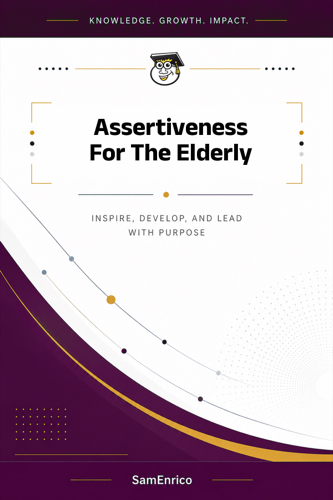
Assertiveness For The Elderly eBook
Advocate for medical needs and resist patronizing
Advocate for medical needs and resist patronizing treatment from adult children.
Formats
Free sample
Chapter 1: The Invisible Injustice--The morning light filtered through the kitchen curtains—the same curtains she had sewn herself, thirty-two years ago, when her hands were steady and her children still needed her to cut the crusts off their sandwiches. Eleanor sat at the head of the table, the same chair she had occupied for four decades, the one that gave her a clear view of the backyard birdfeeder and the driveway where she had watched her husband leave for work every single day until he didn’t anymore. She was eighty-two years old. She had argued cases in front of federal judges. She had managed a law firm’s litigation department for twenty-three years.
She had raised three children through chickenpox, college rejections, and one very expensive wedding.And now, her son Mark was asking her if she remembered to take her pills.Not asking in a normal, adult-to-adult way, mind you. Not “Mom, have you taken your medications today?” in a regular tone of voice. No. Mark was using the voice—that high-pitched, sing-song, exaggeratedly gentle cadence that people use when they are speaking to a confused toddler or a frightened puppy. “Ele-a-norrrr… did you re-mem-berrr… to take your little pills this mor-orning?”She stared at him.He stared back, blinking slowly, as if waiting for a goldfish to complete a trick.“Mark,” she said, her voice flat and low, “I am sitting here drinking my coffee.
The pills are right there.” She pointed to the weekly pill organizer on the counter, which she had filled herself, on Sunday, as she had done every Sunday for the past six years since her blood pressure medication was added to the regimen. “They are taken. At seven-fifteen. As always.”Mark smiled—that tight, patronizing smile that said Oh, you’re being cute rather than Oh, I made a mistake. “I’m just checking, Mom.
You know the doctor said your memory might—”“My memory is fine,” Eleanor said. “Your manners could use some work.”Mark laughed, because he thought she was joking.She was not joking.She was furious.And that fury—that hot, pulsing, righteous fury that rose from her chest into her throat—was the very thing that this book is about to validate, protect, and weaponize on your behalf.The Anger Is Not the Problem If you are reading this book, you have likely experienced some version of Eleanor’s morning coffee scene. Maybe it wasn’t a son asking about pills. Maybe it was a daughter rearranging your kitchen cabinets without asking. Maybe it was a doctor turning to your adult child and saying, “So, how has Mom been doing?” while you sat right there, breathing, conscious, and fully capable of answering.
Maybe it was a nurse who patted your hand and called you “sweetie.” Maybe it was your own grandchild—a twenty-two-year-old who has never paid a mortgage or buried a spouse—explaining to you, slowly and loudly, how to use your own television remote.And maybe, like Eleanor, you felt that surge of anger. And then, almost immediately, you felt guilty about the anger. Because they are trying to help, right? Because they love you, right? Because you should be grateful that anyone cares enough to check on you, right?Wrong.Let us be absolutely, unambiguously clear: Your anger is not a symptom of grumpiness, old age, or ingratitude.
Your anger is a healthy, calibrated, biologically appropriate signal that your boundaries are being crossed.Anger is not the enemy. Anger is the messenger. Anger is your nervous system raising its hand and saying, “Excuse me. Something here is not right. Someone has just treated you as less than you are.”The problem is not that you feel angry.
The problem is that most older adults have been taught—by well-meaning family members, by a medical system that values efficiency over dignity, by a culture that worships youth and fears aging—to swallow that anger. To smile. To say “thank you” when what you really want to say is “please stop treating me like a child.”This chapter is going to give you permission to stop swallowing. It is going to help you understand, for the first time perhaps, exactly what is happening in these interactions—and why it is not “all in your head.” We are going to name the phenomenon, break down the psychology behind it, and prove to you that your desire for respect is not a burden you are placing on your loved ones. It is the baseline requirement of any healthy relationship.And we are going to start with a story that is not Eleanor’s.
It is yours. Or rather, it is the story of every older adult who has ever been systematically erased by the very people who claim to love them.The Anatomy of a Disappearance Here is what happens when benevolent ageism goes unchecked: you disappear.Not physically, of course. You are still sitting in the chair. You are still breathing. Your name is still on the deed to the house and the checking account and the advance directive.
But you—the person who made decisions, who had opinions, who was consulted rather than informed—that version of you begins to fade.Let us walk through the typical sequence, because it is so common that it might as well be a script.Stage One: The Small Interruptions It starts small. Almost invisibly small. Your daughter finishes your sentence for you at a family dinner. Your son-in-law explains a news story to you that you read about three hours earlier on your own phone. A cashier at the grocery store asks your adult child—who is standing next to you, holding your reusable bags—“Does she need help out to the car?” as if you are a package to be transported rather than a person capable of walking.At this stage, you might laugh it off.
“Oh, I’m fine, thank you.” You might even appreciate the help. There is nothing wrong with accepting assistance. The problem is not the help itself. The problem is the assumption that you always need it.Stage Two: The Medical Erasure Then comes the medical appointment. Perhaps for a routine checkup, perhaps for something more serious.
You arrive with an adult child—because driving at night is harder now, or because parking at the hospital is confusing, or because your child insisted on coming “just to help.”The nurse calls your name. You stand up. Your child stands up too. The nurse looks at your child and asks, “And you are?”“I’m her daughter.”“Great. You can come back too.”In the exam room, the doctor enters.
The doctor shakes your hand—briefly—and then turns to your daughter. “So, how has she been doing?”Your daughter answers. She means well. She tells the doctor about the fall you had six months ago (the one you told her not to mention because it was a fluke, the rug slipped, you didn’t even bruise). She tells the doctor about the time you forgot to turn off the stove (you were distracted by a phone call, it happens to everyone, you caught it within two minutes).…
This is the end of the free sample. Get the eBook to keep going. Buy now
About this book
Details
- Author
- Randolph Maurita
- Publisher
- SamEnrico
- Language
- English
- Genre
- Non-Fiction, Self-Help, Aging
- Released
- 2026-06-06
- Pages (approx.)
- 146
- Available as
- eBook, Audiobook

Read better in the ZLOADR app
Your eBooks on your phone or tablet. Sign in with your SamEnrico account and start reading.
More by Randolph Maurita
 The Nap Soundscape GuideRandolph Maurita$11.99
 Parent Loss and FriendshipsRandolph Maurita$11.99
 Zumba Aqua FitnessRandolph Maurita$11.99
 Lamotrigine For BipolarRandolph Maurita$11.99
 Pain Meditation ChecklistRandolph Maurita$11.99
 Bipolar Anxiety ManagementRandolph Maurita$11.99
 Alibaba Order Tracking GuideRandolph Maurita$11.99
 Child Loss And Physical HealthRandolph Maurita$11.99
 The Golden Contract: The Untold Story of Middle Eastern Football's First Super AgentRandolph Maurita$11.99
 Shadow of Power: The Untold Story of Nelson Rockefeller's Rise and FallRandolph Maurita$11.99
 The Curse of the Forgotten Pharaoh’s ShadowRandolph Maurita$11.99
 Venture Capital and Private EquityRandolph Maurita$11.99
You may also like
 The Elder Parent TalkAltman Jules$11.99
 Elderly Nightmare ProcessingWorth Willena$11.99
 The Joy of Growing OldCoward Kimberlee$11.99
 The Assertiveness for Retirees GuideSiler Roseann$11.99
 MBSR For Elders GuideFogle Adella$11.99
 Imposter Syndrome for Late CareerSnell Xiao$11.99
 The Aging Fear PracticeOsullivan Mammie$11.99
 Failure Fear for SeniorsHammons Jarvis$11.99
 Elder Breath Awareness ManualPounds Bebe$11.99
 The Walking Meditation for SeniorsEsposito Pinkie$11.99
 The Senior Self Esteem GuideGranger Leigh$11.99
 The Growth Mindset for SeniorsMaurer Allyson$11.99