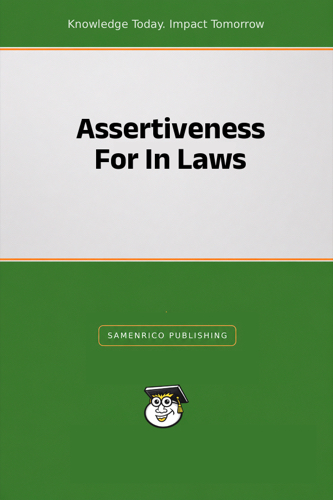
Assertiveness For In Laws eBook
Set limits with extended family without causing ma
Set limits with extended family without causing major drama.
Formats
Free sample
Chapter 1: The In-Law Trap--–- The first time my mother-in-law rearranged my kitchen, I was thirty-four years old, a regional manager for a logistics company, and responsible for forty-seven employees. I had negotiated million-dollar contracts, fired a man for embezzlement without flinching, and once talked a gunman out of robbing a convenience store by simply asking him if he was sure he wanted to spend the next ten years eating prison food. I was, by any reasonable measure, an assertive adult.But when Carol—my husband’s mother—sighed loudly and began moving my spice rack from the cabinet above the stove to a drawer next to the refrigerator, I stood frozen in my own kitchen like a child caught stealing cookies. My mouth opened. Nothing came out.
She said, “You’ll thank me later, dear. This is much more efficient.” And I smiled. I actually smiled. Then I went into the bathroom and cried.That night, I lay awake at 3 AM, furious at myself. Why hadn’t I said something?
Why had I let her move my things in my house? And more importantly, why did I feel like I was twelve years old again, being told that my opinions didn’t matter?The answer, which took me another six months of passive-aggressive text messages, two ruined Thanksgiving dinners, and one spectacular blowup over a casserole dish to understand, is what I call the In-Law Trap. And if you’re reading this book, you’ve probably been trapped in it too.This chapter is about two things. First, understanding why competent, assertive adults turn into mute, people-pleasing doormats the moment their in-laws enter the room. Second, learning the single most important distinction that will unlock every other skill in this book: the difference between trying to control someone else and protecting yourself.
Get this wrong, and no script or strategy will save you. Get it right, and you’ll never again cry in a bathroom over a misplaced spice rack.The Return to Hierarchy Phenomenon Let me describe a scene and see if it feels familiar.You are at your in-laws’ house for a holiday dinner. You’re an adult. You pay taxes, hold down a job, and have successfully kept at least one human child alive for multiple years. But then your father-in-law asks, loudly, across the table, “So, when are you going to get a real job?” Or your mother-in-law looks at your casserole and says, “Oh.
You used cream of mushroom soup. Interesting choice.” Or your sister-in-law—the golden child—mentions that she just got promoted, again, and everyone cheers while you sit there wondering why your career never comes up at all.And what do you do? If you’re like most people, you do one of three things. You freeze, saying nothing while your face gets hot. You fawn, laughing nervously or making a self-deprecating joke to smooth things over.
Or you store it all up and explode later, usually at your spouse, in the car on the way home.None of these responses are assertive. And none of them happen because you’re weak or broken. They happen because of a neurological phenomenon I call the Return to Hierarchy.Here’s the science in plain English. Your brain contains a structure called the amygdala, which is essentially your threat-detection system. It’s very old, evolutionarily speaking, and it doesn’t distinguish between physical danger and social danger very well.
When your amygdala perceives a threat, it hijacks your prefrontal cortex—the part of your brain responsible for rational thought, impulse control, and complex decision-making—and triggers one of four survival responses: fight, flight, freeze, or fawn.Now, here’s the crucial insight. Your in-laws are, by definition, authority figures from your partner’s past. Even if they’re lovely people ninety percent of the time, their mere presence triggers something deep in your brain. Because your partner once submitted to their authority as a child, and because family systems are wired to maintain hierarchy, your brain perceives your in-laws as occupying a higher rung on the social ladder than you. This isn’t logical.
It’s not fair. But it’s neurobiology.When your mother-in-law criticizes your cooking, your amygdala doesn’t hear, “A woman with different taste preferences is expressing an opinion.” It hears, “An authority figure is disapproving of you. You are in danger of being rejected from the tribe. Without the tribe, you will die. Submit immediately.” That’s why you freeze.
That’s why you fawn. That’s why you can’t find your words.The In-Law Trap is this: you are an adult in your own life, but their presence pulls you into child mode. And until you learn to recognize that pull and interrupt it, you will never be able to set a boundary effectively.The first step out of the trap is simply naming it. The next time you feel yourself regressing—your voice gets higher, your shoulders curl forward, you start apologizing for things that aren’t your fault—say to yourself, silently: Return to hierarchy. I am being pulled into child mode.
I am actually an adult. This simple labeling interrupts the amygdala hijack just enough to give your prefrontal cortex a fighting chance.You Are Not Crazy: The Gaslighting of In-Law Dynamics One of the cruelest aspects of the In-Law Trap is that it makes you doubt your own perception. After Carol moved my spice rack, I asked my husband if he thought it was strange. He said, “She was just trying to help. You’re being too sensitive.” After the casserole incident, my sister-in-law said, “She didn’t mean anything by it.
That’s just how she is.” After the Thanksgiving blowup, my father-in-law said, “We’re family. You shouldn’t take things so personally.”This is what I call the Gaslighting of In-Law Dynamics. It’s not always malicious. Sometimes it’s genuinely well-intentioned. But the effect is the same: you start to believe that your feelings are the problem, not their behavior.Let me be very clear about this.
Your feelings are not the problem. Your reaction to their behavior might need adjustment. Your communication might need improvement. But the discomfort you feel when someone criticizes you, invades your space, or disregards your boundaries is not a character flaw. It is a signal.
And signals exist to be listened to.The research on emotional invalidation is unequivocal. When people’s feelings are consistently dismissed—especially by family members—they develop what psychologists call low emotional self-efficacy. That’s a fancy way of saying they stop trusting their own judgment. They ask themselves questions like, “Am I being too dramatic?” “Maybe it wasn’t that bad.” “She probably meant well.” And then they tolerate behavior that they would never accept from a coworker, a neighbor, or a stranger on the street.So let me give you permission right now, at the beginning of this book, to trust your discomfort. If something feels wrong, it probably is wrong.
You don’t need to prove it to anyone. You don’t need a jury of your peers to validate your feelings. Your discomfort is enough.That…
This is the end of the free sample. Get the eBook to keep going. Buy now
About this book
Details
- Author
- Hebert Janean
- Publisher
- SamEnrico
- Language
- English
- Genre
- Non-Fiction, Self-Help, Family Boundaries
- Released
- 2026-06-09
- Pages (approx.)
- 148
- Available as
- eBook, Audiobook

Read better in the ZLOADR app
Your eBooks on your phone or tablet. Sign in with your SamEnrico account and start reading.
More by Hebert Janean
 DBT For Grief EmotionsHebert Janean$11.99
 Relationship First Aid for StressHebert Janean$11.99
 Persuasion Master ClassHebert Janean$11.99
 Mario Andretti VersatilityHebert Janean$11.99
 Lou Hoover First LadyHebert Janean$11.99
 Toilet Paper Auto-ship StickinessHebert Janean$11.99
 Low Income Therapy InnovationsHebert Janean$11.99
 Darius the Great: Architect of the Achaemenid EmpireHebert Janean$11.99
 The Maestro's Crown: How Black Composers Conquered the Classical WorldHebert Janean$11.99
 A Collector's Handbook to the Bristol 401Hebert Janean$11.99
 How to Start a Ammonium Compounds (excluding Ammonium Nitrate, Sulphate and Phosphate) Business (BegHebert Janean$11.99
 How to Produce Shoes Processing ServicesHebert Janean$11.99