
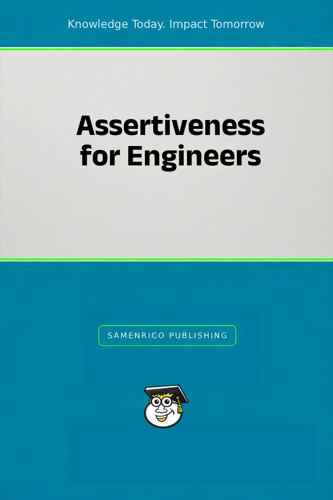
Assertiveness for Engineers eBook
Team and project communication.
Team and project communication.
Formats
Free sample
Chapter 1: The Logic Trap--–- The meeting was already thirty minutes over schedule. Six people sat around a glass conference table, their laptops glowing like judgemental oracles. The project sponsor, a vice president of product named Diane, had just asked for the third time: “Can we get the migration done by the end of Q2?” The tech lead, a brilliant senior engineer named Marcus, knew the answer was no. He had run the numbers. He had simulated the load tests.
He had even built a small prototype to prove that the legacy database would corrupt under the proposed timeline. His jaw tightened. His mouth opened. And then he said nothing.Diane turned to the other engineering manager in the room, a man with a louder voice and a weaker grasp of the technical constraints, who said: “We’ll make it work. We always do.” Diane nodded, wrote down “Q2 delivery confirmed,” and moved to the next agenda item.
Marcus spent the rest of the meeting staring at his own hands.Afterward, in the hallway, his junior engineer pulled him aside. “Marcus, why didn’t you say something? You had the data. You had the proof. We’re going to crash this thing in June, and everyone will blame us.”Marcus sighed.
“I wasn’t 100% sure. What if I was wrong? What if there was a way to optimize the queries that I hadn’t thought of? I didn’t want to be the guy who kills the timeline based on incomplete information.”That story is fictional. But if you are an engineer, you have lived some version of it.
Perhaps not in a glass conference room. Perhaps in a Slack thread, a code review comment, a sprint planning session, or a one-on-one with your manager. The setting changes. The script does not.The Central Paradox of Engineering Communication You were hired for your technical judgment. Your ability to assess risk, to model systems, to see failure modes before they happen—that is your core value proposition.
Yet in meeting after meeting, you watch less technical people make worse decisions because they speak with greater confidence. You possess the correct answer, the data-backed solution, the elegant architecture. And no one listens.This is not because stakeholders are stupid. It is not because your organization is uniquely dysfunctional. It is because technical correctness does not automatically translate into influence.That statement is the bedrock of this entire book.
And it violates a deeply held belief in engineering culture: the belief that good work speaks for itself, that data is self-advocating, that the best idea will inevitably rise to the top. These beliefs are comforting. They are also wrong.What you are about to read is not a manual for becoming a different person. You do not need to become an extrovert, a salesman, or a manipulator. You need to learn a specific, learnable, technical skill: assertiveness.
This book reframes assertiveness not as a soft skill—that dismissive phrase that engineering culture uses to marginalize communication—but as a technical competency required for project success.Why Engineers Default to the Computer Before we fix the problem, we have to name it. In thousands of hours observing engineering teams, a consistent pattern emerges. When placed under pressure—a tight deadline, a high-stakes meeting, a conflict with a product manager—engineers default to one of two dysfunctional communication styles. Neither serves them.The first is passivity, which we will call the Computer. The Computer engineer communicates only in facts, waits for 100% certainty before speaking, avoids emotional or emphatic language, and operates under the mistaken belief that data should speak for itself.
The Computer says things like: “I just think maybe we could consider looking at the database logs if that’s okay with everyone.” The Computer’s internal monologue is a loop of qualifying phrases: “I’m not sure,” “I could be wrong,” “This might be a stupid question, but…”The second is aggression, which we will call the Steamroller. The Steamroller engineer overpowers others, dismisses dissent, conflates confidence with competence, and treats every disagreement as a zero-sum battle. The Steamroller says things like: “That’s wrong. Here’s the real answer. Next.” The Steamroller often gets their way in the short term but poisons team culture, drives out junior engineers, and creates brittle decisions that fail when challenged by reality.Between these two lies the assertive engineer, whom we will call the Leader.
The Leader states needs clearly, respects others’ boundaries, combines data with intentional delivery, and treats conflict as a problem to be solved rather than a war to be won. The Leader says things like: “I have a concern about the Q2 timeline based on these three data points. Let me walk you through them. I need us to either adjust the scope or add resources before I can commit.”Here is the painful truth that emerges from every communication audit I have conducted with engineering teams: most engineers believe they are operating as the Leader. But when you record their actual behavior in meetings, code reviews, and email threads, they are operating as the Computer.
They are leaving their value on the table, sentence by silent sentence.The Data: What the Thomas-Kilmann Instrument Reveals About Engineers The Thomas-Kilmann Conflict Mode Instrument (TKI) is the most widely researched framework for understanding how people respond to conflict. It measures two dimensions: assertiveness (the degree to which you try to satisfy your own concerns) and cooperativeness (the degree to which you try to satisfy the other person’s concerns). These two dimensions create five distinct conflict modes:Competing (high assertiveness, low cooperativeness): “My way or the highway.”Accommodating (low assertiveness, high cooperativeness): “Whatever you want.”Avoiding (low assertiveness, low cooperativeness): “I’m not going to deal with this.”Collaborating (high assertiveness, high cooperativeness): “Let’s find a solution that works for both of us.”Compromising (moderate assertiveness, moderate cooperativeness): “Let’s split the difference.”When researchers have administered the TKI to software engineers, a striking pattern emerges. Engineers disproportionately favor Avoiding and Accommodating in cross-functional conflicts—that is, conflicts with product managers, executives, designers, and sales. In conflicts with other engineers, they shift toward Competing, but only when they are confident.
When they are uncertain (which is most of the time, because engineering problems are genuinely complex), they fall back to Avoiding.In other words, the default engineering response to high-stakes, cross-functional pressure is to retreat. Not because engineers are cowardly. Because their training has taught them that certainty precedes speech, and in complex systems, certainty is rare.The goal of this book—and the explicit target of your practice—is to move from Avoiding toward Collaborating. Collaborating is the mode that requires both high assertiveness (you advocate for your technical concerns) and high cooperativeness (you genuinely seek to understand and address stakeholder needs). It is the hardest mode to learn.
It is also the only mode that consistently produces good technical outcomes without burning relationships.The Myth of the Self-Evident Truth Let me tell you about a study that changed how I think about engineering communication. In 2013, researchers placed experienced engineers in a simulated project meeting. Half the engineers were given a technical…
This is the end of the free sample. Get the eBook to keep going. Buy now
About this book
Details
- Author
- Preston Diamond
- Publisher
- SamEnrico
- Language
- English
- Genre
- Non-Fiction, Self-Help, Engineering
- Released
- 2026-06-05
- Pages (approx.)
- 139
- Available as
- eBook, Audiobook

Read better in the ZLOADR app
Your eBooks on your phone or tablet. Sign in with your SamEnrico account and start reading.
More by Preston Diamond
 Road Rage for New DriversPreston Diamond$11.99
 Intellectual Property ListPreston Diamond$11.99
 Meditation for Exam NervesPreston Diamond$11.99
 Divorce and Moving OutPreston Diamond$11.99
 Anticipatory Grief DepressionPreston Diamond$11.99
 Lifestyle Breast Cancer PreventionPreston Diamond$11.99
 Constraints for Project ManagersPreston Diamond$11.99
 The Siege of the Iranian Embassy in London: Terror in the Heart of the Cold WarPreston Diamond$11.99
 Ironclad Valor: The Harlem Hellfighters' Last Stand at Château-ThierryPreston Diamond$11.99
 How to Produce Contract Manufacturing For ElectronicsPreston Diamond$11.99
 Renting Out Your Action Camera FleetPreston Diamond$12.99
 UNC Argentina Student HandbookPreston Diamond$12.99
You may also like
 Relationship Building for EngineersGetz Cordie$11.99
 Dreaming for Engineering DesignKline Sharee$11.99
 Constraints for EngineersSlaughter Birgit$11.99
 Emotional Intelligence For EngineersWorth Zina$11.99
 Personal Branding for EngineersKimmel Cletus$11.99
 Failure Fear in EngineeringSpalding Richard$11.99
 TRIZ Problem SolvingMcdade Refugio$11.99
 NVC for EngineersCrump Krysta$11.99
 Workaholism in EngineeringHughes Derrick$11.99
 Fear of Failure for EngineersSchott Charline$11.99
 Engineering Student StressBurris Trinh$11.99
 Engineer Imposter SyndromeMoreau Melodee$11.99