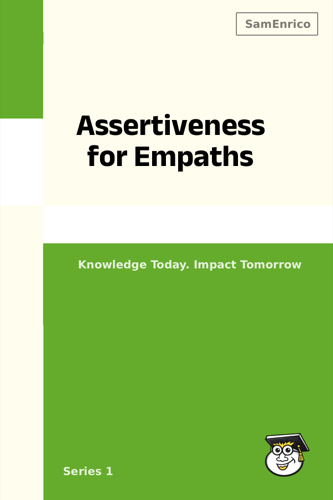
Assertiveness for Empaths eBook
Stop absorbing others' emotions and people pleasin
by Zimmer Amina
Stop absorbing others' emotions and people pleasing.
Formats
Free sample
Chapter 1: The Wired Healer--You wake up before your alarm. Not because you're rested, but because you already feel it—the weight of the day pressing against your chest before you've even opened your eyes. You scan the bedroom for clues about how everyone else is doing. Is your partner sleeping peacefully, or is there tension in their breathing? Did your teenager come home late last night, and if so, does that mean you'll need to navigate their mood at breakfast?
You haven't spoken a word to anyone yet, and already your nervous system is running diagnostics on every relationship in your orbit.This is the lived experience of the empath. It is not a metaphor. It is not a personality quirk you can shrug off. It is a physiological reality—a way of moving through the world that feels like having no skin. You feel everything.
And because you feel everything, you try to fix everything. And because you try to fix everything, you are exhausted.If you picked up this book, you already know this cycle. What you may not know is that your exhaustion is not evidence that you are too sensitive or too weak. It is evidence that you have been operating without the right tools. This chapter will name what you have lived but perhaps never had language for: the neuroscience of emotional absorption, the distinction between healthy empathy and toxic empathy, the paradox of being brilliant at reading others but blind to your own inner state, and the crucial difference between genuine kindness and the compulsion to people-please.
By the end of this chapter, you will understand exactly how your wiring became a liability—and why that liability is not permanent.The Neuroscientific Foundation of Empathic Absorption Let us begin with a question that most books on empathy avoid: Is it real? Do empaths actually absorb the emotions of others, or is this a convenient metaphor for high sensitivity?The answer, supported by a growing body of research in social neuroscience, is that emotional absorption is real—but not magical. It is the result of ordinary neural machinery operating at extraordinary intensity.At the center of this machinery are mirror neurons, first discovered in macaque monkeys in the 1990s and later identified in humans. Mirror neurons fire both when you perform an action and when you observe someone else performing that same action. When you see someone smile, your mirror neurons for smiling fire.
When you see someone wince in pain, your own pain-related neural circuits activate. This system is the biological basis of empathy: you literally feel, in a muted form, what someone else is experiencing.In most people, this system creates a useful social signal. You register that someone is sad, you feel a flicker of that sadness, and you respond appropriately—perhaps with comfort or space. Then the signal fades, and you return to your own emotional baseline. In empaths, however, the mirror neuron system appears to be more active and the boundaries between self and other more permeable.
The flicker becomes a flame. The signal does not fade; it settles into your nervous system as if it were your own.This is compounded by emotional contagion, the phenomenon by which emotions spread through groups like a virus. You have experienced this: you walk into a room where two people have just argued, and the air feels thick. You sit next to a anxious colleague, and within minutes, your own heart rate has elevated. Emotional contagion is normally unconscious and automatic.
In empaths, it operates at high volume with the filter turned off.The result is a nervous system that is exquisitely tuned to others and chronically disregulated itself. You feel their stress as your stress. Their anger lands in your chest. Their grief becomes a weight you carry home. And because this happens below the level of conscious choice, you have likely spent years believing that these borrowed feelings are simply who you are.But here is what the neuroscience also tells us: the brain is plastic.
The nervous system can be trained. Absorption may be your default, but it is not your destiny.Healthy Empathy Versus Toxic Empathy Now that we understand the machinery, we must make a critical distinction—one that will undergird every chapter that follows. There is a profound difference between healthy empathy and toxic empathy. Most empaths have never been taught to see the line between them.Healthy empathy is compassion without fusion. It looks like this: you notice that your friend is grieving.
Your mirror neurons activate, and you feel a wave of sadness in response. But because your boundaries are intact, you recognize that this sadness is theirs, not yours. You feel for them, not as them. You offer presence, a listening ear, perhaps a hand on their shoulder. Then, when you leave, the sadness fades.
You return to your own emotional state. You have connected without collapsing.Toxic empathy is the absence of that boundary. It looks like this: you notice that your friend is grieving. Your mirror neurons activate, and the sadness floods your system as if the loss were your own. You cannot distinguish their grief from your emotional state.
You feel compelled to fix it, to make it better, because their pain feels unbearable inside your own body. When you leave, you carry the grief with you. You lie awake that night processing emotions that do not belong to you. You have fused, not connected.Healthy empathy is a bridge between two separate people. Toxic empathy is a dissolution of the self into the other.The difference is not in the intensity of feeling.
Many empaths can feel both forms intensely. The difference is in differentiation—the ability to know, in your body, where you end and the other begins. Without differentiation, empathy becomes absorption. And absorption leads inexorably to exhaustion, resentment, and the slow erosion of your own identity.Throughout this book, we will train your differentiation skill. For now, simply sit with the question: in your most draining relationships, are you practicing healthy empathy or toxic empathy?
Be honest. The answer will tell you why you are tired.The Paradox: Brilliant on Others, Blurry on Yourself Here is the paradox that every empath knows but few can articulate. You are exceptional at reading the emotional states of everyone around you. You can walk into a room and instantly know who is upset, who is hiding something, who needs reassurance. Friends call you psychic.
Colleagues marvel at your intuition. You have been told your whole life that you are "so emotionally intelligent."And yet, when someone asks you how you are feeling, you draw a blank. "Fine," you say. Or "stressed." Or "overwhelmed." Vague words that cover vast territory but name nothing specific.This is not because you lack feelings. You are awash in feelings constantly.
The problem is low emotional granularity—the inability to differentiate global distress into specific, nameable emotions. You know that something is wrong, but you cannot tell if you are sad, angry, disappointed, afraid, ashamed, or lonely. It all just feels like too much.Low emotional granularity is a hallmark of empaths who have spent decades…
This is the end of the free sample. Get the eBook to keep going. Buy now
About this book
Details
- Author
- Zimmer Amina
- Publisher
- SamEnrico
- Language
- English
- Genre
- Non-Fiction, Self-Help, Empathy Management
- Released
- 2026-06-10
- Pages (approx.)
- 139
- Available as
- eBook, Audiobook

Read better in the ZLOADR app
Your eBooks on your phone or tablet. Sign in with your SamEnrico account and start reading.
More by Zimmer Amina
 Idea Parking Lot MethodZimmer Amina$11.99
 Flow Recovery GuideZimmer Amina$11.99
 Growth Mindset Praise GuideZimmer Amina$11.99
 Outsourcing for TherapistsZimmer Amina$11.99
 The Team OKR Facilitation GuideZimmer Amina$11.99
 Financial Support Group GuideZimmer Amina$11.99
 Dual Diagnosis MasterZimmer Amina$11.99
 The Lost Voyages of Abubakari II: The African Admiral Who Sailed Beyond the HorizonZimmer Amina$11.99
 The God Complex: How a Self-Help Guru Built a Billion-Dollar Empire on BeliefZimmer Amina$11.99
 Runner Bean: Harvesting For Shelling & Immature PodsZimmer Amina$11.99
 The Essential Guide to German FolkZimmer Amina$11.99
 How to Produce Punch Bowl StandsZimmer Amina$11.99