
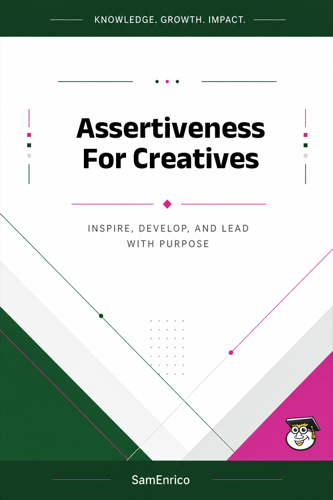
Non-FictionSelf-HelpCreativity
Assertiveness For Creatives eBook
Defend your artistic vision without becoming defen
Defend your artistic vision without becoming defensive.
Formats
Free sample
Chapter 1: The Two Graves--The graveyard of creative careers is filled with two kinds of headstones. The first reads: “They never said what they meant.” The second reads: “They said exactly what they meant, and no one could stand them.”Between these two graves lies the narrow path of creative assertiveness. Most artists, designers, writers, and musicians spend their careers wandering back and forth between these two plots, never realizing there is a third option—a way to defend your artistic vision without becoming a doormat or a monster.This chapter is called The Two Graves because I want you to see them clearly. I want you to walk right up to the edge of each one, look inside, and recognize the bones of the artists who came before you. Then, I want you to step back and choose a different path.Let me tell you about the first grave.The Grave of the People-Pleasing Doormat Her name was Sarah.
She was a freelance illustrator with undeniable talent—soft watercolors that seemed to breathe, characters whose eyes held genuine emotion. Her portfolio was exquisite. Her bank account was empty.Sarah had a problem that she mistook for a virtue: she said yes to everything. Every revision request, every timeline compression, every “Can you just tweak this one small thing?” She believed that being nice was the price of being hired. She believed that if she ever pushed back, the client would vanish and tell everyone she was difficult.So she worked nights.
She worked weekends. She produced three rounds of revisions for every one round she was paid for. Her art became a ghost of itself—not because she lacked skill, but because she had killed her own vision so many times that she no longer trusted her instincts.The final client of her career asked for a logo to be “more friendly.” Sarah had made it friendly. Then “more approachable.” She made it approachable. Then “more warm.” She made it warm.
Then “Can we see version one again?”Sarah closed her laptop, walked to her kitchen, and cried for an hour. She didn’t eat. She didn’t paint. She just sat there, realizing that she had spent three years building a reputation as the easiest person to work with—which meant, in practice, the easiest person to walk all over.She quit freelancing six months later. She took a data entry job.
She still paints on weekends, but only for herself, in a sketchbook no one will ever see.Sarah is not a cautionary tale about being too nice. She is a cautionary tale about passive aggression. Because here is the truth that no one told Sarah: saying yes when you mean no is not kindness. It is cowardice dressed up as generosity. And the person you betray first is yourself.The Grave of the Tortured Genius His name was Marcus.
He was a graphic designer with a reputation for brilliance and a trail of burned bridges behind him. His posters were arresting. His brand identities were iconic. He was also, by his own admission, “difficult.”Marcus believed that artistic vision was a zero-sum game. If the client won, he lost.
If his idea survived, theirs had to die. He walked into every presentation with his shoulders up, his jaw tight, and a speech prepared about how he “would not compromise on integrity.”When a client asked to move a logo three pixels to the left, Marcus would spend twenty minutes explaining why that request was aesthetically bankrupt. When a stakeholder used the word “pop,” Marcus would roll his eyes so dramatically that one client asked if he was having a seizure.He lost clients. He told himself they were idiots who didn’t understand art. He lost more clients.
He told himself he was a purist in a world of philistines. Eventually, he lost his largest account—a tech company that had been paying his rent for two years.The creative director who fired him said something Marcus has never forgotten: “You’re right about almost everything. And I never want to work with you again.”Marcus is not a cautionary tale about having high standards. He is a cautionary tale about aggression dressed up as passion. Because here is the truth that no one told Marcus: being right does not entitle you to be unbearable.
Your vision is not a weapon. And no one owes you their patience just because you are talented.The Shared Root of Both Graves Here is what Sarah and Marcus had in common, despite seeming like opposites.Both of them were terrified.Sarah was terrified of rejection. She believed that if she said no, the client would leave, the money would stop, and she would be exposed as a fraud who didn’t deserve to call herself an artist. Her Gremlins—those internal voices we will explore in Chapter 2—whispered constantly: “Say yes. Be grateful.
You’re lucky they’re paying you at all.”Marcus was terrified of irrelevance. He believed that if he said yes, his vision would be diluted, his voice would disappear, and he would become just another interchangeable designer in a sea of mediocrity. His Gremlins whispered: “Fight. Dominate. If you don’t control every pixel, you will vanish.”Two artists.
Two different behaviors. One shared driver: fear.The people-pleaser fears abandonment. The genius fears insignificance. But both are reacting to the same primal threat—the possibility that their work, and therefore they themselves, might not be enough.This is the dirty secret of creative work that almost no one talks about: your work is not just a product. It is an extension of your identity.
When someone criticizes your logo, your nervous system reacts as if they criticized your face. When someone rejects your manuscript, a part of your brain registers it as a social rejection—the same neural pathways that light up when you are excluded from a group.You are not weak for feeling this. You are human. But you are also an artist, which means you have the capacity to observe your own reactions and choose a different response. That is what this book is for.The Third Option: The Vision Steward Between the grave of the doormat and the grave of the genius lies a narrow, grassy path.
It is not well-trodden because it requires something that most creative professionals are never taught: the ability to hold your vision lightly but defend it fiercely.I call the person who walks this path the Vision Steward.A steward is not an owner. An owner possesses. An owner says, “This is mine, and I will fight anyone who touches it.” That is Marcus. That is the Tortured Genius, clutching his work like a territorial animal.A steward is not a servant. A servant surrenders.
A servant says, “Tell me what you want, and I will make it exactly that way.” That is Sarah. That is the People-Pleasing Doormat, handing over her vision like a hostage.A steward is something else entirely. A steward is a temporary guardian—someone who has been entrusted with a piece of art, a project, a vision, and is responsible for protecting its…
This is the end of the free sample. Get the eBook to keep going. Buy now
About this book
Details
- Author
- Mullins Michael
- Publisher
- SamEnrico
- Language
- English
- Genre
- Non-Fiction, Self-Help, Creativity
- Released
- 2026-06-07
- Pages (approx.)
- 135
- Available as
- eBook, Audiobook

Read better in the ZLOADR app
Your eBooks on your phone or tablet. Sign in with your SamEnrico account and start reading.
More by Mullins Michael
 Wholesaling Hard Money LendersMullins Michael$11.99
 Sorry for the SlamMullins Michael$11.99Sorry for the SlamMullins Michael$11.99
 Immigrant Home Health Care Business GuideMullins Michael$11.99
 High Performer Confidence PlanMullins Michael$11.99
 Glass Density Gradient GuideMullins Michael$11.99
 Canadian Competition Act FinesMullins Michael$11.99
 Finger Dislocation RecoveryMullins Michael$11.99
 Behavioral Economics GlossaryMullins Michael$11.99
 Phantom Freeway: The Unsolved Mystery of the I-5 Phantom KillerMullins Michael$11.99
 Fenrir’s Oath: The Wolf and the King’s ShadowMullins Michael$11.99
 The Gambler's Waltz: How a Forgotten Dancer Revolutionized 18th-Century Sports BettingMullins Michael$11.99
You may also like
 Hong Kong Handover 1997Dunn Johnnie$11.99
 Zumba For Postnatal Recovery CourseNeal Christian$11.99
 Zumba for BeginnersLadner Nikia$11.99
 YouTube Comment Mining GuideHumes Pandora$12.99
 Worry Box MeditationCarlin Rudy$11.99
 Workplace Stress MeditationNguyen Lynn$11.99
 Workplace Stress and Sleep RepairHawley Ivory$11.99
 Workplace Perfectionism CureDelaney Jeffry$11.99
 Workplace Injustice Anger GuideWallen Isabelle$11.99
 Work Addiction and Burnout LinkGreenwood Ester$11.99
 Women in Yoga and WellnessBeattie Galina$11.99
 Women in Stand Up ComedyChun Evangeline$11.99