
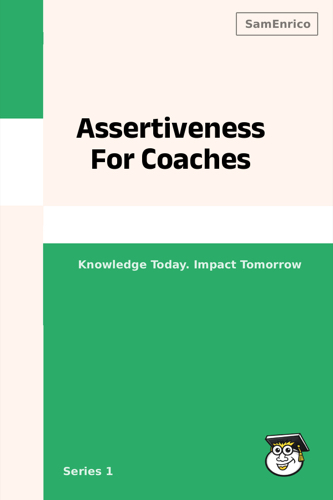
Assertiveness For Coaches eBook
Challenge clients directly while maintaining rappo
Challenge clients directly while maintaining rapport.
Formats
Free sample
Chapter 1: The Empathy Trap--–- The email arrived at 11:47 PM on a Tuesday. Maria, a certified executive coach with eight years of experience, had just finished her last session of the day. The subject line read: "Ending our coaching engagement." The body was brief but devastating: "Maria, I've decided not to renew our contract. I've enjoyed our time together, but I don't feel I've made enough progress to justify the investment. You're wonderful to talk to, but I need someone who will push me harder.
I feel like you've been too nice to tell me what I really need to hear. I hope you understand."Maria stared at the screen for ten minutes. She had genuinely liked this client—a senior director at a tech firm who was stuck in a promotion pattern. In eight months of coaching, Maria had never once raised her voice, never delivered a harsh truth, never risked upsetting him. She thought she was being kind.
She thought she was building trust. She thought that if she was patient enough, he would eventually see his own patterns.He didn't. And worse—he saw hers.Maria is not a bad coach. She is an empathetic, well-trained, caring professional. But she fell into what this chapter calls The Empathy Trap: the mistaken belief that direct challenge endangers the coaching relationship, and that silence, patience, and unconditional niceness are the same as trust.
They are not. And the cost of this trap is not just lost revenue—it is stalled clients, unfulfilled contracts, and the quiet, corrosive feeling that you have failed the people who trusted you.This chapter is the foundation of everything that follows. Before you learn a single script or technique, you must understand why you avoid the hard truth in the first place. Because the person you most need to challenge is not your client. It is yourself.The Anatomy of Nice Coaching Let us name the phenomenon clearly.
Nice Coaching is the systematic avoidance of direct challenge in favor of maintaining pleasant emotional states during sessions. The nice coach never interrupts, never names the elephant, never says "That story is keeping you stuck," never points out the gap between words and actions. The nice coach nods, reflects, asks gentle questions, and waits for the client to spontaneously change—which almost never happens.The nice coach mistakes comfort for connection. They believe that if a client feels good during the session, the client will achieve better outcomes. The research suggests otherwise.
A meta-analysis of coaching effectiveness published in the Journal of Applied Psychology found that the single strongest predictor of client goal attainment was not the coach's warmth, empathy, or listening skills. It was the coach's willingness to provide constructive, behaviorally specific, and direct feedback—even when that feedback caused temporary discomfort.Nice coaching is not kindness. It is fear dressed up as professionalism.Consider the following scenarios. Which sound familiar?A client repeatedly misses action items. You ask, "How can I support you?" instead of saying, "You made a commitment and you broke it.
Let's discuss that directly."A client dominates the session with the same story for the fourth week. You say, "That sounds really difficult" instead of saying, "We have discussed this story three times. Nothing has changed. We need to do something different or end this line of inquiry."A client blames their boss, their team, the market, and their childhood for their lack of progress. You say, "It sounds like there are many obstacles" instead of saying, "You have externalized responsibility for your goal to six different people and systems.
At what point do you own your part?"A client interrupts you repeatedly. You say nothing, waiting for them to finish, instead of saying, "You just interrupted me. I need you to pause for ten seconds before responding."If any of these scenarios resonate, you have been practicing nice coaching. You are not alone. The majority of coaches—even experienced, certified ones—struggle with this pattern.
The question is why.Where Nice Coaching Comes From: The Three Roots The Empathy Trap has three distinct roots. Each one operates beneath conscious awareness, and each one must be excavated before assertiveness training can take hold.Root One: The Selection Bias of the Helping Professions People who become coaches, therapists, social workers, and other helping professionals are systematically different from the general population. Studies of career selection in human services consistently find that helping professionals score higher on measures of empathy, emotional sensitivity, and harm avoidance—the tendency to avoid causing emotional distress to others.This is not a flaw. It is why you entered the profession. You care.
You listen. You feel what your clients feel.But the same trait that makes you an excellent listener also makes you vulnerable to avoidance. Your brain is wired to register your client's discomfort as your own. When you anticipate delivering a challenge that might upset your client, your brain's anterior cingulate cortex—the region associated with processing emotional pain—activates as if you were about to experience the pain yourself. You are not protecting your client from discomfort.
You are protecting yourself from the experience of witnessing their discomfort.This is the first and most important insight of this chapter: Your avoidance of hard truths is not about your client. It is about you. You are not sparing them. You are sparing yourself.Root Two: Mistaking Reactivity for Rupture The second root of nice coaching is the failure to distinguish between temporary emotional reactivity and permanent relationship rupture.When a client receives a direct challenge, their nervous system will often react. Their face may flush.
Their breathing may quicken. They may cross their arms, look away, or offer a defensive explanation. These are signs of reactivity—the amygdala's brief, automatic response to a perceived social threat. Reactivity lasts seconds to minutes. It is not a rupture.A rupture, by contrast, is a breakdown in the working alliance that persists beyond the initial reaction.
Ruptures occur when the coach delivers a challenge that is inaccurate, poorly timed, or cruelly worded—or when the coach delivers an accurate challenge but fails to repair the client's defensive response.The nice coach cannot distinguish between reactivity and rupture. They see any sign of client discomfort—a furrowed brow, a defensive comment, a moment of silence—and interpret it as evidence that they have done something wrong. They rush to soften, apologize, or retreat. They never learn that most reactivity passes on its own if the coach simply holds steady and waits.This is a catastrophic training gap. Most coach certification programs teach empathy, active listening, and motivational interviewing.
Few teach the physiology of threat response, the distinction between reactivity and rupture, or the skill of sitting calmly in a client's discomfort without trying to rescue them.Root Three: The Self-Defeating Beliefs of the Coach The third root is the most insidious because it operates entirely within the coach's own belief system. Every coach carries a set of internal rules about what assertiveness means, what it risks, and what kind of person they want to be. These beliefs are rarely examined. They function as silent algorithms that determine whether the…
This is the end of the free sample. Get the eBook to keep going. Buy now
About this book
Details
- Author
- Barker Archie
- Publisher
- SamEnrico
- Language
- English
- Genre
- Non-Fiction, Self-Help, Coaching
- Released
- 2026-06-06
- Pages (approx.)
- 156
- Available as
- eBook, Audiobook

Read better in the ZLOADR app
Your eBooks on your phone or tablet. Sign in with your SamEnrico account and start reading.
More by Barker Archie
 Dynamic Warm Up Injury PreventionBarker Archie$11.99
 Mindful Morning Routine GuideBarker Archie$11.99
 Mentorship in Nonprofit LeadershipBarker Archie$11.99
 Reflective Listening Techniques CourseBarker Archie$11.99
 Perfectionism Block GuideBarker Archie$11.99
 CPRA Enforcement Actions LogBarker Archie$11.99
 Baldwin Dynasty - Alec BaldwinBarker Archie$11.99
 The Punishment FitBarker Archie$11.99
 Shadows in the Congo: The Battle of Tabora and the Clash of African EmpiresBarker Archie$11.99
 Echoes of the Deep: The Lost City of Atlantis RediscoveredBarker Archie$11.99
 The Last River: The Epic Quest to Find the Amazon's True SourceBarker Archie$11.99
 Risk Management FundamentalsBarker Archie$11.99
You may also like
 Hong Kong Handover 1997Dunn Johnnie$11.99
 Zumba For Postnatal Recovery CourseNeal Christian$11.99
 Zumba for BeginnersLadner Nikia$11.99
 YouTube Comment Mining GuideHumes Pandora$12.99
 Worry Box MeditationCarlin Rudy$11.99
 Workplace Stress MeditationNguyen Lynn$11.99
 Workplace Stress and Sleep RepairHawley Ivory$11.99
 Workplace Perfectionism CureDelaney Jeffry$11.99
 Workplace Injustice Anger GuideWallen Isabelle$11.99
 Work Addiction and Burnout LinkGreenwood Ester$11.99
 Women in Yoga and WellnessBeattie Galina$11.99
 Women in Stand Up ComedyChun Evangeline$11.99