
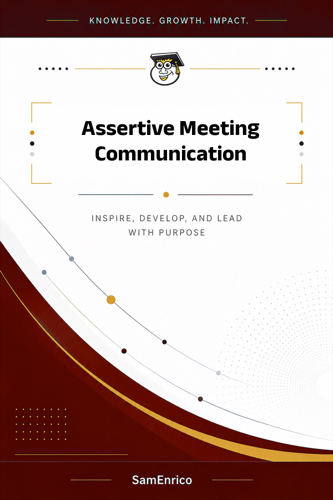
Non-FictionSelf-HelpMeeting Skills
Assertive Meeting Communication eBook
Speak up in meetings without interrupting using th
by Kopp Suzann
Speak up in meetings without interrupting using this practical guide.
Formats
Free sample
Chapter 1: The Silence Tax...--–- Sarah had been preparing for this moment for three days. She had the data, the slides, and the backing of her department head. As the quarterly review meeting reached the critical decision point on allocating the $500,000 innovation fund, Sarah knew exactly what to say. Her analysis showed that the proposed marketing campaign would deliver only half the return of investing in customer retention. She had the numbers, the case studies, and the CEO's prior comments hinting at support for retention.
Everything was ready.The meeting room was full—twelve people, including two senior vice presidents and the Chief Financial Officer. The discussion bounced between marketing and product teams. Sarah sat forward, her hand slightly raised, her throat tight with the words she wanted to speak. She found a breath pause. She opened her mouth.
And then Tom, the Director of Sales, jumped in with a point about quarterly targets. The moment passed. Sarah tried again during the next consensus pause, but Jennifer from Product began speaking first. By the third attempt, the conversation had moved on to implementation timelines, and Sarah's window had closed. She never spoke.
The decision was made to fund the marketing campaign. Three months later, it failed to deliver, and the company lost $200,000.After the meeting, Sarah's boss asked her, "Why didn't you say anything? You had the best data in the room." Sarah couldn't answer. She wasn't shy. She wasn't unprepared.
She simply could not find a way into the conversation that did not feel like she was interrupting.If this story resonates with you, this book is for you.The Hidden Cost of Staying Quiet The problem Sarah faced is not rare. It is epidemic. In organizations ranging from Fortune 500 boardrooms to non-profit staff meetings to startup all-hands, millions of capable, intelligent, prepared professionals sit silently while less-prepared colleagues speak simply because they spoke first or spoke louder. This silence is not a matter of personality. It is not a matter of competence.
It is a matter of permission. Specifically, the permission you give yourself to enter a conversation that is already moving.Before we solve this problem, we must understand its true cost. Most people who fail to speak up in meetings believe they are paying a small price—perhaps a moment of frustration or a missed opportunity to look smart. The reality is far more severe. The silence tax compounds daily, and over the course of a career, it can cost you hundreds of thousands of dollars in missed promotions, eroded leadership perception, and lost influence.Consider the research.
A landmark study published in the Journal of Organizational Behavior followed 238 professionals over five years. Researchers tracked two variables: the frequency of verbal contributions in meetings and subsequent career outcomes, including promotions, salary increases, and leadership opportunities. The results were striking. The top twenty percent of meeting contributors received fifty-eight percent more promotions than the bottom twenty percent, controlling for job performance, education, and years of experience. Speaking up in meetings was a better predictor of advancement than performance review scores.Why?
Because meetings are the primary stage where leadership is performed. Your day-to-day work—the spreadsheets you build, the code you write, the clients you serve—is invisible to senior leadership. Meetings are the exception. In meetings, your competence, confidence, and strategic thinking are on display. When you do not speak, you are not merely quiet.
You are signaling, accurately or not, that you have nothing to add.The silence tax has three specific components that compound over time, each feeding into the next in a destructive cycle that can take years to reverse.The Visibility Tax Every time you stay silent, you miss an opportunity to be seen as a contributor. Leadership is not awarded to the most competent. It is awarded to the most visible competent people. Visibility without competence is dangerous, but competence without visibility is invisible. Meetings are the primary visibility engine in most organizations.
Each silent meeting is a day you did not remind decision-makers that you exist and have value.Think of it this way. Your manager has between five and fifteen direct reports. They cannot watch everyone's daily work. They cannot read every email. They cannot review every document.
What they can do is observe who speaks in meetings. The person who speaks regularly and reasonably becomes, in the manager's mind, the person who is doing the work. This is not fair. It is not rational. But it is human nature.
The brain defaults to what it sees and hears most often.A 2019 study from the University of North Carolina found that managers rated employees who spoke at least three times in a one-hour meeting as twenty-three percent more competent than employees who spoke once or not at all, even when the content of the speaking was identical. The act of speaking itself, independent of quality, created a perception of competence. This is the visibility tax in action. Every silent meeting is a meeting where you allow others to appear more competent than you, regardless of your actual work product.The Authority Tax Authority is not granted solely by title. It is also granted by airtime.
The person who speaks frequently and reasonably becomes, in the group's perception, a leader. This is not a conspiracy. It is cognitive availability. The brain assumes that what it hears most often is most important. When you are silent, other people's voices become the default authority in the room.
You are training your colleagues to ignore you.This effect is measurable. In a study conducted at Stanford Graduate School of Business, researchers recorded fifty-seven cross-functional team meetings. They then asked independent observers to identify the "leaders" in each meeting based solely on watching the video with the sound off. The results were shocking. The people identified as leaders were not the ones with the best ideas or the most experience.
They were the ones who spoke first and most often. Airtime predicted perceived leadership better than any other variable, including job title and tenure.The authority tax is particularly insidious because it is self-reinforcing. Once the group perceives you as having low authority, they stop looking to you for input. They stop asking your opinion. They stop waiting for your agreement.
You become invisible not because you are silent, but because you were silent, and now no one expects anything else.The Opportunity Tax This is the most concrete cost. Promotions, choice assignments, and stretch roles go to people who demonstrate strategic thinking. The primary way to demonstrate strategic thinking in a meeting is to speak. Your brilliant idea about customer retention does not exist until you say it out loud. Until then, it is just a thought in your head, and the organization cannot act on thoughts.
Every silent meeting is a meeting where your ideas died unborn.I have seen this play out hundreds of times. A junior employee has a breakthrough insight during a strategy meeting. They are too nervous to share it. The meeting ends. Two weeks later, a more senior person proposes the same idea and receives credit, a bonus, and a promotion.
The junior employee is bitter but silent. The cycle repeats. Five years later, they are still in the same role…
This is the end of the free sample. Get the eBook to keep going. Buy now
About this book
Details
- Author
- Kopp Suzann
- Publisher
- SamEnrico
- Language
- English
- Genre
- Non-Fiction, Self-Help, Meeting Skills
- Released
- 2026-06-09
- Pages (approx.)
- 146
- Available as
- eBook, Audiobook

Read better in the ZLOADR app
Your eBooks on your phone or tablet. Sign in with your SamEnrico account and start reading.
More by Kopp Suzann
 Remote Work Weekly PlanningKopp Suzann$11.99
 Retirement Housing Property Tax TransferKopp Suzann$11.99
 Sunscreen Chemical FiltersKopp Suzann$11.99
 Parent Loss Books ListKopp Suzann$11.99
 Running Away from Foster CareKopp Suzann$11.99
 Remote Work New Hire GuideKopp Suzann$11.99
 Success Without Burnout for NursesKopp Suzann$11.99
 Rhythm of the Sphinx: The Forgotten Composer of Ancient EgyptKopp Suzann$11.99
 The Great Formula Heist: The Cold War Race for DuPont’s SecretKopp Suzann$11.99
 A Collector's Handbook to the Mg 18Kopp Suzann$11.99
 Service Providers Guide to MusicKopp Suzann$11.99
 How to Produce LiqueursKopp Suzann$11.99
You may also like
 Hong Kong Handover 1997Dunn Johnnie$11.99
 Zumba For Postnatal Recovery CourseNeal Christian$11.99
 Zumba for BeginnersLadner Nikia$11.99
 YouTube Comment Mining GuideHumes Pandora$12.99
 Worry Box MeditationCarlin Rudy$11.99
 Workplace Stress MeditationNguyen Lynn$11.99
 Workplace Stress and Sleep RepairHawley Ivory$11.99
 Workplace Perfectionism CureDelaney Jeffry$11.99
 Workplace Injustice Anger GuideWallen Isabelle$11.99
 Work Addiction and Burnout LinkGreenwood Ester$11.99
 Women in Yoga and WellnessBeattie Galina$11.99
 Women in Stand Up ComedyChun Evangeline$11.99