
Non-FictionSelf-HelpLeadership
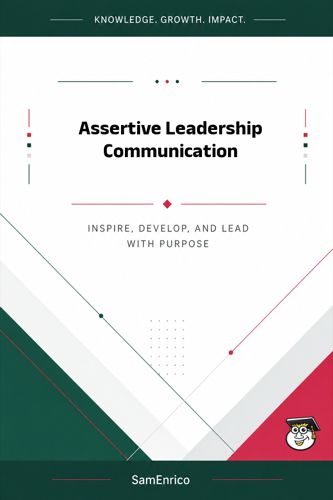
Assertive Leadership Communication eBook
Lead teams with clarity and firmness without bully
by Shuler Tran
Lead teams with clarity and firmness without bullying.
Formats
Free sample
Chapter 1: The Nice Jerk Paradox--–- Every leader I have ever coached has asked me some version of the same question, usually in a moment of exhausted honesty. They lean forward, lower their voice, and admit something they would never say in a performance review. "How do I get people to do what I need without being a jerk?" Or sometimes, flipped around: "Why does every attempt to be nice make me feel like a doormat?" The question betrays a hidden assumption—one that is so widely shared and so rarely examined that it has become the single greatest barrier to effective leadership in the modern workplace. The assumption is that leadership communication exists on a single sliding scale. On one end, you have aggression: loud, demanding, unforgiving.
On the other end, you have passivity: soft, accommodating, conflict-averse. And every leader believes they must choose a position somewhere along this line. The aggressive leader gets results but damages relationships. The passive leader preserves relationships but sacrifices results. And most leaders spend their careers oscillating between the two, never realizing they have been playing a rigged game.The truth is that the single-scale model is a lie.
It is a lie told by exhausted managers, by Hollywood depictions of CEOs, and by leadership books that have not been updated since the 1980s. Assertiveness is not the midpoint between aggression and passivity. It is an entirely different dimension. Aggression is high clarity with low respect. Passivity is low clarity with high respect.
Assertiveness is high clarity with high respect. And the leaders who master this distinction do not have to choose between being liked and being effective. They become something rare and powerful: the person who is simultaneously the toughest and safest person in the room.This chapter introduces the central framework of this book—the Clarity Compass—and exposes the hidden cost of what I call the Nice Jerk Paradox. You will learn why avoiding conflict kills teams faster than bullying, why your well-intentioned kindness might be damaging your people, and how to distinguish between social niceness (a vice disguised as a virtue) and structural kindness (a virtue disguised as toughness). By the end of this chapter, you will never look at your own communication the same way again.The Two Leaders You Do Not Want to Be Let me introduce you to two executives.
Their names have been changed, but their stories are real. I have worked with dozens of versions of both.First, there is Marcus. Marcus runs a regional sales team for a mid-sized technology company. He is known for being demanding. His team hits their numbers—usually in the top three nationally—but the turnover is staggering.
In the past eighteen months, he has lost seven of his twelve direct reports. Exit interviews cite the same themes: "unreasonable pressure," "public criticism," "fear of speaking up." Marcus does not see himself as a bully. He sees himself as someone with high standards in a low-accountability world. He tells me, "I'm not here to be their friend. I'm here to win." And he means it.
But here is what Marcus does not see: his team has stopped innovating. They do exactly what he asks and nothing more. They hide bad news until it is too late to fix. And the top performers—the ones with the most options—leave first. Marcus is winning the battle and losing the war.Then there is Priya.
Priya leads a product development team at a financial services firm. She is beloved. Her team describes her as "supportive," "understanding," and "someone who truly cares." And they are right. Priya spends hours listening to personal problems, accommodating competing requests, and shielding her team from organizational pressure. But here is what Priya will not admit: her team is underperforming.
They have missed three consecutive delivery deadlines. The quality of work has slipped. And the high-performers are frustrated—not because Priya is mean, but because she refuses to hold anyone accountable. One of her best engineers told me, "I have no idea what good looks like anymore. Every deadline is negotiable.
Every mistake gets a pass. I am leaving because I am bored and embarrassed by what we produce."Marcus is the aggressive leader: high clarity, low respect. His team knows exactly what he wants, but they feel humiliated and afraid. Priya is the passive leader: low clarity, high respect. Her team feels safe but lost.
Both are failing. And both believe they are doing the right thing.This is the Nice Jerk Paradox. Leaders who try to avoid being a jerk often become passive and ineffective. Leaders who try to avoid being weak often become aggressive and toxic. And the vast majority of leaders oscillate between these two poles, never realizing there is a third option.The Clarity Compass: A New Map for Leadership Communication To understand why Marcus and Priya are both failing, we need a better map than the one-dimensional sliding scale.
Let me introduce you to the Clarity Compass. It has two independent axes, not one.The vertical axis measures clarity. How clearly do your team members understand what you expect from them? Do they know exactly what success looks like? Do they understand deadlines, quality standards, and priorities?
Or are they guessing, interpreting, and hoping?The horizontal axis measures respect. How much dignity do your team members feel when you communicate with them? Do they feel seen, heard, and valued as human beings? Or do they feel dismissed, humiliated, or irrelevant?When you combine these two axes, you get four distinct quadrants. And each quadrant produces a different leadership style and a different set of outcomes.Quadrant 1: Aggressive (High Clarity, Low Respect)This is Marcus.
He is crystal clear about what he wants. His team never wonders about priorities or deadlines. But they pay for that clarity with their dignity. He uses shame, volume, and public criticism to enforce standards. The result is short-term compliance and long-term erosion.
Teams in this quadrant hit their numbers—until they don't. They burn out. They hide mistakes. They stop thinking creatively. And the best people leave.Quadrant 2: Passive (Low Clarity, High Respect)This is Priya.
She is warm, supportive, and deeply respectful. Her team feels psychologically safe—at least in the sense that no one will yell at them. But they have no idea what is actually expected. Priorities shift. Deadlines are suggestions.
Accountability is a foreign concept. The result is a comfortable culture of underperformance. No one is terrified, but no one is excellent either.Quadrant 3: Passive-Aggressive (Low Clarity, Low Respect)This quadrant is the most toxic and the most common among burned-out mid-level managers. These leaders are not clear about expectations, but they also do not treat people with respect. Instead, they communicate through hints, sarcasm, exclusion, and silent treatment.
They will say "We'll see" when they mean "No." They will schedule a meeting at a time they know you cannot attend. They will compliment you in public and undermine you in private. Teams in this quadrant live in constant anxiety, never knowing where they stand or when the subtle punishment will arrive.Quadrant 4: Assertive (High Clarity, High Respect)This is the goal of…
This is the end of the free sample. Get the eBook to keep going. Buy now
About this book
Details
- Author
- Shuler Tran
- Publisher
- SamEnrico
- Language
- English
- Genre
- Non-Fiction, Self-Help, Leadership
- Released
- 2026-06-06
- Pages (approx.)
- 125
- Available as
- eBook, Audiobook

Read better in the ZLOADR app
Your eBooks on your phone or tablet. Sign in with your SamEnrico account and start reading.
More by Shuler Tran
 The Joy of ParentingShuler Tran$11.99
 New Leader Imposter SyndromeShuler Tran$11.99
 Graduation Without CapShuler Tran$11.99
 Mindfulness for Teen Beginners GuideShuler Tran$11.99
 The Vanished Troubadours: The Lost Songs of Al-AndalusShuler Tran$11.99
 CartwrightShuler Tran$11.99
 How to Become a Laboratory MillerShuler Tran$11.99
 Understanding Myopathy Congenital Multicore With External OphthalmoplegiaShuler Tran$17.99
 Bad Debt Formula PrimerShuler Tran$12.99
 Okta SWOT Analysis GuideShuler Tran$12.99
You may also like
 Hong Kong Handover 1997Dunn Johnnie$11.99
 Zumba For Postnatal Recovery CourseNeal Christian$11.99
 Zumba for BeginnersLadner Nikia$11.99
 YouTube Comment Mining GuideHumes Pandora$12.99
 Worry Box MeditationCarlin Rudy$11.99
 Workplace Stress MeditationNguyen Lynn$11.99
 Workplace Stress and Sleep RepairHawley Ivory$11.99
 Workplace Perfectionism CureDelaney Jeffry$11.99
 Workplace Injustice Anger GuideWallen Isabelle$11.99
 Work Addiction and Burnout LinkGreenwood Ester$11.99
 Women in Yoga and WellnessBeattie Galina$11.99
 Women in Stand Up ComedyChun Evangeline$11.99