
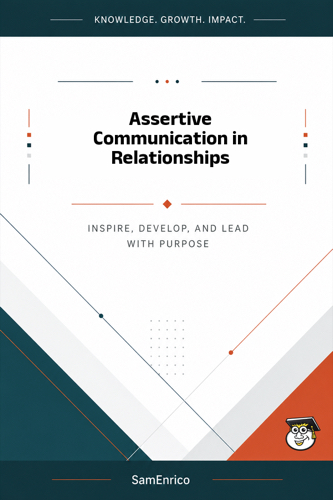
Non-FictionSelf-HelpRelationship Skills
Assertive Communication in Relationships eBook
Express needs to partners and family without blame
by Dias Codi
Express needs to partners and family without blame or withdrawal.
Formats
Free sample
Chapter 1: The Dishwasher War--–- The fight that ended a ten-year marriage did not begin with an affair, a secret bank account, or a betrayal of trust. It began with a dishwasher.At 7:43 PM on a Tuesday, Sarah loaded the dishwasher. She placed the plates on the bottom rack, cups on top, silverware handles-down in the basket. This was the correct way. Everyone knew this.
At 7:44 PM, her husband Mark opened the dishwasher, rearranged three plates, moved the cups to the bottom, and turned it on.Sarah felt something crack inside her chest."You always do this," she said."Do what?""Correct me. Like I cannot load a dishwasher correctly.""I am not correcting you. I am just making space for the pot.""The pot was fine on the counter.""It fits better inside.""I had a system.""Your system left the pot out."And then they were fighting. Not about the dishwasher. About every dishwasher.
About every time he had rearranged her work. About every time she had swallowed her frustration. About the vacation where he rebooked the flights without asking. About the basement renovation where he overruled her paint choice. About ten years of small corrections that had calcified into one large belief: I am not trusted in my own home.Sarah stopped talking first.
She went to the bedroom, closed the door, and sat in the dark. This was her pattern: withdrawal. Not the dramatic kind. Not the slamming-doors kind. The quiet kind.
The I have nothing left to say kind.Mark stayed in the kitchen. He ran the dishwasher twice that night. He did not know why. He was not trying to hurt her. He was trying to help.
But help, when it is unwanted, is not help. It is a verdict.Three weeks later, they sat in a marriage counselor's office."Describe the problem," the counselor said.Sarah said: "He does not respect me."Mark said: "She will not talk to me."The counselor asked: "What was the last fight about?"A long silence."The dishwasher," Sarah said.Mark laughed. Not because it was funny. Because it was absurd. Ten years of marriage, three children, a mortgage, a business they had built together, and they were in a therapist's office because of a dishwasher.That laugh was the last sound of their marriage.Sarah filed for divorce four months later.
In her deposition, she wrote: "I could not feel heard. I could not express a need without it becoming a critique. Eventually, I stopped trying. He took my silence as agreement. By the time I spoke again, I had nothing left to say."Mark, in his deposition, wrote: "I did not know she was unhappy.
She never told me. She just got quiet. I thought quiet meant okay."Two people, both intelligent, both loving, both committed to their family. Destroyed not by malice but by a failure of communication so ordinary, so mundane, that it could happen to anyone.Including you.The Three Traps That Set Every Fight on Fire Before we build the skills that Sarah and Mark did not have, we must name the enemies. Every destructive argument follows one of three paths.
Learn to recognize them in real time, and you have already won half the battle.Trap One: The Blame Bomb The Blame Bomb is any statement that locates the problem entirely inside another person. It uses the word "you" as a weapon. "You are so lazy." "You never listen." "You do not care about me." "You ruined dinner."The Blame Bomb feels satisfying in the moment because it discharges your emotional pressure onto someone else. But it guarantees two outcomes: first, the other person will become defensive; second, the real issue will remain unaddressed. When you say "You are lazy," the other person hears an attack and responds with a counter-attack ("I am not lazy; you are a control freak") or a withdrawal ("Fine, I cannot do anything right").
Neither response solves the problem. The dishwasher stays misloaded. The need stays unexpressed.Blame Bombs are seductive because they are easy. They require no vulnerability. They do not ask you to examine your own feelings or needs.
They simply point a finger. But as the saying goes: when you point one finger, three fingers point back at you.Trap Two: Silent Withdrawal Silent Withdrawal is the act of leaving a conversation—physically or emotionally—without explanation. It includes going quiet, changing the subject, leaving the room, or staring at your phone. It is the most common form of withdrawal in intimate relationships, and it is devastating precisely because it is invisible.To the person who withdraws, silence feels like self-protection. "I am too angry to speak." "I do not want to say something I will regret." "Nothing I say matters anyway." But to the person left behind, silence is not neutral.
It is a message: You are not worth my words. This relationship is not worth my effort. I am done.Silent Withdrawal is the primary pattern Sarah used. She did not see it as aggression. She saw it as restraint.
But her silence told Mark a story he could not read. He filled the空白 with his own interpretation: She is fine. She would tell me if she were not fine. By the time she spoke again, the gap between them was too wide to bridge.Trap Three: The Judgment Triangle Most people believe that conflicts escalate because of what is said. But the research—decades of it from the Gottman Institute and others—shows something different.
Conflicts escalate because of how we frame the other person.The Judgment Triangle has three corners:Blame: "This is your fault."Criticism: "There is something wrong with you as a person."Defensiveness: "I have done nothing wrong; you are the problem."Once a conversation enters the Judgment Triangle, it almost never leaves. Each corner reinforces the others. Blame triggers defensiveness, which triggers more blame. Criticism invites counter-criticism. The original issue—the dishwasher, the late arrival, the forgotten anniversary—disappears entirely.
The couple is no longer fighting about a behavior. They are fighting about each other's character.The antidote to the Judgment Triangle is the Empathy Circle, which we will build throughout this book. But for now, simply recognize: if you hear yourself or your partner using the words "always," "never," "you are," or "you should," you are in the triangle. Stop. Take a breath.
And ask: What need is underneath this fight?The Myth of Winning an Argument Here is a truth that will change how you fight: there is no such thing as winning an argument in a relationship.In a courtroom, winning means the judge agrees with you. In a sports arena, winning means more points on the board. In a relationship, winning an argument means your partner loses. And when your partner loses, they feel hurt, dismissed, or humiliated. Those feelings do not disappear.
They accumulate. They become resentment. And resentment is the termite that destroys foundations from the inside.I have never met a couple who said, "We had a terrible fight, but I won, and our relationship is stronger because of it." That sentence does not exist. Winning an argument…
This is the end of the free sample. Get the eBook to keep going. Buy now
About this book
Details
- Author
- Dias Codi
- Publisher
- SamEnrico
- Language
- English
- Genre
- Non-Fiction, Self-Help, Relationship Skills
- Released
- 2026-06-08
- Pages (approx.)
- 129
- Available as
- eBook, Audiobook

Read better in the ZLOADR app
Your eBooks on your phone or tablet. Sign in with your SamEnrico account and start reading.
More by Dias Codi
 The Freelance Website SeparationDias Codi$11.99
 Child Actor Financial Ruin GuideDias Codi$11.99
 The Interruption Scripting for Managers CourseDias Codi$11.99
 Scripting AppsDias Codi$11.99
 Laci Peterson Jury SelectionDias Codi$11.99
 The Persuasion ChallengeDias Codi$11.99
 UK VAT Threshold and Compliance PrimerDias Codi$11.99
 Buffett NetJetsDias Codi$11.99
 The Unstoppable Comeback: How a 1990s Pop Icon Reclaimed Her ThroneDias Codi$11.99
 Frozen Quantum: The Arctic Adventures of Chien-Shiung Wu and the Hunt for Cosmic TruthsDias Codi$11.99
 Global Web ProducerDias Codi$11.99
 Zoom Scrum For Distributed TeamsDias Codi$12.99
You may also like
 Hong Kong Handover 1997Dunn Johnnie$11.99
 Zumba For Postnatal Recovery CourseNeal Christian$11.99
 Zumba for BeginnersLadner Nikia$11.99
 YouTube Comment Mining GuideHumes Pandora$12.99
 Worry Box MeditationCarlin Rudy$11.99
 Workplace Stress MeditationNguyen Lynn$11.99
 Workplace Stress and Sleep RepairHawley Ivory$11.99
 Workplace Perfectionism CureDelaney Jeffry$11.99
 Workplace Injustice Anger GuideWallen Isabelle$11.99
 Work Addiction and Burnout LinkGreenwood Ester$11.99
 Women in Yoga and WellnessBeattie Galina$11.99
 Women in Stand Up ComedyChun Evangeline$11.99