
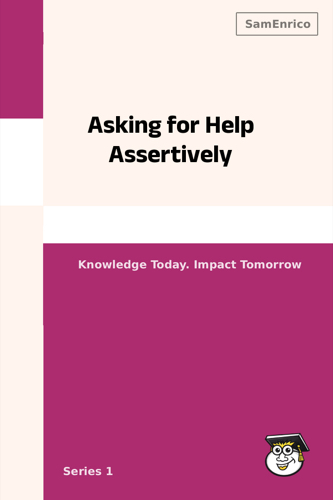
Non-FictionSelf-HelpHelp Seeking
Asking for Help Assertively eBook
Request support without groveling or demanding, fi
Request support without groveling or demanding, find the middle ground.
Formats
Free sample
Chapter 1: The Two Poisoned Stories--–- Most people who struggle to ask for help do not have a skills problem. They have a story problem. The skills—the words, the timing, the body language—matter enormously, and we will spend the rest of this book mastering them. But if you try to layer assertive asking techniques on top of a narrative that secretly believes you should never need help, or that others owe you their support, those techniques will crumble the moment you face resistance. You will find yourself apologizing before you even open your mouth, or you will hear a demand slip out when you meant to make a request.
The techniques will feel fake, because the story underneath is real.This chapter is about excavating those stories. Not judging them. Not pretending they do not exist. Excavating them, naming them, and then deciding whether you want to keep them. Because here is the truth that every bestseller on boundaries, vulnerability, and emotional intelligence agrees on: the way you learned to ask for help—or learned not to ask—was not born in a vacuum.
It was taught to you. And what was taught can be unlearned.The Two Poisoned Stories There are two primary narratives that sabotage assertive asking. They appear to be opposites, but they share a common root: both disconnect you from the simple, neutral truth that human beings need help, and asking for it is a sign of health, not failure.The first story is shame-based self-reliance. Its internal script sounds like this: “I should be able to handle this alone. If I can’t, something is wrong with me.
Asking for help is admitting defeat.” The second story is hidden entitlement. Its internal script sounds like this: “After everything I’ve done for them, they should help me. I shouldn’t have to ask. They owe me.” These two stories feel different—one shrinks you, the other inflates you—but they produce the same result: you do not make clean, clear, respectful requests. You either grovel or demand.Let us look at each story in detail, because you cannot unlearn what you have not first recognized.Story One: Shame-Based Self-Reliance Shame-based self-reliance is the belief that needing help is a personal failing.
It often wears a mask of virtue: “I’m independent,” “I don’t like to bother people,” “I was raised to handle my own problems.” But underneath the virtuous mask is something heavier: fear. Fear that if you ask, you will be seen as weak, incompetent, needy, or burdensome. Fear that people will secretly think less of you. Fear that you will owe something you cannot repay.Where does this story come from? For most people, it begins in childhood.
Perhaps you grew up in a household where asking for help was met with irritation, sighs, or explicit punishment. “Can you help me with my homework?” was answered with “Figure it out yourself.” “I don’t feel good” was met with “You’re always complaining.” Over time, you learned that your needs were an inconvenience. The only safe way to exist was to need as little as possible.For others, the story comes from culture. The bootstrap myth—the idea that anyone can succeed through pure individual effort—is one of the most pervasive narratives in Western societies. It shows up in workplace slogans (“Hustle culture,” “Grind until you make it”), in inspirational quotes (“The strongest people need no one”), and in the way we celebrate lone geniuses while ignoring the teams, mentors, and support systems behind them.
If you have internalized this cultural story, asking for help feels like cheating. It feels like admitting you are not one of the strong ones.Gender norms also play a powerful role. Boys are often shamed for showing vulnerability or asking for direction. “Be a man,” “Stop crying,” “Figure it out yourself”—these messages train many men to treat asking for help as emasculating. Women, conversely, are often praised for over-giving and self-sacrifice, but shamed for asking for what they need.
A woman who asks for help can be labeled demanding, difficult, or high-maintenance. So both genders learn distorted versions of asking: men avoid it to preserve an illusion of strength; women avoid it to preserve an illusion of selflessness.The cost of shame-based self-reliance is enormous. It leads to burnout, because you keep taking on more than you can handle. It leads to isolation, because you push people away rather than let them support you. It leads to resentment, because eventually you cannot sustain the performance of having no needs, and you start to feel angry at a world that you believe expects too much while giving too little.
But here is the cruel irony: the world did not expect you to do it alone. You did. Your story did. And that story can change.Story Two: Hidden Entitlement The second poisoned story looks nothing like the first. Where shame-based self-reliance whispers, “I don’t deserve help,” hidden entitlement whispers, “They owe me.” It sounds like this: “After everything I’ve done for this team, they should have offered to help by now.” “I shouldn’t have to ask—they know I’m struggling.” “If they really cared about me, they would just show up.”Hidden entitlement is called “hidden” because it rarely announces itself as entitlement.
It feels like justified frustration. It feels like keeping score in a relationship where you are convinced you are ahead. You have given and given—your time, your energy, your money, your emotional support—and now you are waiting for the universe to pay you back. When help does not arrive unbidden, you feel resentful. And sometimes, that resentment explodes into a demand: “You never help me,” “I always do everything around here,” “You owe me after last time.”Where does hidden entitlement come from?
Often, it grows from the same soil as shame-based self-reliance: unmet childhood needs. If you grew up in a household where your needs were inconsistently met—sometimes with generosity, sometimes with neglect—you may have developed a deep, unspoken belief that love is transactional. You learn to give in order to earn the right to receive. But because the rules of the transaction are never stated, you are always left waiting, watching, and tallying. You become a silent scorekeeper.Hidden entitlement also arises from cultural scripts about reciprocity.
Many of us were taught that “one good turn deserves another,” that “what goes around comes around,” that relationships should be balanced. These are not false ideas, but they become toxic when they turn into silent contracts. A silent contract is when you do something for someone without their agreement, and then expect something in return without ever stating that expectation. You stay late at work to help a colleague, and then you expect them to cover for you next week—but you never ask. You plan a surprise for your partner, and then you expect them to read your mind about what you need in return.
When they fail, you feel betrayed. But they never agreed to your terms.The cost of hidden entitlement is equally devastating. It poisons relationships with unspoken expectations.…
This is the end of the free sample. Get the eBook to keep going. Buy now
About this book
Details
- Author
- Littleton Anette
- Publisher
- SamEnrico
- Language
- English
- Genre
- Non-Fiction, Self-Help, Help Seeking
- Released
- 2026-06-08
- Pages (approx.)
- 123
- Available as
- eBook, Audiobook

Read better in the ZLOADR app
Your eBooks on your phone or tablet. Sign in with your SamEnrico account and start reading.
More by Littleton Anette
 Food Dream Symbolism WorkbookLittleton Anette$11.99
 Friends With Benefits Self EsteemLittleton Anette$11.99
 Fear of Needles MasteryLittleton Anette$11.99
 The Mindful Drinking Recovery GuideLittleton Anette$11.99
 Whispers from the Black Sun: The Plague Doctor’s Last PatientLittleton Anette$11.99
 How to Become a Digester-operator HelperLittleton Anette$11.99
 Antifreeze/coolant Top-offLittleton Anette$11.99
 Millennial Spending Power ForecastLittleton Anette$12.99
 Internal Breach Communication ScriptLittleton Anette$12.99
 Understanding Inclusion-cell DiseaseLittleton Anette$17.99
You may also like
 Hong Kong Handover 1997Dunn Johnnie$11.99
 Zumba For Postnatal Recovery CourseNeal Christian$11.99
 Zumba for BeginnersLadner Nikia$11.99
 YouTube Comment Mining GuideHumes Pandora$12.99
 Worry Box MeditationCarlin Rudy$11.99
 Workplace Stress MeditationNguyen Lynn$11.99
 Workplace Stress and Sleep RepairHawley Ivory$11.99
 Workplace Perfectionism CureDelaney Jeffry$11.99
 Workplace Injustice Anger GuideWallen Isabelle$11.99
 Work Addiction and Burnout LinkGreenwood Ester$11.99
 Women in Yoga and WellnessBeattie Galina$11.99
 Women in Stand Up ComedyChun Evangeline$11.99