
Non-FictionInformativeEducational
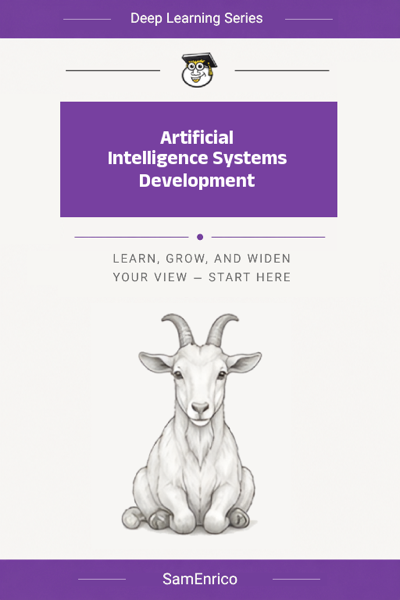
Artificial Intelligence Systems Development eBook
A Coursebook on Artificial Intelligence Systems De
by Gifford Mary
A Coursebook on Artificial Intelligence Systems Development
Formats
Free sample
Chapter 1: The Fallacy of Finished Models--– In the winter of 2018, a team of elite data scientists at a multinational bank celebrated the deployment of what they believed was a perfect fraud detection system. Their model achieved 99.2% accuracy on the test set—a triumph of feature engineering and gradient-boosted trees. Six weeks later, the bank lost $47 million to a coordinated fraud attack that the model failed to detect. The model hadn't broken. It hadn't crashed.
It was running exactly as trained. But the fraud patterns had shifted, and no one was watching.This story is not an outlier. It is the norm.Welcome to the uncomfortable reality of artificial intelligence systems development. The journey from a working Jupyter notebook to a reliable, maintainable, trustworthy AI system in production is littered with corpses of models that excelled in offline validation and failed catastrophically in the real world. This book exists to ensure you are not the next casualty.The Great Illusion: Why Software Engineering Doesn't Prepare You for AIEvery software engineer learns a foundational truth: given the same inputs and the same code, a deterministic system produces the same outputs every time.
If your web server crashes, you fix the bug, redeploy, and the problem is solved. If your database query returns inconsistent results, you correct the SQL and move on. The system is predictable, testable, and—once verified—reliable.Artificial intelligence systems invert this entire paradigm.When you deploy a machine learning model, you are not deploying logic. You are deploying a statistical approximation of patterns extracted from historical data. The model has no understanding of causality, no resilience to distributional shifts, and no ability to signal its own degradation.
It will silently produce increasingly incorrect predictions as the world changes around it, and the only indication of failure may be a complaint from a customer—or a $47 million loss.Consider the fundamental differences. Traditional software is deterministic: the same input always maps to the same output through explicit rules written by humans. AI systems are probabilistic: outputs are distributions, not guarantees, derived from patterns in training data. Traditional software fails explicitly: exceptions, error codes, and stack traces tell you exactly what broke. AI systems fail silently: performance degrades gradually, often invisibly, without any exception being thrown.Traditional software is static once deployed: a function that worked in 2018 will work identically in 2025, assuming the underlying infrastructure remains unchanged.
AI systems are dynamic by nature: a model trained on customer behavior from 2018 will become increasingly irrelevant as preferences, regulations, and market conditions evolve. Traditional software is unit-testable: every function can be verified against expected outputs with deterministic assertions. AI systems are statistically verifiable: you cannot assert that a prediction is "correct"; you can only measure aggregate performance on held-out data, which may not represent future conditions.This fundamental mismatch explains why organizations that treat AI development as just another software project consistently fail. They apply traditional engineering practices to problems that demand a completely new discipline.The Six-Stage AI Systems Development Lifecycle To build AI systems that survive contact with the real world, you need a lifecycle designed for probabilistic, data-dependent, continuously evolving artifacts. The AI Systems Development Lifecycle consists of six iterative stages, connected by feedback loops that traditional software processes lack.Stage 1: Scoping – Before any data is collected or any code is written, you must define the business problem in precise terms, determine whether AI is the appropriate solution, establish success metrics that connect model performance to business outcomes, and assess feasibility given data availability, annotation budget, and regulatory constraints.
This stage is covered in depth in Chapter 2.Stage 2: Data – With a well-scoped problem, you source, label, validate, version, and transform the data that will become the foundation of your model. This includes building reproducible pipelines that ensure training data and serving data are processed identically. Chapters 3 and 4 provide the complete data engineering toolkit.Stage 3: Modeling – You select appropriate model architectures, run systematic experiments, track hyperparameters and metrics, tune performance, and validate against both offline benchmarks and production-like conditions. Chapters 5 and 6 cover the model development and evaluation lifecycle.Stage 4: Deployment – The refactored, containerized, and versioned model moves from development environment to production, integrated with CI/CD/CT pipelines that support both batch and real-time inference. Chapters 7 and 8 address packaging, serving, scaling, and edge deployment.Stage 5: Monitoring – Once live, the model is continuously observed for data drift, concept drift, prediction distribution shifts, and performance degradation.
Monitoring feeds directly back into the data and modeling stages, triggering retraining when thresholds are crossed. Chapter 9 provides the complete observability stack.Stage 6: Maintenance – Retraining is orchestrated automatically based on monitoring signals, with versioned deployments, canary rollouts, and automated rollbacks. The system becomes self-healing rather than static. Chapter 10 builds the automation pipeline that closes the feedback loop.This lifecycle is iterative, not sequential. Monitoring may reveal data drift that requires revisiting data sourcing.
Deployment may reveal latency constraints that force model architecture changes. Successful AI organizations embrace this circularity; failed organizations treat AI development as a linear handoff from data scientists to engineers.The Notebook Trap and the Production Gap The Jupyter notebook is simultaneously the greatest productivity tool for data science and the greatest liability for production AI. Notebooks enable rapid experimentation, interactive visualization, and iterative exploration. But they also encourage exactly the anti-patterns that destroy production systems.Open any data science notebook from a typical project and you will find cells executed out of order, global variables mutated silently, data transformations repeated across multiple notebooks with subtle variations, and zero unit tests. The notebook records the final state of a session, not the reproducible path to that state.
It captures the what but not the how.The production gap emerges when an organization attempts to convert a successful notebook into a deployed service. The data scientist hands over a notebook that "works" on a static snapshot of data. The engineering team discovers that the notebook depends on an unrecorded version of a library, that data cleaning steps are scattered across 47 cells with no clear ordering, that the feature extraction logic is duplicated in preprocessing and inference code with inconsistent handling of missing values, and that no error handling exists for malformed inputs that never appeared in the training set.This gap is not a failure of individual competence. It is a structural failure of process and tooling. Data scientists are trained to explore, to iterate, to find patterns.
Engineers are trained to build reliable, testable, maintainable systems. Neither discipline is wrong, but they speak different languages and operate under different incentives.Throughout this book, I will show you how to bridge this gap without forcing data scientists to become engineers or engineers to become statisticians. The solution lies in shared interfaces, automated validation, and a common vocabulary of success.The Four Pillars of Production AIFour foundational capabilities distinguish organizations that successfully deploy AI from those that produce shelfware models that never deliver business value.Pillar One: Reproducibility – Every artifact in the AI lifecycle must be versioned and auditable. Data versions, code versions, hyperparameter configurations, environment specifications, and model binaries must be linked together such that any prediction can be traced back to the exact training run that produced it. Without reproducibility, debugging is impossible, compliance is…
This is the end of the free sample. Get the eBook to keep going. Buy now
About this book
Details
- Author
- Gifford Mary
- Publisher
- SamEnrico
- Language
- English
- Genre
- Non-Fiction, Informative, Educational
- Released
- 2026-05-06
- Pages (approx.)
- 132
- Available as
- eBook, Audiobook

Read better in the ZLOADR app
Your eBooks on your phone or tablet. Sign in with your SamEnrico account and start reading.
More by Gifford Mary
 Mindfulness for College StudentsGifford Mary$11.99
 Customer Service Text AnalyticsGifford Mary$11.99Customer Service Text AnalyticsGifford Mary$11.99
 Teresa's Concept of MortificationGifford Mary$11.99
 Neurodivergent Social ConnectionGifford Mary$11.99
 The Hypnosis Audio File ManagementGifford Mary$11.99
 Operation: Secret Dossier – The 1994 USA World Cup HeistGifford Mary$11.99
 MOOC vs Degree Hiring StudyGifford Mary$12.99
 Ambassador Program Pre LaunchGifford Mary$12.99
 Learn to Play the Air HornGifford Mary$11.99
 How to Start a Phosphatic Straight Fertiliser Business (Beginners Guide)Gifford Mary$11.99
You may also like
 Hong Kong Handover 1997Dunn Johnnie$11.99
 Zumba For Postnatal Recovery CourseNeal Christian$11.99
 Zumba for BeginnersLadner Nikia$11.99
 YouTube Comment Mining GuideHumes Pandora$12.99
 Worry Box MeditationCarlin Rudy$11.99
 Workplace Stress MeditationNguyen Lynn$11.99
 Workplace Stress and Sleep RepairHawley Ivory$11.99
 Workplace Perfectionism CureDelaney Jeffry$11.99
 Workplace Injustice Anger GuideWallen Isabelle$11.99
 Work Addiction and Burnout LinkGreenwood Ester$11.99
 Women in Yoga and WellnessBeattie Galina$11.99
 Women in Stand Up ComedyChun Evangeline$11.99