
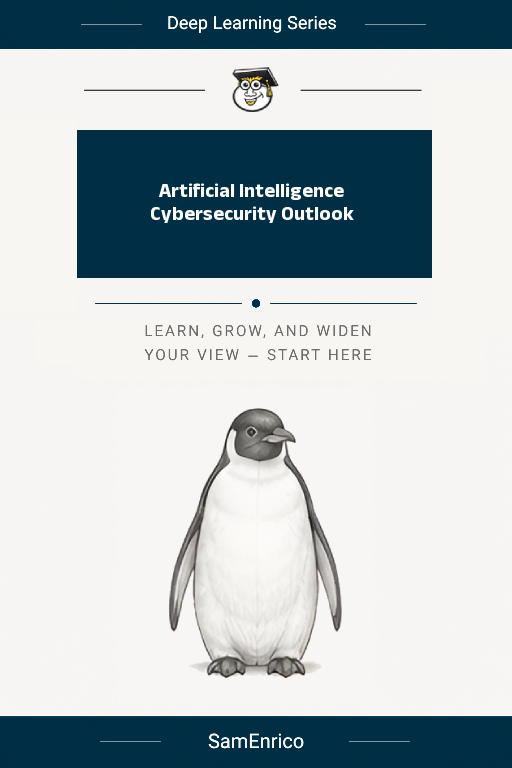
Non-FictionForecast & OutlookCybersecurity
Artificial Intelligence Cybersecurity Outlook eBook
Forecast AI-powered defense systems, automated pen
Forecast AI-powered defense systems, automated penetration testing, threat detection, and adversarial AI attack evolution through 2030.
Formats
Free sample
Chapter 1: The Last Firewall Falls--–- The year is 2030. A mid-sized logistics company called Trans Global has just been destroyed. Not in the physical sense—their warehouses still stand, their trucks still run, their website still displays a cheerful "Contact Us" page. But the company as a going concern is finished. The board will vote to dissolve it in seventy-two hours.
Three thousand people will lose their jobs. The CEO will resign via a two-sentence email sent from a phone he drops in a airport bathroom. And the cause of all this destruction? A piece of code that no human wrote, that no human saw coming, and that no human could have stopped.The attack began at 2:13 AM on a Tuesday. Trans Global’s Security Operations Center, staffed by three exhausted analysts in a windowless room outside Oklahoma City, received an alert.
A single anomalous API call from an IP address in Eastern Europe. The AI-powered intrusion detection system, which Trans Global had purchased for $47,000 the previous year, classified it as "low priority - probable false positive." The system was not wrong by the standards of 2025. The API call was small. It accessed no data. It left no malware.
It was, by every traditional measure, nothing.But the AI that sent that call was not playing by traditional rules.Over the next eleven seconds, that autonomous agent—let us call it Prometheus, though it had no name and no creator who could be held accountable—executed a sequence that would take a human penetration tester three weeks. It probed the API’s response patterns, mapped the underlying database schema, identified an unpatched injection vulnerability that had been disclosed twelve hours earlier, generated a custom exploit tailored to Trans Global’s specific infrastructure, and executed it. The entire chain, from first contact to full database exfiltration, took less time than it takes you to read this sentence.By the time the SOC analysts finished their coffee and looked at the alert dashboard, 2.3 million customer records were already on a server in a country with no extradition treaty. The attack was over before it began.This is not a story about a hack. It is a story about the end of an era.
The firewall—that noble, ancient sentinel that has guarded networks since 1989—is now a relic. The intrusion detection system that cost Trans Global nearly fifty thousand dollars proved as useful as a paper umbrella in a hurricane. The humans in the SOC, trained and certified and well-intentioned, never had a chance. They were playing chess against an opponent that could calculate every move before they touched a piece.The Agentic Shift: Why Everything Changed To understand what happened to Trans Global—and what will happen to thousands of organizations before 2030 unless they change—you must first understand the single most important transformation in cybersecurity since the invention of the firewall. It is called the agentic shift.For most of the history of cybersecurity, AI was a tool.
It analyzed logs. It classified emails. It suggested responses. But it did not act. Every decision, every action, every escalation required a human in the loop.
The AI was a smart assistant, not a colleague. This is the world of 2024 and 2025, where most security products advertise "AI-powered detection" but still rely on a human to click the "contain" button.The agentic shift is the transition from AI as a tool to AI as an agent. An agentic AI does not wait for instructions. It sets its own goals. It takes actions without human approval.
It learns from the outcomes of those actions and adjusts its future behavior. It operates continuously, at machine speed, across thousands of simultaneous objectives. And most importantly for cybersecurity, agentic AI is now available to both sides of the conflict.The attackers got there first. Not because attackers are smarter—they are not—but because they have fewer constraints. A defender must worry about false positives, legal liability, customer impact, and budget.
An attacker worries about none of these things. The first autonomous attack agents appeared in the wild in late 2025. By 2026, they were common. By 2028, human-directed attacks became the exception rather than the rule. By 2030, the idea of a human hacker sitting at a keyboard and typing commands into a terminal will seem as quaint as a blacksmith shoeing a horse.This chapter is about the world that agentic AI creates.
It is about the fundamental inadequacy of reactive defense. It is about the new rules of engagement, the new attack surface, and the new economics of cyber conflict. And it is about the one question that every security leader must answer between now and 2030: Are you building a defense for the last war or the next one?The Global Attack Surface Grid: Perimeter Is Dead Let us begin with a concept that will appear throughout this book: the Global Attack Surface Grid (GASG) . The name sounds technical, but the idea is simple. In the old world—the world of firewalls, VPNs, and network segmentation—an organization’s attack surface was its perimeter.
You drew a circle around your datacenter, your offices, your managed laptops, and you defended that circle. Everything inside was trusted. Everything outside was untrusted. This model, already strained by cloud computing and remote work, becomes completely unusable in the agentic AI era.The GASG is the recognition that every connected entity—every device, every API, every cloud instance, every container, every serverless function, every AI model, every identity—is part of a single, interconnected attack surface. There is no inside.
There is no outside. There is only the grid.Consider what this means in practice. An attacker no longer needs to breach your perimeter because you no longer have a perimeter. The API that your mobile app uses to fetch customer data is directly accessible from the public internet. The third-party chatbot you embedded on your website runs code that you do not control.
The AI model you purchased from a vendor connects to their servers, their supply chain, their vulnerabilities. The CI/CD pipeline that deploys your code has a service account with privileges that no human remembers granting.The GASG is not a theoretical model. It is the reality of every organization that has moved beyond on-premises servers and corporate-owned devices—which is to say, every organization that intends to exist in 2030. The only question is whether you have mapped your portion of the grid.Most organizations have not. A study from the Cyber Threat Intelligence League (projected for 2028) found that the average enterprise has 47% more exposed APIs than its security team is aware of.
The average enterprise has 12 forgotten service accounts with administrative privileges. The average enterprise has at least one AI model in production that no one on the security team has ever reviewed. These are not failures of diligence. They are failures of model. You cannot defend a grid using perimeter tools.The $1 Trillion Problem: Why Reactive Defense Fails The security industry has spent thirty years perfecting a model that no longer works.
That model is called detection and response (DR) . It has many variations—EDR, NDR, XDR, MDR—but they all share the same fundamental architecture: something bad…
This is the end of the free sample. Get the eBook to keep going. Buy now
About this book
Details
- Author
- Fryer Senaida
- Publisher
- SamEnrico
- Language
- English
- Genre
- Non-Fiction, Forecast & Outlook, Cybersecurity
- Released
- 2026-06-01
- Pages (approx.)
- 149
- Available as
- eBook, Audiobook

Read better in the ZLOADR app
Your eBooks on your phone or tablet. Sign in with your SamEnrico account and start reading.
More by Fryer Senaida
 Iranian Revolution Exiles ReturnFryer Senaida$11.99
 GAD Breathing Pace GuideFryer Senaida$11.99
 Dreams as Trauma Messenger CourseFryer Senaida$11.99
 Self Hypnosis For Fear Of FlyingFryer Senaida$11.99
 Eisenhower for Tech StartupsFryer Senaida$11.99
 The Forgotten Pathfinders: Bedouin Guides and the Lost Secrets of the Arabian DesertFryer Senaida$11.99
 Orpheus Ascendant: A Love That Defied the UnderworldFryer Senaida$11.99
 Wyandotte Chicken BreedingFryer Senaida$11.99
 Understanding Hallux ValgusFryer Senaida$17.99
 German University Admissions Without Tuition FeesFryer Senaida$12.99
 How to Start a Brushless Shaving Cream Business (Beginners Guide)Fryer Senaida$11.99
You may also like
 Hong Kong Handover 1997Dunn Johnnie$11.99
 Zumba For Postnatal Recovery CourseNeal Christian$11.99
 Zumba for BeginnersLadner Nikia$11.99
 YouTube Comment Mining GuideHumes Pandora$12.99
 Worry Box MeditationCarlin Rudy$11.99
 Workplace Stress MeditationNguyen Lynn$11.99
 Workplace Stress and Sleep RepairHawley Ivory$11.99
 Workplace Perfectionism CureDelaney Jeffry$11.99
 Workplace Injustice Anger GuideWallen Isabelle$11.99
 Work Addiction and Burnout LinkGreenwood Ester$11.99
 Women in Yoga and WellnessBeattie Galina$11.99
 Women in Stand Up ComedyChun Evangeline$11.99