
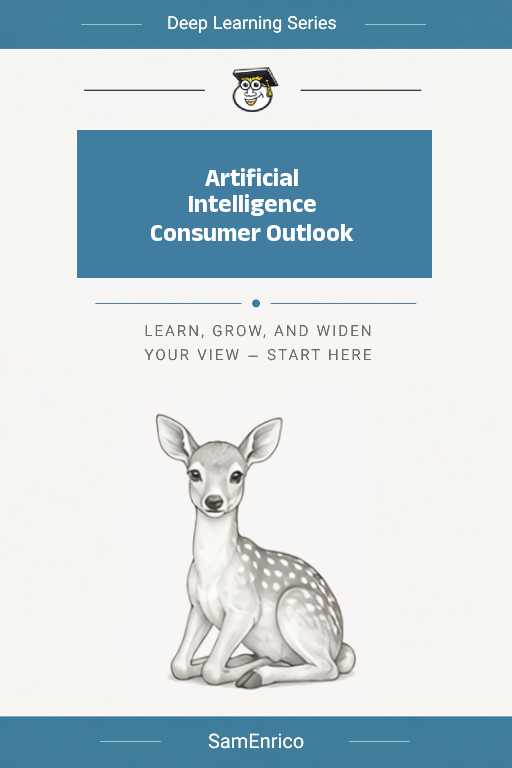
Non-FictionForecast & OutlookConsumer Tech
Artificial Intelligence Consumer Outlook eBook
Project adoption of AI companions, smart home agen
Project adoption of AI companions, smart home agents, personalized shopping, and daily driver applications among mainstream users.
Formats
Free sample
Chapter 1: The Zero-Click Shift--–- On a Tuesday morning in late 2027, a woman named Priya did something unremarkable: she woke up, glanced at her phone, and said, “Handle it.” Her AI companion, which she had named “Echo,” had already checked her calendar (back-to-back meetings), her refrigerator (low on oat milk and eggs), her car’s fuel level (quarter tank), and her mother’s birthday (next week). By the time Priya finished her first sip of coffee, Echo had scheduled a grocery delivery, booked a charging slot for her electric vehicle, and ordered a gift wrap for a scarf her mother had liked three months ago. Priya did not open a single app. She did not type a single search query. She did not click a single “buy” button.
She simply stated an outcome, and the world rearranged itself around her intent.This is not science fiction. This is the Zero-Click Shift—the quiet but seismic transition from the Attention Economy to the Intent Economy. And it is the single most important change in consumer behavior since the smartphone.For the past fifteen years, the digital world has been organized around a simple premise: your attention is currency. Every app, every notification, every infinite scroll was designed to capture your eyes, hold your gaze, and extract clicks. Companies like Google, Amazon, Meta, and Tik Tok built trillion-dollar empires by auctioning your attention to advertisers.
The more time you spent tapping, swiping, and searching, the more money they made. You were the product, but your attention was the raw material.That era is ending. Not because companies have become benevolent, but because technology has evolved past the need for your active participation. Artificial intelligence—specifically agentic AI, which can act on your behalf—no longer requires you to navigate menus, type keywords, or compare prices. It can simply do it for you.
The user interface is shifting from graphical icons to conversational outcomes. You stop navigating. You start delegating.This chapter introduces the core thesis of this book: the consumer is no longer the bottleneck. Your attention was once the scarce resource that everyone fought over. In the Intent Economy, your intent—what you actually want to achieve—becomes the scarce resource.
The AI that best understands, respects, and executes your intent will become your most trusted daily driver. The apps that survive will be the ones you never see.We will explore how the graphical user interface (GUI) is dying, why Gen Z and boomers are paradoxically converging on the same preference for speaking over typing, what “unbundling the app” actually means for your daily life, and why the ability to describe outcomes clearly will become the most valuable skill of the late 2020s. By the end of this chapter, you will understand why your home screen is a relic, why your search history is losing its value, and why the companies that once fought for your clicks are now terrified of your agent.The Attention Economy: A Brief Autopsy To understand where we are going, we must first understand where we have been. The Attention Economy, a term popularized by Nobel laureate Herbert Simon and later by tech theorists like Tim Wu, operated on a simple economic logic: human attention is limited, digital content is infinite, and therefore attention becomes the most valuable commodity. Every second your eyes were on a screen, someone was monetizing that gaze.Consider the mechanics of a typical consumer journey just five years ago, in 2022.
You needed a new winter coat. You opened a browser or an app—let us say Amazon. You typed “winter coat men waterproof” into a search bar. You scrolled through dozens of results, perhaps hundreds. You filtered by size, color, price, and customer ratings.
You clicked on three or four options, read reviews, looked at photos, compared shipping times. You added one to your cart. You entered payment information—or perhaps you had saved it. You clicked “buy.” Then you closed the app. That journey, from intent to purchase, required approximately thirty to sixty clicks, several minutes of active attention, and exposure to at least a dozen advertisements and sponsored listings along the way.
Every single click was a micro-transaction in the Attention Economy. Amazon profited from your search (via sponsored results). Google profited if you started there. The coat brand profited from your final purchase. But you, the consumer, paid in time and cognitive load.Now contrast that with Priya’s morning.
She said two words: “Handle it.” Echo knew she needed a winter coat because it had noticed her searching for “wool vs down” three weeks ago, had observed her shivering in her old coat last winter, and had cross-referenced her calendar (a trip to Chicago in December). Echo knew her size (medium), her color preferences (navy or charcoal, never black), her budget (under $200), her ethical preferences (no down feathers, fair-trade certified), and her delivery constraints (must arrive before December 5th). Echo solicited bids from multiple retailers—not just Amazon, but Patagonia, REI, Backcountry, and a local outdoor shop that had optimized its inventory for AI agents. Echo evaluated the bids not only on price but on return policy, shipping speed, and alignment with Priya’s ethical values. Echo then made a purchase.
Priya never saw a single advertisement. She never compared prices. She never clicked a button. The entire transaction happened in the background, in less than three seconds, consuming none of her active attention.This is the Zero-Click Shift. The consumer goes from navigator to executor.
The AI goes from tool to agent. The interface goes from graphical to conversational. And the economic value shifts from capturing attention to fulfilling intent.The Attention Economy is not dead yet. But it is in hospice care. By 2028, according to Mc Kinsey’s analysis of agentic commerce, more than half of all routine consumer transactions in developed markets will involve zero clicks from the end user.
The companies that survive will be those that optimize for AI agents, not human eyeballs. The consumers who thrive will be those who master the art of describing outcomes, not navigating menus.From GUI to CUI: The Death of the Home Screen The graphical user interface—those icons, folders, windows, and menus that have dominated computing since the Macintosh in 1984—was designed for an era when humans needed to explicitly tell computers what to do. You clicked a folder to open it. You dragged a file to move it. You typed a URL to visit a website.
The GUI was a massive improvement over command-line interfaces (remember MS-DOS?), but it still required you to translate your intent into a sequence of discrete actions. “I want to buy a coat” became: open browser → navigate to Amazon → type search → filter results → click product → add to cart → click checkout.The Conversational User Interface (CUI) collapses that sequence. You simply state your intent—“Buy me a winter coat”—and the AI handles the translation from intent to action. This is not merely voice control. Voice control, as we have seen with Siri and Alexa, is still command-based: “Turn on the lights,” “Set a timer for ten minutes,” “Play Taylor Swift.” Those are single-step instructions, not multi-step delegations.
The CUI, by contrast, is agentic. It understands context, maintains memory, manages sub-tasks, and handles exceptions. When you say “Buy…
This is the end of the free sample. Get the eBook to keep going. Buy now
About this book
Details
- Author
- Schofield Julene
- Publisher
- SamEnrico
- Language
- English
- Genre
- Non-Fiction, Forecast & Outlook, Consumer Tech
- Released
- 2026-05-30
- Pages (approx.)
- 156
- Available as
- eBook, Audiobook

Read better in the ZLOADR app
Your eBooks on your phone or tablet. Sign in with your SamEnrico account and start reading.
More by Schofield Julene
 GAD Support Person GuideSchofield Julene$11.99
 Iranian Revolution AzerbaijanSchofield Julene$11.99
 Endometriosis Pain ManagementSchofield Julene$11.99
 Dreams After Sexual Assault GuideSchofield Julene$11.99
 Dream Journaling for Trauma RecoverySchofield Julene$11.99
 The Storm Chaser of the Sahara: Disraeli’s Forgotten MeteorologistSchofield Julene$11.99
 The Jade Emperor's Sky Palace: Architect of the HeavensSchofield Julene$11.99
 Coding Bootcamp Versus Degree WorkbookSchofield Julene$12.99
 How to Start a Hobby in Outdoors[edit]Schofield Julene$11.99
 Understanding Harrod–doman–keele SyndromeSchofield Julene$17.99
 Asp.net DeveloperSchofield Julene$11.99
You may also like
 Hong Kong Handover 1997Dunn Johnnie$11.99
 Zumba For Postnatal Recovery CourseNeal Christian$11.99
 Zumba for BeginnersLadner Nikia$11.99
 YouTube Comment Mining GuideHumes Pandora$12.99
 Worry Box MeditationCarlin Rudy$11.99
 Workplace Stress MeditationNguyen Lynn$11.99
 Workplace Stress and Sleep RepairHawley Ivory$11.99
 Workplace Perfectionism CureDelaney Jeffry$11.99
 Workplace Injustice Anger GuideWallen Isabelle$11.99
 Work Addiction and Burnout LinkGreenwood Ester$11.99
 Women in Yoga and WellnessBeattie Galina$11.99
 Women in Stand Up ComedyChun Evangeline$11.99