
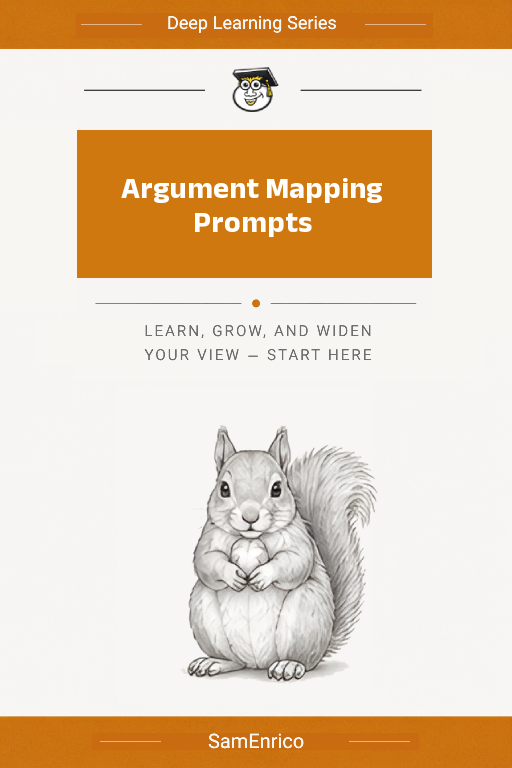
Non-FictionStudent's ShortcutCritical Thinking
Argument Mapping Prompts
Visualize and structure complex arguments using GP
Visualize and structure complex arguments using GPT prompts that identify premises, conclusions, and logical gaps.
Formats
About this book
Free sample
Chapter 1: The Logic Trap--–- Every morning, you wake up ready to be right. You scroll through social media, nod along with news anchors who share your views, and dismiss opposing opinions with a flick of your thumb. By noon, you've likely made a dozen confident judgments: your colleague's proposal is flawed, that advertisement is manipulative, your partner's excuse is weak, the politician's promise is empty. You feel sharp. You feel rational.
You are almost certainly wrong about half of it—and you'll never know which half.This is not a moral failing. It is a cognitive design flaw. Your brain evolved to survive, not to reason. It prioritizes speed over accuracy, social cohesion over truth, and narrative coherence over logical consistency. The result is a paradox that has haunted philosophers from Socrates to Kahneman: human beings are excellent at having arguments but spectacularly poor at evaluating their own arguments.This chapter exposes the three cognitive traps that make you vulnerable to bad reasoning, introduces the only proven solution—externalization through argument mapping—and explains why GPT has suddenly transformed this ancient discipline from a tedious academic exercise into a superpower available to anyone with a keyboard.The Invisible Blind Spot Let me tell you a story.
In 2017, a team of surgeons at a prominent teaching hospital reviewed their own diagnostic decisions over the previous six months. They were confident, experienced, and board-certified. When shown cases they had personally handled, they rated their own reasoning as "sound" or "excellent" in 94 percent of cases. Then the researchers performed an independent audit. The actual correct diagnosis rate?
Sixty-two percent.The surgeons were not incompetent. They were blind to their own gaps. Every single misdiagnosis followed a pattern: the surgeon had latched onto an early assumption (the patient had a common condition) and then selectively noticed evidence that confirmed that assumption while ignoring or reinterpreting contradictory evidence. This is confirmation bias in its purest form, and it operates in your brain right now, whether you are diagnosing a patient, evaluating a job candidate, or arguing about politics at dinner.Here is the deeper problem. You…
This is the end of the free sample. Get the eBook to keep going. Buy now
Contents
- Chapter 1
- Chapter 2
- Chapter 3
- Chapter 4
- Chapter 5
- Chapter 6
- Chapter 7
- Chapter 8
- Chapter 9
- Chapter 10
- Chapter 11
- Chapter 12
Details
- Author
- Sanford Quentin
- Publisher
- SamEnrico
- Language
- English
- Genre
- Non-Fiction, Student's Shortcut, Critical Thinking
- Released
- 2026-05-30
- Pages (approx.)
- 140
- Available as
- eBook, Audiobook

Read better in the ZLOADR app
Your eBooks on your phone or tablet. Sign in with your SamEnrico account and start reading.
More by Sanford Quentin
 C Section Recovery HandbookSanford Quentin$11.99
 Hospitality Brand MappingSanford Quentin$11.99
 Pick Path Optimization AISanford Quentin$11.99
 Alzheimer Anticipatory GriefSanford Quentin$11.99
 The Metabolic Adaptation for Personal TrainersSanford Quentin$11.99
 Stealing Child Parent AngerSanford Quentin$11.99
 Creative Constraints WorkbookSanford Quentin$11.99
 Boundary Setting for CaregiversSanford Quentin$11.99
 The Sky Pioneers: Black Engineers Who Built the FutureSanford Quentin$11.99
 The Forgotten Goddess: Serket’s Venom and VengeanceSanford Quentin$11.99
 How to Produce Outfit SetsSanford Quentin$11.99
 How to Become a Bar ExaminerSanford Quentin$11.99
You may also like
 Hong Kong Handover 1997Dunn Johnnie$11.99
 Zumba For Postnatal Recovery CourseNeal Christian$11.99
 Zumba for BeginnersLadner Nikia$11.99
 YouTube Comment Mining GuideHumes Pandora$12.99
 Worry Box MeditationCarlin Rudy$11.99
 Workplace Stress MeditationNguyen Lynn$11.99
 Workplace Stress and Sleep RepairHawley Ivory$11.99
 Workplace Perfectionism CureDelaney Jeffry$11.99
 Workplace Injustice Anger GuideWallen Isabelle$11.99
 Work Addiction and Burnout LinkGreenwood Ester$11.99
 Women in Yoga and WellnessBeattie Galina$11.99
 Women in Stand Up ComedyChun Evangeline$11.99