
Non-FictionInformativeEducational
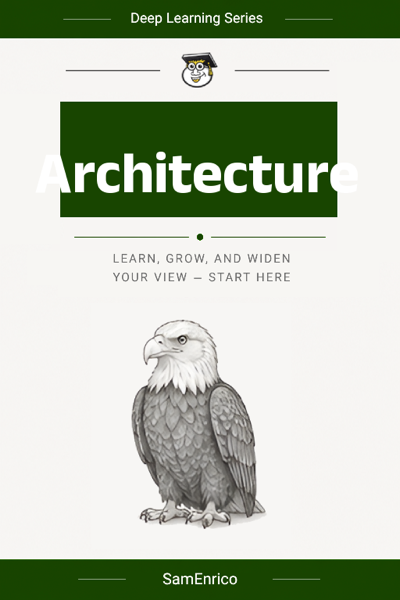
Architecture eBook
A Coursebook on Architecture
A Coursebook on Architecture
Formats
Free sample
Chapter 1: The Elephant in the Room--–- Imagine you are standing in a dark room. In front of you is something enormous, alive, and impossibly complex. You reach out your hands and touch one small part of it—a warm, leathery curve. “An elephant,” you say with confidence. But someone else across the room touches a different part—a sharp, ivory protrusion.
“A spear,” they declare. A third person, standing near the back, touches a thick, swinging rope. “A snake,” they insist. Each of you is certain. Each of you is wrong.
And yet each of you is holding onto a piece of the truth.This ancient parable, attributed to the Sufi poet Rumi and found in various forms across Buddhist, Hindu, and Jain traditions, is not merely a fable about perception. It is the foundational problem of architecture. The elephant is every complex system you will ever design, inhabit, or maintain. The blind men are the specialists—the structural engineer who sees only load paths, the software developer who sees only code, the CFO who sees only budget, the user who sees only their own frustration or delight, the regulator who sees only compliance, the community member who sees only displacement or belonging. Each specialist knows their part intimately.
None sees the whole. And the architect’s job is not to be yet another blind man insisting on a different part. The architect’s job is to see the elephant.The word “architecture” is among the most promiscuous in the English language. It is used to describe cathedrals and computer networks, corporate strategies and city plans, databases and democracies. A quick search of any bookstore or library reveals titles like The Architecture of Happiness, Enterprise Architecture as Strategy, Software Architecture in Practice, The Architecture of Light, and The Architecture of the Mind.
This profusion is not mere sloppiness. It is a signal that something fundamental unites these disparate domains. That something is the intentional design of systems to manage complexity and serve human purpose. But before we can explore that unity, we must first confront the terrifying responsibility it implies: the architect is the one person in the room who cannot afford to be a specialist.This chapter dismantles the siloed definitions of architecture—buildings versus software versus business processes—to reveal a universal core. It introduces the three-part definition that will constrain and guide the entire book.
It establishes the Vitruvian triad as an organizing framework, not a historical curiosity. It names the first of two dilemmas that every architect faces. And it closes by defining systems thinking not as an abstract ideal but as the specific, trainable skill of holding the whole elephant in your mind while your hands touch only one part.What This Book Means by “Architecture”Before we proceed, we must be ruthlessly clear about what the word means in these pages. If architecture can mean everything, it means nothing. The term has been stretched so thin by metaphorical usage that it now covers everything from planetary geology (“the architecture of a mountain range”) to the arrangement of living rooms (“the architecture of a cozy home”).
This book is not about geology or coziness. It is about designed systems.Architecture, as defined in this book, requires three elements: (1) intentional design, (2) a system of interconnected parts, and (3) a stakeholder whose behavior or well-being is affected by the system.Let us examine each element in turn.Intentional design excludes random or purely natural phenomena. A beehive is not architecture by this definition—bees did not intend it; they followed instinct. A rock formation shaped by millennia of wind and water is not architecture. But a building designed by an architect, a software system designed by an engineer, a legal code designed by legislators, a supply chain designed by logisticians—these qualify because someone made deliberate choices among alternatives.
Intention does not require omniscience or perfection; it requires agency. The architect could have done otherwise and chose this.A system of interconnected parts excludes solitary objects. A standalone sculpture in an empty field is not architecture. A single line of code that does nothing is not architecture. A law that applies to no one is not architecture.
Architecture emerges from relationships between components—load-bearing walls connected to foundations, microservices connected by APIs, regulations connected to enforcement mechanisms, supply chain nodes connected by shipping routes. Remove the connections, and you have a pile of parts, not a system.A stakeholder excludes systems that affect no one. A thought experiment about a closed system with no observers, no users, no inhabitants, no downstream effects—that is mathematics, not architecture. Architecture is always for someone. That someone may be a building occupant, a software user, a citizen subject to a law, a worker in a supply chain, or even a non-human entity like a river affected by a dam or a forest affected by zoning.
But if no stakeholder exists, there is no architecture—only abstract pattern-making.Apply this definition to common examples. A Roman aqueduct qualifies: it was intentionally designed, it has interconnected channels and arches and sluices, and it affects the water-dependent citizens of the empire. A software API qualifies: intentional endpoints and contracts, interconnected services and data flows, and developers as stakeholders. A credit score qualifies: intentionally designed algorithms (not natural phenomena), interconnected data sources and scoring models, and borrowers as stakeholders. A random pile of stones fails all three.
A standalone sculpture in a museum fails the second (no system of parts) unless it is part of a larger installation. A mathematical proof with no application fails the third.This boundary definition is not gatekeeping. It is precision. It allows us to compare a cathedral, a cloud computing platform, and a zoning ordinance without category error. All three meet the definition.
All three can be analyzed with the same tools. All three require the same architectural mindset. And all three will appear in the chapters ahead.The Vitruvian Triad: An Ancient Framework for Modern Problems Around 30 BCE, the Roman architect and engineer Marcus Vitruvius Pollio wrote De architectura, the only surviving major work on architecture from classical antiquity. In it, he proposed that all good architecture embodies three qualities: Firmitas, Utilitas, Venustas—Strength, Utility, Beauty. For two thousand years, these three words have haunted and inspired architects.
They are deceptively simple. They are maddeningly vague. And they are, for the purposes of this book, the organizing framework for everything that follows.Firmitas—Strength—is the quality of durability, resilience, and robustness. A building must stand up. A software system must not crash under load.
A supply chain must survive a port closure. A legal code must resist arbitrary reinterpretation. In modern architectural discourse, Firmitas maps to what engineers call “non-functional requirements” or “quality attributes”: scalability, resilience, maintainability, security, performance. These are the “-ilities” that determine whether a system survives contact with reality. Chapter 4 will explore them in depth.Utilitas—Utility—is the quality of usefulness, functionality, and fit to purpose.
A building must shelter its occupants. A software system must perform its intended tasks. A supply chain must deliver goods. A legal code must regulate behavior effectively. But utility goes deeper than mere function.
A knife can cut; that is its utility. But a knife that is uncomfortable to hold, or that requires complex…
This is the end of the free sample. Get the eBook to keep going. Buy now
About this book
Details
- Author
- Wingfield Roseanna
- Publisher
- SamEnrico
- Language
- English
- Genre
- Non-Fiction, Informative, Educational
- Released
- 2026-06-03
- Pages (approx.)
- 158
- Available as
- eBook, Audiobook

Read better in the ZLOADR app
Your eBooks on your phone or tablet. Sign in with your SamEnrico account and start reading.
More by Wingfield Roseanna
 Road Rage And Performance CarsWingfield Roseanna$11.99
 Spinning Top MeditationWingfield Roseanna$11.99
 The Catholic Pulpit Counter AttackWingfield Roseanna$11.99
 Journaling Through DivorceWingfield Roseanna$11.99
 Assertiveness for Physical TherapistsWingfield Roseanna$11.99
 The Whispering Coach: How a Maori Warrior Shaped Pacific Rowing (1789)Wingfield Roseanna$11.99
 Understanding Pili CanulatiWingfield Roseanna$17.99
 JEE Stress and Anxiety ManagementWingfield Roseanna$12.99
 VA English Assessment GuideWingfield Roseanna$12.99
 How to Start a Optical Positioning Equipment Business (Beginners Guide)Wingfield Roseanna$11.99
You may also like
 Hong Kong Handover 1997Dunn Johnnie$11.99
 Zumba For Postnatal Recovery CourseNeal Christian$11.99
 Zumba for BeginnersLadner Nikia$11.99
 YouTube Comment Mining GuideHumes Pandora$12.99
 Worry Box MeditationCarlin Rudy$11.99
 Workplace Stress MeditationNguyen Lynn$11.99
 Workplace Stress and Sleep RepairHawley Ivory$11.99
 Workplace Perfectionism CureDelaney Jeffry$11.99
 Workplace Injustice Anger GuideWallen Isabelle$11.99
 Work Addiction and Burnout LinkGreenwood Ester$11.99
 Women in Yoga and WellnessBeattie Galina$11.99
 Women in Stand Up ComedyChun Evangeline$11.99