
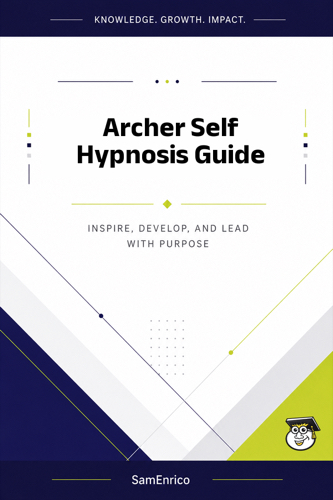
Archer Self Hypnosis Guide eBook
Achieves focus and releases tension for perfect sh
Achieves focus and releases tension for perfect shots.
Formats
Free sample
Chapter 1: The Gatekeeper’s Trap--–- The arrow leaves the bow at roughly 200 feet per second. By the time the sound of the release reaches your ears, the arrow has already traveled halfway to the target. In that sliver of time—approximately 0.3 seconds—nothing you consciously decide will change where that arrow lands. The shot is over before you know it went wrong.Yet here is the paradox that ruins more archery careers than any physical flaw: most archers spend those 0.3 seconds thinking. They think about their elbow.
They think about the clicker. They think about the last shot that missed. They think about the score. And in that storm of conscious interference, they guarantee the very outcome they are trying to prevent.This chapter is not about hypnosis. Not yet.
Before you learn to enter the Archer’s Trance, you must first understand why you need it. You must see the enemy clearly. And the enemy is not the target, the wind, the crowd, or your对手 on the shooting line. The enemy is the part of your brain that believes it can help.The Neuroscientist and the Archer Let us begin with a number: 40.That is the approximate number of bits of information per second that your conscious mind can process. It is the bandwidth of your inner voice, your analytical thoughts, your running commentary on every shot.
Forty bits is enough to tie your shoes, remember a phone number, or decide which lane to drive in. It is not enough to execute a technically perfect archery shot.Now consider another number: 11,000,000.That is the approximate number of bits per second that your subconscious motor system processes. This system handles proprioception (where your joints are in space), kinesthetic feedback (how much tension each muscle is exerting), vestibular input (your balance), visual tracking, and a hundred other variables you have never consciously named. It runs the show while you think you are in charge.Here is the problem that destroys otherwise talented archers: when you consciously think “keep your elbow high” or “release cleanly at the clicker,” you are forcing a 40-bit processor to override an 11-million-bit system. That is like trying to steer an aircraft carrier with a rowboat’s rudder while the carrier’s own navigation computer is screaming at you to let go.The result is not better control.
The result is jerky hesitation, micro-flinches, target panic, and the bizarre experience of having your hand freeze at full draw while your brain screams “RELEASE!”This phenomenon has many names in sports psychology: paralysis by analysis, conscious interference, the yips, choking. In archery, we often call it target panic. But regardless of the label, the mechanism is the same. Your conscious mind, which evolved to solve problems and plan for the future, has hijacked a task that requires automaticity.The Myth of the “Thinking Athlete”We have been taught a lie. From youth sports to Olympic training centers, the dominant culture praises the “thinking athlete”—the one who can analyze their form mid-performance, make corrections on the fly, and outsmart their opponent through sheer willpower.
Coaches shout technical corrections from the sidelines. Sport psychologists teach visualization and positive self-talk. Parents remind their children to “focus” and “try harder.”All of this advice, delivered with the best intentions, is structurally identical to the neural sabotage described above.Consider the basketball player at the free-throw line. A free throw takes about one second from the start of the motion to the release of the ball. In that second, the conscious mind cannot possibly calculate the exact angle of the elbow, the rotation of the wrist, the arc of the ball, and the distance to the rim.
Yet the subconscious motor system can do all of this and more, drawing on thousands of previous free throws stored in procedural memory.The player who thinks “bend the knees, follow through, wrist snap” is not helping their body. They are interrupting the automated program. They are guaranteeing a clunky, mechanical shot that misses long or short. The player who steps to the line, takes a breath, and lets their body do what it has done ten thousand times before will make the shot more often.The same is true in archery. The perfect shot does not feel like effortful control.
It feels like effortless release. It feels like the bow is shooting itself and you are just watching. That feeling is not mystical. It is neurological. It is the feeling of the conscious mind stepping aside and letting the 11-million-bit processor do its job.The Misunderstood Brain: A Brief Tour To understand why self-hypnosis works, you need a simple map of the brain.
We will keep this painless—no medical school required.Imagine your brain as a building with three floors.The ground floor is the brainstem and cerebellum. This is the oldest part of your brain, evolutionarily speaking. It handles breathing, heart rate, balance, and basic motor coordination. You do not need to think about these things. If you did, you would never fall asleep.The middle floor is the limbic system, which includes the amygdala (fear and emotion), the hippocampus (memory), and the basal ganglia (habit formation and procedural learning).
This floor is where your subconscious shot program lives. It is also where the emotional charge of a bad shot—the frustration, the embarrassment, the fear—gets stored.The top floor is the neocortex, specifically the prefrontal cortex. This is the “conscious mind.” It is the newest part of the brain, evolutionarily speaking. It is responsible for language, planning, abstract reasoning, and self-awareness. It is also the slowest part of the brain.Here is the critical insight for archers: the top floor (conscious mind) cannot directly control the middle floor (subconscious habits) any more than a CEO can directly control every assembly line worker in a factory.
The CEO can set the goal, provide the resources, and then get out of the way. If the CEO runs down to the factory floor and starts trying to tighten every bolt, production stops.Target panic is what happens when the CEO runs down to the factory floor.Redefining Target Panic: Not Fear, But Conflict Almost every archer who has struggled with target panic has been told the same thing: “You’re afraid of the target. You need to get over your fear.” This advice is not merely unhelpful; it is wrong about the mechanism.Target panic is not primarily a fear response. Yes, fear may be present. Yes, the amygdala (the brain’s alarm system) may be activated.
But the core of target panic is a neurological conflict between the conscious mind and the subconscious release reflex.Let me explain.The release reflex is a beautiful piece of neural engineering. In a healthy archer, the shot cycle proceeds automatically: draw, anchor, expand, and at the precise moment of full expansion (often signaled by the clicker), the subconscious releases the string. The conscious mind is barely involved. It sets the intention—”shoot this arrow”—and then steps back.In target panic, the conscious mind, having been burned by past misses or humiliations, refuses to step back. It hovers.
It watches. It second-guesses. And at the moment of release, it does something catastrophic: it interjects a command.Sometimes that command…
This is the end of the free sample. Get the eBook to keep going. Buy now
About this book
Details
- Author
- Holley Florene
- Publisher
- SamEnrico
- Language
- English
- Genre
- Non-Fiction, Self-Help, Archery
- Released
- 2026-06-08
- Pages (approx.)
- 145
- Available as
- eBook, Audiobook

Read better in the ZLOADR app
Your eBooks on your phone or tablet. Sign in with your SamEnrico account and start reading.
More by Holley Florene
 Collaborative Six Thinking HatsHolley Florene$11.99
 Self Hypnosis for Phantom Limb PainHolley Florene$11.99
 Aerophobia Flight Fear GuideHolley Florene$11.99
 Nap Before Interview GuideHolley Florene$11.99
 Canva Font Pairing GuideHolley Florene$11.99
 Acupuncture for Plantar FasciitisHolley Florene$11.99
 Digital Workplace CommunicationHolley Florene$11.99
 The Lion’s Wisdom: The Royal Hunters of the Kingdom of KongoHolley Florene$11.99
 The Baby Farmers of Victorian England: The Dark Trade in InfanticideHolley Florene$11.99
 How to Produce Pinball MachinesHolley Florene$11.99
 South African Business Funding AccessHolley Florene$12.99
 Social Media Audit SheetHolley Florene$12.99
You may also like
 Hong Kong Handover 1997Dunn Johnnie$11.99
 Zumba For Postnatal Recovery CourseNeal Christian$11.99
 Zumba for BeginnersLadner Nikia$11.99
 YouTube Comment Mining GuideHumes Pandora$12.99
 Worry Box MeditationCarlin Rudy$11.99
 Workplace Stress MeditationNguyen Lynn$11.99
 Workplace Stress and Sleep RepairHawley Ivory$11.99
 Workplace Perfectionism CureDelaney Jeffry$11.99
 Workplace Injustice Anger GuideWallen Isabelle$11.99
 Work Addiction and Burnout LinkGreenwood Ester$11.99
 Women in Yoga and WellnessBeattie Galina$11.99
 Women in Stand Up ComedyChun Evangeline$11.99