
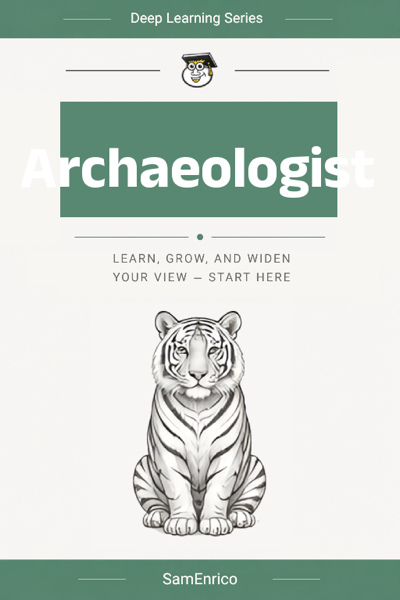
Non-FictionInformativeEducational
Archaeologist eBook
A Coursebook on Archaeologist
A Coursebook on Archaeologist
Formats
Free sample
Chapter 1: Dust, Not Gold--–- The first time I watched a student quit archaeology, she was sitting on an upturned bucket in the rain, trying to peel apart two fragments of waterlogged medieval pottery that had cemented themselves together over six hundred years. Her trowel was muddy. Her back ached. She had not showered in four days. And somewhere behind her, buried in a trench that had produced nothing but sheep bones and roof tiles for two straight weeks, was the stone foundation wall she had been promised would be "spectacular." She looked up at me—I was the site supervisor that season—and said, "I thought we would find gold."I told her the truth.
We never find gold. Or rather, we almost never find gold, and when we do, the gold is the least interesting part of the story. What we find is dust. We find broken pottery, rusted nails, charred seeds, fish bones, ash stains, and the collapsed rubble of houses that ordinary people lived in a thousand years ago. We find the debris of everyday life, because that is what the past mostly was: everyday life.
The student quit the next morning. She was not wrong to quit. She had been sold a version of archaeology that did not exist, and I cannot blame her for not wanting the version that does.This chapter is about that gap. It is about the chasm between what popular culture promises archaeology will be and what archaeology actually is. It is also about why the real thing, once you learn to see it, is far more rewarding than any fantasy of golden idols and booby traps.
If you are reading this book because you want to become an archaeologist, you need to know what you are signing up for. The chapters that follow will teach you how to survey, excavate, process, date, theorize, and find work. But this first chapter is the gate. Walk through it only if you are willing to trade the dream of treasure for the reality of dust.The Three Great Myths of Popular Archaeology Let us begin by naming the enemy. Popular culture has fed the public—and by extension, you—three enduring myths about what archaeologists do and who they are.
These myths appear in films, novels, video games, and even some museum exhibits. They are seductive. They are also catastrophically wrong.Myth One: Archaeology Is About Finding Valuable Objects The single most damaging idea in popular archaeology is that the goal of excavation is to recover things that are beautiful, rare, or expensive. This is the treasure-hunting model. In this model, a dig is successful if it produces gold, jewels, intact vases, or "museum-quality" pieces.
Everything else—the broken stuff, the common stuff, the stuff that is not photogenic—is either ignored or thrown away.Real archaeology works in exactly the opposite direction. The most valuable thing you can find in an excavation is not the golden idol. It is the context sheet. It is the plan drawing. It is the soil sample.
It is the record of exactly where every single artifact was found in relation to every other artifact. A golden idol ripped out of a grave and dropped into a pocket has lost almost all of its scientific value. It becomes an object of aesthetic interest only. But a broken piece of cooking pot, found in situ, with its association recorded, its surrounding soil sampled for phytoliths, and its position mapped relative to a hearth and a posthole—that broken sherd can tell you about diet, technology, trade networks, social organization, and even gender roles. The archaeologist does not seek beauty.
The archaeologist seeks information. And information is not found in the gleaming object. It is found in the matrix, the associations, the three-dimensional web of relationships that excavation inevitably destroys in order to document.This is why real archaeologists cringe when news headlines announce "Treasure Hoard Found!" We know that the word "treasure" signals a framing we cannot accept. A hoard of coins is not treasure. It is a deliberate deposit of wealth, probably buried for safekeeping and never recovered, and its scientific value lies entirely in its composition (which tells you about the economy), its location (which tells you about property and landscape use), and its association with other features (which might tell you about ritual practice).
Calling it treasure invites the public to see it as a collection of valuable objects rather than a dataset. And that invitation leads directly to looting.Myth Two: Archaeologists Are Lone Adventurers The second myth is the Indiana Jones figure: the solo hero, armed with intellect and daring, who outwits rivals, dodges traps, and single-handedly uncovers lost civilizations. This is fantasy. But the deeper problem is not the action sequences. It is the individualism.Real archaeology is relentlessly social.
A single excavation project—let us take a typical summer field school as an example—might involve: one project director (a professor or senior archaeologist with a Ph D), two or three field supervisors (graduate students or contract archaeologists with years of experience), six to twelve field school students (you, for the first time), a lab director (who processes artifacts back at the base), a geophysicist (who runs the GPR and magnetometer), a surveyor (who handles the total station and GPS), a conservator (who treats fragile materials as they come out of the ground), and a rotating cast of specialists who visit for a few days to sample for flotation, take soil cores, or examine bone. That is easily fifteen to twenty people for a modest excavation. Large projects at major sites like Çatalhöyük in Turkey or Pompeii in Italy employ hundreds of people from dozens of countries.No one person can do all of this. The skills required are simply too many and too specialized. The person who is brilliant at identifying medieval pottery may be useless with a total station.
The person who can read stratigraphy like a book may not know how to conserve waterlogged wood. The person who can raise funding and manage permits may never have held a trowel. Archaeology is a team sport, and the most successful archaeologists are not the loudest or the most charismatic. They are the ones who can collaborate, delegate, and trust other people’s expertise.There is another dimension to this myth that is worth naming explicitly. The lone adventurer archetype is almost always male, almost always white, and almost always Western.
He descends upon a foreign country (usually Egypt, Peru, or somewhere in Southeast Asia), ignores local expertise, takes what he wants, and leaves. This is not just bad archaeology. It is colonialism. The real history of archaeology is deeply entangled with imperialism, and one of the great projects of twenty-first-century archaeology is to untangle that relationship—to center local voices, to repatriate stolen heritage, and to acknowledge that the people whose ancestors we study have the right to tell their own stories. We will return to this theme throughout the book, particularly in Chapter 8 and Chapter 10.
For now, simply note: the lone adventurer is not a hero. He is a problem.Myth Three: The Past Is a…
This is the end of the free sample. Get the eBook to keep going. Buy now
About this book
Details
- Author
- Vanover Dottie
- Publisher
- SamEnrico
- Language
- English
- Genre
- Non-Fiction, Informative, Educational
- Released
- 2026-06-02
- Pages (approx.)
- 143
- Available as
- eBook, Audiobook

Read better in the ZLOADR app
Your eBooks on your phone or tablet. Sign in with your SamEnrico account and start reading.
More by Vanover Dottie
 The Workaholic Identity WorkbookVanover Dottie$11.99
 Stress and Irritable Bowel SyndromeVanover Dottie$11.99
 Empathy for Aging ParentsVanover Dottie$11.99
 Kingdom Italy Napoleonic GuideVanover Dottie$11.99
 The Battle of Telamon: Rome’s First Great VictoryVanover Dottie$11.99
 London to Lagos Shipping GuideVanover Dottie$12.99
 How to Start a Bone Reconstruction Cements Business (Beginners Guide)Vanover Dottie$11.99
 How to Produce Ball Pit AccessoriesVanover Dottie$11.99
You may also like
 Hong Kong Handover 1997Dunn Johnnie$11.99
 Zumba For Postnatal Recovery CourseNeal Christian$11.99
 Zumba for BeginnersLadner Nikia$11.99
 YouTube Comment Mining GuideHumes Pandora$12.99
 Worry Box MeditationCarlin Rudy$11.99
 Workplace Stress MeditationNguyen Lynn$11.99
 Workplace Stress and Sleep RepairHawley Ivory$11.99
 Workplace Perfectionism CureDelaney Jeffry$11.99
 Workplace Injustice Anger GuideWallen Isabelle$11.99
 Work Addiction and Burnout LinkGreenwood Ester$11.99
 Women in Yoga and WellnessBeattie Galina$11.99
 Women in Stand Up ComedyChun Evangeline$11.99