
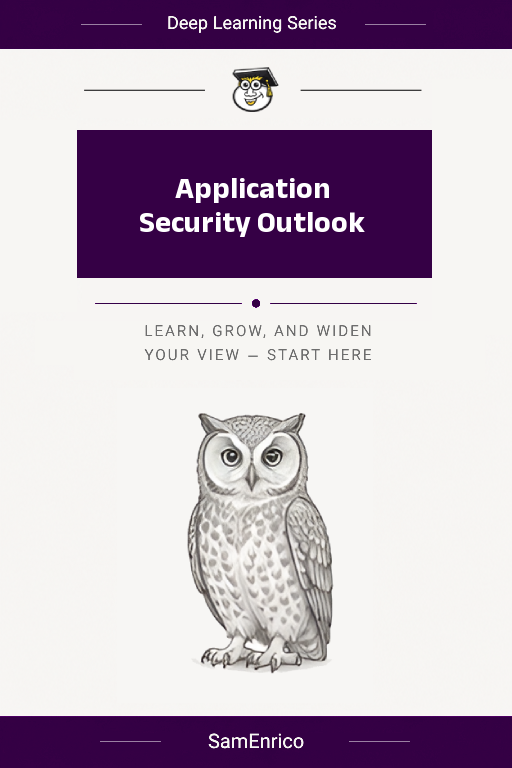
Non-FictionForecast & OutlookAppSec
Application Security Outlook eBook
Project DevSecOps integration, SAST/DAST adoption,
by Brantley Pei
Project DevSecOps integration, SAST/DAST adoption, software composition analysis, and runtime protection through 2030.
Formats
Free sample
Chapter 1: The Dashboard of Shame...--–- Maya’s Monday morning started like every other Monday morning for the past eighteen months: with four cups of coffee, a deep sigh, and the slow, dreadful realization that she was about to lose four hours of her life to what she privately called The Dashboard of Shame.The name wasn't dramatic. It was clinical. The dashboard—actually seven separate dashboards, each with its own login, its own color scheme, its own vocabulary for describing risk, and its own way of making her feel like she was failing—was shameful not because of what it revealed about the company's security posture, but because of what it revealed about the industry. Fifteen years into the Application Security revolution, and she was still stitching together alerts from a static analysis tool that flagged 1,200 issues (980 of which were false positives), a dynamic scanner that crashed every third run, a software composition tool that listed 400 open-source dependencies (three with known critical vulnerabilities), a cloud workload protector that was configured incorrectly, an API security scanner she'd forgotten the purpose of, a runtime protection agent that had been in "monitor only" mode for six months, and a separate dashboard for compliance reporting that duplicated data from all the others.Three thousand four hundred and twelve alerts. That was the count at 9:17 AM.
By 1:00 PM, after four hours of triage, she had found exactly two real vulnerabilities. Both were low severity. Both were already documented in the backlog.She closed her laptop, walked to the window of her tenth-floor office, and asked herself the question she'd been avoiding for six months: Why am I still doing this?This chapter is for everyone who has asked themselves that same question. It is for the security engineer who spends more time logging into tools than fixing vulnerabilities. It is for the CISO who sees a thirty percent annual turnover rate in the App Sec team and blames "burnout" instead of admitting the real cause: you have built a system that is designed to fail.
And it is for the developer who has stopped responding to security tickets because the signal-to-noise ratio is so abysmal that ignoring everything has become a rational survival strategy.The era of buying separate point solutions for SAST, DAST, SCA, RASP, CWPP, API security, and every other acronym in the alphabet is ending. Not because the vendors are bad. Not because the technology doesn't work. But because the human being sitting in front of seven screens cannot do the job you are asking them to do.The Math of Madness Let us begin with a simple calculation. A typical enterprise App Sec team consists of one security engineer for every sixty developers.
That engineer is responsible for ensuring that all code produced by those sixty developers—hundreds of thousands of lines per month—is free of vulnerabilities that could lead to a breach.The industry's solution to this impossible ratio has been to throw tools at the problem. Lots of tools. A 2025 industry survey found that the average enterprise uses between six and twelve different application security tools. The logic seems sound on the surface: each tool addresses a different layer of the stack. SAST finds code-level flaws.
DAST finds runtime flaws. SCA finds open-source vulnerabilities. IAST finds issues during testing. RASP protects at runtime. API scanners find API-specific flaws.
And so on.But here is the problem that no vendor will tell you: each additional tool does not add linearly to your security coverage. After three tools, each new tool adds exponentially to your operational burden. The reason is simple. Every tool produces alerts. Every alert must be triaged.
Every triaged alert must be prioritized against alerts from other tools. And every prioritized finding must be assigned to a developer who has already learned to ignore security tickets because 80% of them are false positives.The result is what security researcher Tanya Janca has called "alert fatigue's evil twin": not just exhaustion, but learned helplessness. When every tool cries wolf, the security team stops listening. When the security team stops listening, vulnerabilities reach production. When vulnerabilities reach production, breaches happen.Consider the data.
A 2024 analysis of breach reports found that in sixty-three percent of cases, the vulnerability that led to the breach had been detected by at least one security tool prior to the attack. It had been found. It had been logged. It had been assigned a severity score. And then it had been lost in the noise of 3,400 other alerts.Maya's Monday morning was not an outlier.
It was the industry standard.The False Positive Epidemic To understand why point solutions fail, you must understand the false positive problem. Traditional rule-based SAST tools operate on a simple principle: look for patterns that match known vulnerability signatures. An unescaped user input flowing into a database query? Flag it. A hardcoded password?
Flag it. A dangerous function call? Flag it.The problem is that code is not a collection of isolated patterns. Code is context. That unescaped user input might be sanitized three lines later by a function the SAST tool doesn't understand.
That hardcoded password might be a placeholder for a test environment that never reaches production. That dangerous function call might be protected by an authentication check the tool cannot see.The result is a false positive rate of thirty to fifty percent for traditional SAST. That means for every hundred alerts, thirty to fifty are not actually vulnerabilities. They are noise.Now add SCA to the mix. Software composition analysis tools scan your open-source dependencies and compare them against the National Vulnerability Database (NVD).
A dependency with a known CVE gets flagged. But here is the nuance that SCA tools often miss: not every CVE is exploitable in your specific context. That logging library with a theoretical remote code execution vulnerability? It might be used only in a development environment. That JSON parser with a denial-of-service flaw?
Your application might never parse untrusted JSON. The SCA tool doesn't know this. It flags everything.By the time you add DAST (which produces its own set of findings, often overlapping with SAST), IAST (which produces findings only during test execution), and runtime tools (which alert on behavioral anomalies), the noise becomes deafening.A 2025 study of enterprise App Sec teams found that the average security engineer spends forty-two percent of their time on alert triage and validation. That is nearly half of their workweek spent determining whether an alert is real. The remaining fifty-eight percent is split between remediation (actually fixing vulnerabilities), reporting, meetings, and the inevitable fire drills that come from ignoring alerts for too long.Maya's four hours every Monday morning was actually better than average.
She had optimized her triage process over years of practice. But optimization is not a solution. It is a coping mechanism.The Platform Promise The alternative to a collection of point solutions is a unified Application Security Platform. The concept is simple: one platform that integrates SAST, DAST, SCA, IAST, RASP, and API security into a single workflow. One dashboard.
One vulnerability database. One set of remediation workflows. One place where developers go to see what needs fixing.But the platform…
This is the end of the free sample. Get the eBook to keep going. Buy now
About this book
Details
- Author
- Brantley Pei
- Publisher
- SamEnrico
- Language
- English
- Genre
- Non-Fiction, Forecast & Outlook, AppSec
- Released
- 2026-05-29
- Pages (approx.)
- 131
- Available as
- eBook, Audiobook

Read better in the ZLOADR app
Your eBooks on your phone or tablet. Sign in with your SamEnrico account and start reading.
More by Brantley Pei
 The Reform MayorBrantley Pei$11.99
 Desert Explorer Fossil HuntBrantley Pei$11.99
 Inner Child Healing for AddictsBrantley Pei$11.99
 Cerebral Palsy Body Image GuideBrantley Pei$11.99
 The Silk Road Diaries: How a Syrian Baker Brought Hummus to AmericaBrantley Pei$11.99
 The Last Play: How a Forgotten NFL Draft Pick Changed the GameBrantley Pei$11.99
 Understanding Holmes–gang SyndromeBrantley Pei$17.99
 Remote Payroll And Compliance ManualBrantley Pei$12.99
 Merchandising AssociateBrantley Pei$11.99
You may also like
 Hong Kong Handover 1997Dunn Johnnie$11.99
 Zumba For Postnatal Recovery CourseNeal Christian$11.99
 Zumba for BeginnersLadner Nikia$11.99
 YouTube Comment Mining GuideHumes Pandora$12.99
 Worry Box MeditationCarlin Rudy$11.99
 Workplace Stress MeditationNguyen Lynn$11.99
 Workplace Stress and Sleep RepairHawley Ivory$11.99
 Workplace Perfectionism CureDelaney Jeffry$11.99
 Workplace Injustice Anger GuideWallen Isabelle$11.99
 Work Addiction and Burnout LinkGreenwood Ester$11.99
 Women in Yoga and WellnessBeattie Galina$11.99
 Women in Stand Up ComedyChun Evangeline$11.99