
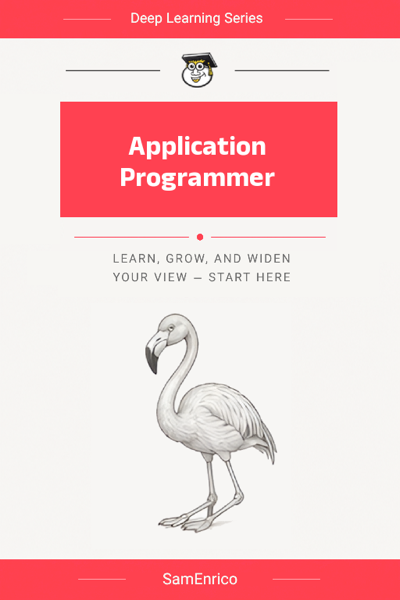
Application Programmer eBook
A Coursebook on Application Programmer
by Hauser Cari
A Coursebook on Application Programmer
Formats
Free sample
Chapter 1: The Cart Before the Code...--Every catastrophic software failure I have ever witnessed began the same way: with a programmer who knew how to write code but had no idea what to write.The scene is painfully familiar. A junior developer—let's call her Maria, though she could be you—sits down at her machine at 9:47 AM on a Tuesday. The coffee is hot. The IDE is open. The ticket in Jira says: "Build a sorting feature for delivery routes." Maria cracks her knuckles.
She knows sorting. She memorized quicksort for her technical interview. She implemented mergesort in her data structures class. By 11:23 AM, she has written a beautiful, efficient, well-tested function that sorts 10,000 delivery addresses by geographic distance from the warehouse in 0.4 seconds.She is proud. She should be proud.
The code is clean. The tests pass. She pushes to Git Hub and opens a pull request.The senior developer, a tired woman named Priya with fifteen years of experience and the thousand-yard stare of someone who has seen this exact mistake one thousand times, leaves a single comment on the pull request:"This is perfect code that solves the wrong problem. The business actually needs routes prioritized by delivery window—medical supplies to pharmacies before noon, then everything else. Distance is irrelevant if the insulin arrives at 3 PM.
Did you talk to the product owner before writing 400 lines of sorting?"Maria spent four hours building the wrong thing correctly.She is not stupid. She is not lazy. She is the victim of the single most pervasive misconception in our industry: that programming is about writing code. It is not. Programming—real, professional, application programming—is about solving human problems within constraints.
The code is merely the medium through which the solution is expressed. A coder writes syntax. An application programmer translates ambiguity into reliability.This book exists because that gap—between writing code and building applications—is where careers stall, projects fail, and developers burn out. The top ten bestselling programming books will teach you clean code, design patterns, algorithms, and Dev Ops. They will not teach you how to sit in a room with a product owner who says "make it faster" and discover that "faster" actually means "the report should load before the stakeholder finishes their coffee, which takes about ninety seconds, but nobody has ever measured it." They will not teach you the difference between being a "coder" and being an "application programmer." This chapter will.Section 1.1: The Coder vs.
The Application Programmer Let me draw a distinction so sharp you can see yourself in it.A coder translates specifications into syntax. Give a coder a detailed requirements document—"When the user clicks this button, validate these three fields, call this API endpoint, and display a success message"—and they will produce functioning software. Coders are valuable. Markets need them. But coders operate in the realm of the known.
Their job begins when ambiguity ends.An application programmer operates in the realm of the unknown. They take a vague statement—"We need to track customer engagement better"—and transform it into a deployable, maintainable, secure system that solves an actual business problem. They do not wait for perfect specifications because perfect specifications do not exist. They ask questions. They challenge assumptions.
They push back when a deadline conflicts with quality. They recognize that the most expensive line of code is the one that solves the wrong problem beautifully.Consider the difference at the level of daily work:Dimension Coder Application Programmer Input Clear specification Ambiguous problem statement Focus Syntax, patterns, efficiency Problem framing, trade-offs, outcomes Success metric Code works, tests pass Stakeholder says "this solves my problem"Failure mode Bug in implementation Solving the wrong problem perfectly Communication Code comments, documentation Conversations, diagrams, shared understanding Temporal horizon The current sprint The next three years of maintenance The coder asks: "How do I implement a binary search?" The application programmer asks: "Do we need a binary search, or would a hash map be simpler? Is this collection even large enough to care about O(log n) vs O(1)? What happens when we have ten thousand items? What happens when we have ten million?
Who maintains this after I leave?"These questions are not pedantic. They are the difference between a system that crumbles under the first real load and one that survives—and even thrives—as requirements evolve.A story from my own early career: I spent three days optimizing a database query that took 2.3 seconds. I added indexes. I rewrote the join. I denormalized a table.
I got it down to 0.4 seconds. I was triumphant. Then the product owner asked, "Why did you do that? The report runs overnight. Nobody sees the latency.
We needed you to add a new field to the export format." I had optimized something that did not need optimizing and delayed something that did. I was a good coder that week. I was a terrible application programmer.Section 1.2: The Software Development Lifecycle as Your Map If coding is the act of writing instructions for a machine, application programming is the act of navigating the entire journey from idea to impact. That journey has a name: the Software Development Lifecycle (SDLC). It is not a bureaucratic obstacle.
It is a map. And like any map, it tells you where you are, what comes next, and where you might fall off a cliff.The SDLC has six phases, though different organizations use different names and sometimes merge adjacent phases. Learn these. They are the skeleton of every project you will ever work on.Phase 1: Requirements Discovery Before a single line of code is written, someone must understand what the software is supposed to do. This is not the same as "what the user asked for." Users ask for features.
Requirements capture the underlying need.Example: A user asks for a "dark mode toggle." The requirement is not "add a dark mode toggle." The requirement is "the application should be usable in low-light environments without causing eye strain." The toggle is one solution. Automatic theme switching based on ambient light sensors is another. A completely different color palette that works in both light and dark is a third. Requirements discovery is the art of finding the real problem beneath the requested solution.In practice, requirements are rarely written down perfectly. They live in emails, Slack threads, hallway conversations, and the product owner's head.
Your job as an application programmer is to extract them, document them, and validate them before you build anything.Phase 2: Design Once you understand the problem, you design a solution. Design happens at multiple levels:Architectural design: What are the major components? How do they communicate? (A web server? A message queue?
A batch job?)Data design: What data do we store? What structure? What database?Interface design: How do users interact with the system? How do different parts of the system interact with each other?Algorithmic design: What specific computations do we need? What are the performance requirements?Design is iterative.
You will not get it right the first time. That is fine. The goal is not perfection; the goal is a plan good enough to begin building…
This is the end of the free sample. Get the eBook to keep going. Buy now
About this book
Details
- Author
- Hauser Cari
- Publisher
- SamEnrico
- Language
- English
- Genre
- Non-Fiction, Informative, Educational
- Released
- 2026-05-09
- Pages (approx.)
- 160
- Available as
- eBook, Audiobook

Read better in the ZLOADR app
Your eBooks on your phone or tablet. Sign in with your SamEnrico account and start reading.
More by Hauser Cari
 Internal Comms ROI CalculatorHauser Cari$11.99
 Anger for TeachersHauser Cari$11.99
 Letting Go Of Ego DefensivenessHauser Cari$11.99
 Work Addiction and ParentingHauser Cari$11.99
 The Space Economy Investment GuideHauser Cari$11.99
 Titanomachy: The Fall of the Sky GiantsHauser Cari$11.99
 Understanding SpondyloenchondrodysplasiaHauser Cari$17.99
 Education Cooperative GuideHauser Cari$12.99
 Zoom Fatigue Nervous System ResetHauser Cari$12.99
 How to Become a Pipe FinisherHauser Cari$11.99