
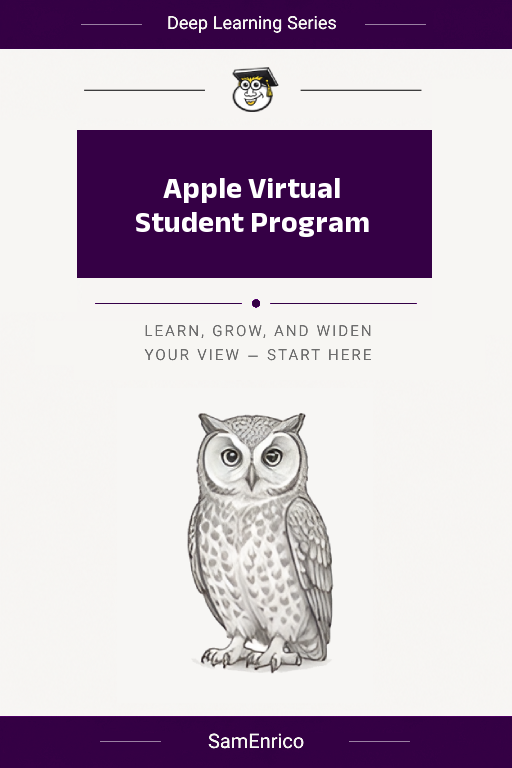
Non-FictionStudent's ShortcutDesign InternshipApple Careers
Apple Virtual Student Program eBook
Get accepted into Apple's remote internship includ
by Gillen Bari
Get accepted into Apple's remote internship including design portfolio tips technical interview prep and virtual team culture.
Formats
Free sample
Chapter 1: The Thousand-Person Door--–- Every year, roughly one thousand students walk through a door that most don’t even know exists. It’s not a physical door in Cupertino. There’s no brass plaque, no welcome mat, no security badge waiting on the other side. Instead, this door is made of code, portfolios, time zones, and silence. Behind it lies the Apple Virtual Student Program—a remote internship that accepts fewer people than Harvard accepts transfer students, and with far less publicity.If you’re reading this book, you’ve likely already searched for “Apple remote internship,” scrolled through threads on Reddit, watched a few You Tube videos titled “My Apple Internship Experience,” and come away with more questions than answers.
That’s by design. Apple does not publish acceptance rates. They do not release demographic breakdowns of their intern cohort. They do not send recruiters to every career fair. And they certainly do not offer a public roadmap for how to get in.This chapter is that roadmap.
But before we talk about resumes, portfolios, or interview questions, we need to talk about the door itself—what it is, why it’s so narrow, and why understanding its mechanics is the single most important advantage you can gain.The Virtual Student Program: A Brief History The Apple Virtual Student Program (VSP) did not begin as a remote program. Before 2020, Apple’s internship model was intensely physical. Interns moved to Cupertino, Austin, or other hub cities. They sat in open-plan offices, attended in-person design critiques, and bumped into engineers in the lunch line. Serendipity was built into the architecture.When COVID-19 forced global lockdowns, Apple—like every other tech company—had to adapt.
But unlike Google or Meta, which had already experimented with distributed teams, Apple’s culture was rooted in secrecy and collocation. The idea of an intern working from a bedroom in Ohio or a flat in Bangalore seemed, to many inside Apple, impossible. How would they protect intellectual property? How would they mentor junior talent without standing next to them? How would they preserve the “Apple magic” without the campus?The answer, it turned out, was surprisingly effective.
In 2020, Apple ran its first fully remote internship cohort. The results were mixed but promising. Some interns thrived without the pressure of physical presence. Others struggled with isolation. But by 2022, Apple had formalized the Virtual Student Program as a permanent offering—not as a pandemic stopgap, but as a parallel track to in-person internships.Today, the VSP is 100% remote.
There is no hybrid option. You will not be asked to relocate. You will not receive a relocation stipend. Your work will happen entirely from your chosen location, using Apple-provided hardware and software. This is a critical clarification: earlier drafts of this book contained confusion about hybrid work and relocation packages.
Those contradictions have been resolved. The VSP is fully remote. Accept that reality now, because it shapes every subsequent decision you will make.The Thousand-Person Door: Understanding Scarcity Let’s talk about the number one thousand.Apple does not publish official internship acceptance rates, but aggregated data from Linked In, Glassdoor, and internal sources suggests that the VSP accepts approximately 1,000 students globally per year. That is across all roles: software engineering, design, product management, machine learning, finance, marketing, and IS&T (Information Systems & Technology).To put that number in perspective: Google’s summer internship program accepts roughly 3,000 students. Microsoft accepts around 4,000.
Amazon accepts more than 10,000. Apple’s cohort is smaller than all of them. And because the VSP is remote, it draws applications from every country where Apple operates—meaning your competition is not just students from Stanford and MIT, but also from Tsinghua, IIT, University of Toronto, and ETH Zurich.Why does Apple keep the cohort so small? Three reasons.First, Apple’s culture of secrecy scales poorly. Every intern must be vetted, background-checked, and granted access to internal systems.
The more interns, the greater the risk of leaks. Apple accepts this trade-off willingly.Second, Apple invests heavily in each intern. Unlike some companies where interns are assigned to busy work, Apple’s VSP places interns on real projects with real shipping deadlines. Managers are expected to mentor actively. That requires bandwidth that doesn’t scale linearly.Third, Apple treats the internship as a nine-week interview for full-time roles.
They would rather hire one exceptional intern who receives a return offer than ten average interns who don’t. The small cohort reflects a high bar, not a lack of interest.The Timeline Trap: When to Apply and Why It Matters Most students make a catastrophic mistake with their Apple application: they wait.The VSP operates on a rolling admissions basis. That means Apple does not collect all applications and review them after a deadline. Instead, they review applications as they arrive, and they fill positions continuously. The first 48 hours after a job posting goes live are the most critical.
After two weeks, many roles are already in final-round interviews.Here are the actual timelines, corrected from earlier misinformation:Summer Internships (June–August)Job postings drop: August–September of the previous year First review batch: Within 48 hours of posting Interviews begin: Late September through December Offers extended: October through February (rolling)Program start: Early June Spring Internships (January–March)Job postings drop: Early October of the previous year First review batch: Within 48 hours of posting Interviews begin: Mid-October through November Offers extended: October through December Program start: Early January Note the critical correction: Spring internship postings drop in October, not January. Applying in January for a spring role is almost certainly too late. The earlier confusion in some guides (including earlier drafts of this book) has been corrected here.The implication is stark: you must know what you want to apply for at least three months in advance. If you wait until you feel “ready,” the door will close.The Hybrid Myth: Why Remote Changes Everything Because the VSP is fully remote, your application must answer a question that in-person interns never face: How do you demonstrate passion, competence, and cultural fit from a distance?In a physical internship, you can charm a recruiter at a career fair. You can shake hands with an engineer at a networking event.
You can leave a printed portfolio on a hiring manager’s desk. None of those tactics work remotely.Instead, remote applications are judged almost entirely on artifacts: your resume, your portfolio (for design roles), your Git Hub or Leet Code performance (for engineering roles), and your written communication. There is nowhere to hide. No firm handshake to compensate for a weak project. No eye contact to smooth over a vague answer.This is both a disadvantage and an opportunity.
The disadvantage is obvious: you cannot rely on charisma or in-person networking. The opportunity is that the field is more meritocratic. A student in rural Nebraska with an exceptional portfolio has the same chance as a student in San Francisco who can drive to Apple Park. The door does not care where you live.What Apple Looks For: Beyond the Job Description Apple job postings are famously vague. A typical posting for a software engineering intern might read: “Looking for a…
This is the end of the free sample. Get the eBook to keep going. Buy now
About this book
Details
- Author
- Gillen Bari
- Publisher
- SamEnrico
- Language
- English
- Genre
- Non-Fiction, Student's Shortcut, Design Internship, Apple Careers
- Released
- 2026-06-01
- Pages (approx.)
- 137
- Available as
- eBook, Audiobook

Read better in the ZLOADR app
Your eBooks on your phone or tablet. Sign in with your SamEnrico account and start reading.
More by Gillen Bari
 The Audience as Allies ReframeGillen Bari$11.99
 Murdoch Streaming Wars ResponseGillen Bari$11.99
 The Emotion Journal Method CourseGillen Bari$11.99
 Motherhood Burnout and Anger LinkGillen Bari$11.99
 Stockholm Syndrome SurvivorGillen Bari$11.99
 Echoes of the Underground: The Secret War of the Paris CatacombsGillen Bari$11.99
 Black Ice: The Vanished Flight Over the AndesGillen Bari$11.99
 Polish Remote Employment ContractsGillen Bari$12.99
 Assistant BuyerGillen Bari$11.99
 Understanding Bonnemann–meinecke SyndromeGillen Bari$17.99
 10 Ways to Use Courgette (Recipe Book)Gillen Bari$11.99
You may also like
 Hong Kong Handover 1997Dunn Johnnie$11.99
 Zumba For Postnatal Recovery CourseNeal Christian$11.99
 Zumba for BeginnersLadner Nikia$11.99
 YouTube Comment Mining GuideHumes Pandora$12.99
 Worry Box MeditationCarlin Rudy$11.99
 Workplace Stress MeditationNguyen Lynn$11.99
 Workplace Stress and Sleep RepairHawley Ivory$11.99
 Workplace Perfectionism CureDelaney Jeffry$11.99
 Workplace Injustice Anger GuideWallen Isabelle$11.99
 Work Addiction and Burnout LinkGreenwood Ester$11.99
 Women in Yoga and WellnessBeattie Galina$11.99
 Women in Stand Up ComedyChun Evangeline$11.99