
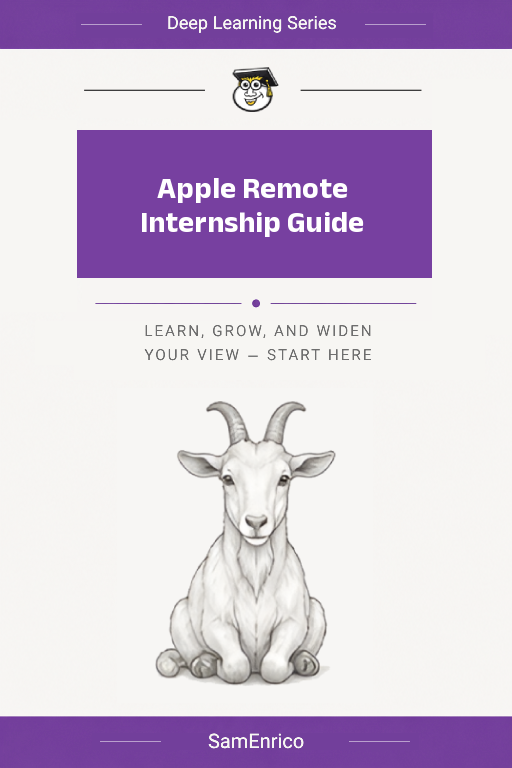
Apple Remote Internship Guide eBook
Find virtual internships at Apple in software, des
by Willson Thi
Find virtual internships at Apple in software, design, marketing, or operations through their careers page.
Formats
Free sample
Chapter 1: The Four Doors-- You have already failed. Not because you lack talent, not because your GPA isn't high enough, and not because you attend the wrong university. You have failed because you are reading this book having already submitted applications to Apple's "General Internship" posting—the digital equivalent of shouting into a hurricane. That single job requisition receives over ten thousand applications per season. Your perfectly crafted resume, your late nights of Leet Code grinding, your meticulously arranged portfolio—all of it disappeared into a database that no human will ever fully review.
The problem is not you. The problem is that you knocked on the wrong door.Apple does not think of internships the way its careers page presents them. To the outside world, there is a single, monolithic application process. But inside the company, there are four distinct worlds, four separate pipelines, four sets of hiring managers who never speak to one another. The author calls them the Four Doors.
Each door leads to a different Apple experience, requires a different preparation strategy, and—most critically—has a different acceptance rate. Students who understand the Four Doors stop competing against all ten thousand applicants and start competing only against the two thousand who chose their specific door. This chapter will help you identify which door is yours, why the other three would have destroyed your chances, and how to walk through the right one with confidence.The Myth of the General Internship Apple's careers page lists something called the "Apple Internship Program." It sounds inclusive. It sounds like a single pathway for all talented students. This is a deliberate illusion.
That general requisition exists primarily for two purposes: to satisfy legal requirements for broad posting and to catch the students who do not know any better. The vast majority of internship offers—estimates from former recruiters suggest over seventy percent—are filled through targeted pipeline programs, university-specific postings, and referral-driven roles that never appear on the public page.When you apply to the general internship, your application enters a queue with every other student who could not find a more specific door. Recruiters do scan this queue, but they scan it last. They prioritize candidates who came through university partnerships, who were referred by current employees, or who applied directly to a team-specific requisition. By the time a human looks at the general pool, most internship slots are already allocated.
You are fighting for leftovers.The Four Doors framework solves this problem by eliminating the guesswork. Instead of asking, "How do I get an internship at Apple?" you will ask, "Which of the four internal pipelines actually matches my skills, and how do I enter that pipeline directly?" The answer to that second question is actionable. The answer to the first is despair.Door One: Software Engineering & Tools The Software door is the largest and most competitive. It includes three distinct subcategories that Apple treats differently: front-end and systems engineering (SWE), quality assurance automation (QA), and internal tools development. Most students assume SWE is the only path.
They are wrong, and their assumption costs them opportunities.SWE (Feature Development) is what most people imagine when they think of an Apple engineering internship. You write code that ships. You might work on the Photos app, i Cloud sync, or the kernel of mac OS. The interview process is brutal: three to five technical rounds, heavy on systems design and language-specific fundamentals. Apple cares less about algorithmic puzzles than Google or Meta, but they care more about your understanding of memory management, concurrency, and the specific frameworks they use (Swift UI, Combine, Metal).
The acceptance rate for SWE internships is below two percent. However, candidates who explicitly tailor their resume to a specific product area—"I want to work on Camera frameworks" rather than "I want to work on software"—have a significantly higher callback rate because they look like they already understand Apple's internal structure.QA Automation is the hidden gem of the Software door. Quality assurance engineers at Apple write code that tests code. They build frameworks that simulate millions of users, automate crash reporting, and verify that a new i OS build does not break the alarm clock. The technical bar is slightly lower than SWE—you need strong scripting skills (Python, Java Script, Swift for XCTest) but less systems design depth.
More importantly, the applicant pool for QA roles is a fraction of the size. Students do not apply because they think QA is beneath them. That arrogance creates opportunity. Many full-time Apple engineers started in QA internships and converted. The work is real, the impact is visible, and the door is open.Tools & Infrastructure is the third subcategory.
Every Apple engineer relies on internal tools for building, testing, and deploying code. Someone has to build those tools. Tools interns work on compilers, build systems, continuous integration pipelines, and developer productivity software. The work is less glamorous than shipping a feature millions of users see, but the hiring bar is calibrated differently: you need deep knowledge of one area (e.g., build systems like Bazel or CMake) rather than breadth across many. Candidates with open-source contributions to developer tools have an almost unfair advantage here because the hiring managers actively search Git Hub for exactly those profiles.How to know if the Software door is yours: You enjoy building things that work reliably at scale.
You are comfortable with at least one systems language (Swift, C++, Rust) and one scripting language (Python, Ruby). You have either shipped a non-trivial project (more than one thousand lines of your own code) or contributed meaningfully to an open-source repository. You do not need to be a computer science major—Apple hires physics, math, and even philosophy graduates for SWE roles if they can code—but you must pass a technical screen within the first two weeks of applying.Door Two: Design (Human Interface & Interactive Media)The Design door is the smallest and most mysterious. Apple does not hire "UI designers." They hire Human Interface Designers, Motion Designers, and sometimes Interaction Designers. The distinction matters because the portfolio expectations are radically different from any other tech company.Human Interface Design (HID) is the classic Apple design role.
You work on the look and feel of software—typography, spacing, color, gesture responses. Apple's Human Interface Guidelines are not suggestions; they are the constitution of the user experience. Your portfolio must demonstrate not just beautiful final screens but a deep understanding of why those screens are beautiful. An Apple HID interviewer will ask: "Why did you choose 12 points of padding here instead of 16?" If you answer "because it looked better," you fail. The correct answer references Apple's own guidelines, spatial reasoning, and thumb reach zones on specific devices.Motion Design is a separate track that most students do not know exists.
Motion designers at Apple create the animations that make i OS feel alive—the bounce when you refresh a list, the smooth transition between apps, the parallax effect on the home screen. Motion design interns need proficiency in tools like Principle, After Effects, or even Swift UI's animation framework. Your portfolio should show video screen recordings of interactions, frame-by-frame breakdowns, and…
This is the end of the free sample. Get the eBook to keep going. Buy now
About this book
Details
- Author
- Willson Thi
- Publisher
- SamEnrico
- Language
- English
- Genre
- Non-Fiction, Student's Shortcut, Tech
- Released
- 2026-05-26
- Pages (approx.)
- 149
- Available as
- eBook, Audiobook

Read better in the ZLOADR app
Your eBooks on your phone or tablet. Sign in with your SamEnrico account and start reading.
More by Willson Thi
 Self Talk for Retirement GuideWillson Thi$11.99
 German Spring Offensive 1918Willson Thi$11.99
 Kitchen Gadget CompulsionWillson Thi$11.99
 Pique Persuasion TechniqueWillson Thi$11.99
 Mindful Baking for Sugar AddictsWillson Thi$11.99
 Extreme Heat AcclimationWillson Thi$11.99
 Atypical AntipsychoticsWillson Thi$11.99
 Smoking Cessation HeartWillson Thi$11.99
 The Golden Age of African Cinema: The Love Story Behind Ousmane Sembène and His MuseWillson Thi$11.99
 Burning Witness: The Arson That Exposed Australia's Witness Protection FlawsWillson Thi$11.99
 How to Produce HooksWillson Thi$11.99
 How to Produce TentsWillson Thi$11.99
You may also like
 The Dubai Mobile Plan GuideSaunders Kenneth$11.99
 Student Tech Setup DubaiFair Leonie$11.99
 Microsoft Remote Internship GuideCardenas Huong$12.99
 LSE Online Technology PlatformLuttrell Lamont$12.99
 Tech Support Student EmploymentUpshaw Juliann$12.99
 Harvard Extension vs LSE for TechHoang Jamey$12.99
 Online Exam Technical TroubleshootingHoffmann Junior$12.99