
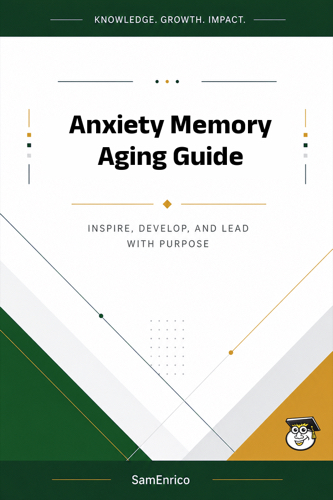
Anxiety Memory Aging Guide eBook
Worry effects on cognitive performance.
Worry effects on cognitive performance.
Formats
Free sample
Chapter 1: The Icebox Detective...--–- The refrigerator hummed softly in the kitchen, its white door a portal to a mystery Margaret had not intended to solve that Tuesday afternoon. She was looking for butter. Instead, she found her car keys nestled between a bag of frozen peas and a half-eaten carton of pistachio ice cream. For a long moment, she simply stared. Then, the familiar terror arrived, not as a wave but as a cold, hard stone dropping into the pit of her stomach.
"This is it," she whispered to the empty room. "It's really starting." The butter forgotten, she sank into a chair, replaying the last hour: she had come home from the grocery store, juggled a phone call from her daughter, checked the mail, and then... what? She had opened the freezer for no reason? Or had she been looking for the butter even then?
The memory was a void. By the time her husband came home, Margaret had already taken an online memory test (results: "moderate concern"), texted her sister about her "senior moment," and silently rehearsed the conversation she would have with her doctor. She did not have dementia. She had a case of the most common, costly, and invisible epidemic of the aging mind: a cognitive trap so well-hidden that most people spend years inside it without ever seeing the walls. This book is about those walls, and how to walk right through them.Every day, millions of adults aged fifty and older commit the same act of unintentional self-deception.
They misplace their glasses and conclude their brain is failing. They forget a name and diagnose themselves with a neurodegenerative disease. They walk into a room and, upon forgetting their purpose, treat the blank as a biopsy of a dying mind. These leaps are not merely harmless anxieties. They are the fuel for a destructive engine called Repetitive Negative Thinking, or RNT, and RNT has a secret superpower: it can manufacture the very memory problems you most fear, using nothing but the raw material of your own attention.
The key you put in the freezer is not evidence of a broken brain. It is evidence of a divided one. But the story you tell yourself about that key can, over time, become a self-fulfilling prophecy of cognitive decline.This chapter will dismantle that story. We will explore the difference between adaptive worry, the kind that solves problems, and maladaptive worry, the kind that creates them. We will introduce the single most important cognitive mechanism you have never heard of, working memory, the fragile mental desktop where all thinking happens.
And we will reveal the accelerating feedback loop that turns a normal, forgivable lapse into a cascade of anxiety that leaves your brain with no resources left for remembering. By the end of this chapter, you will never look at a misplaced set of keys the same way again. You will see the loop. And once you see it, you can begin to break it.The One-Second Catastrophe To understand how a frozen key becomes a neurological crisis, we must first slow down time. Imagine the moment of the lapse itself.
Margaret reaches into the freezer, finds the keys, and for one second, there is only confusion. "Why are my keys here?" This is the neutral event, the raw data. In that single second, the brain has not yet decided what the keys mean. They are simply an anomaly, a piece of information out of place.What happens next takes less time than a heartbeat. The brain, a meaning-making machine evolved to detect threats, asks a silent question: "Is this dangerous?" For a twenty-five-year-old, the answer is usually no.
Keys in the freezer are annoying, mildly amusing, or a sign of sleep deprivation. But for a sixty-year-old who has spent the last decade absorbing cultural messages about Alzheimer's, watching commercials for memory clinics, and attending funerals of friends who "lost their minds," the brain's threat-detection system tags the event differently. The keys are not just keys. They are a sign. And the sign points to a single terrifying destination: dementia.This is the one-second catastrophe.
In less time than it takes to blink, the brain has transformed a neutral event into a threat. And once the threat is identified, the worry machinery engages automatically, not because you are weak or foolish, but because your brain is doing exactly what it evolved to do: protect you from danger. The problem is that the danger is not real. The keys in the freezer pose no threat to your survival. But your brain does not know that.
It only knows that a pattern has been flagged, and flagged patterns demand attention. And attention, as we will see throughout this book, is the single most precious resource your aging brain possesses.Adaptive Worry vs. The Rumination Parasite Not all worry is bad. In fact, some worry is essential for survival and high performance. The ability to anticipate problems, rehearse solutions, and motivate action is one of the gifts of a sophisticated prefrontal cortex.
This is adaptive worry. It has a distinct fingerprint: it is brief, specific, solution-focused, and time-limited. Adaptive worry sounds like this: "I forgot my keys. I need to put them on the hook every day when I come home. I will start that habit now." The thought arises, a plan forms, action follows, and the thought dissolves.
The total cognitive cost is measured in seconds.Maladaptive worry is a different creature entirely. It is cyclical, repetitive, abstract, and endless. It does not seek solutions because it is not interested in problems. It is interested in threat. Maladaptive worry sounds like this: "I forgot my keys.
That means my memory is getting worse. My mother had memory problems. Does this mean I have what she had? I should take a test. What if the test says yes?
I can't go through what she went through. I need to tell my daughter. But I don't want to worry her. Oh God, I forgot my keys again yesterday too. It's getting worse." Notice what happens: the loop never reaches an action.
It circles from observation to fear to memory to future dread and back to observation, each revolution tightening the spiral of anxiety.Psychologists call this Repetitive Negative Thinking (RNT) , and it is one of the most robust predictors of cognitive decline in older adults, not because it damages the brain directly (though it can, as we will see in Chapter 5), but because it consumes the very cognitive resources needed to remember. RNT is a parasite. It feeds on attention, the lifeblood of memory, and leaves nothing behind for encoding, storage, or retrieval. The more you worry about your memory, the less memory you have available to worry with. This is not a metaphor.
It is a measurable, replicable, neurological fact.The Mental Desktop: Introducing Working Memory To understand why worry is so destructive to memory, we need to understand a concept that will appear in every chapter of this book: working memory. Working memory is not a place in the brain. It is a process, a set of operations that hold information in mind while you manipulate it. Think…
This is the end of the free sample. Get the eBook to keep going. Buy now
About this book
Details
- Author
- Dyer Saturnina
- Publisher
- SamEnrico
- Language
- English
- Genre
- Non-Fiction, Self-Help, Anxiety
- Released
- 2026-06-09
- Pages (approx.)
- 125
- Available as
- eBook, Audiobook

Read better in the ZLOADR app
Your eBooks on your phone or tablet. Sign in with your SamEnrico account and start reading.
More by Dyer Saturnina
 Voice Lineup AccuracyDyer Saturnina$11.99
 Cocaine Psychosis ExplainedDyer Saturnina$11.99
 Pregnancy Loss Support GroupDyer Saturnina$11.99
 Setting Boundaries at WorkDyer Saturnina$11.99
 Narcissistic Parent Recovery GuideDyer Saturnina$11.99
 Keto Hormone Balance HandbookDyer Saturnina$11.99
 Art And Design Studies DubaiDyer Saturnina$11.99
 The Berlin Connection: The Rise and Fall of the BND's Shadow WarDyer Saturnina$11.99
 Quetzalcoatl's Wisdom: The Feathered Serpent's Guide to TransformationDyer Saturnina$11.99
 Eu Domain Brand ProtectionDyer Saturnina$12.99
 Succession Tax Penalty GuideDyer Saturnina$12.99
 How to Become a Private-branch-exchange RepairerDyer Saturnina$11.99
You may also like
 Hong Kong Handover 1997Dunn Johnnie$11.99
 Zumba For Postnatal Recovery CourseNeal Christian$11.99
 Zumba for BeginnersLadner Nikia$11.99
 YouTube Comment Mining GuideHumes Pandora$12.99
 Worry Box MeditationCarlin Rudy$11.99
 Workplace Stress MeditationNguyen Lynn$11.99
 Workplace Stress and Sleep RepairHawley Ivory$11.99
 Workplace Perfectionism CureDelaney Jeffry$11.99
 Workplace Injustice Anger GuideWallen Isabelle$11.99
 Work Addiction and Burnout LinkGreenwood Ester$11.99
 Women in Yoga and WellnessBeattie Galina$11.99
 Women in Stand Up ComedyChun Evangeline$11.99