
Non-FictionCrisis ManagementAntitrust
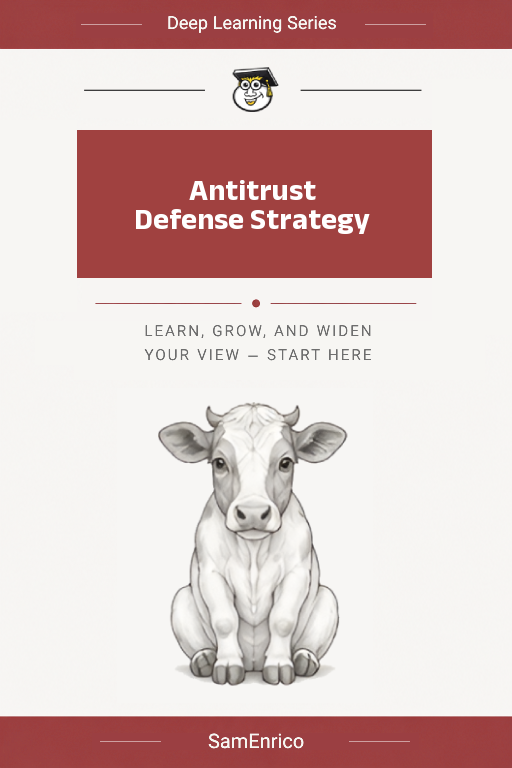
Antitrust Defense Strategy eBook
File antitrust complaints arguing the hostile take
File antitrust complaints arguing the hostile takeover would create a monopoly.
Formats
Free sample
Chapter 1: The Monopoly Panic--–- In the spring of 2021, a group of antitrust lawyers gathered in a windowless conference room on Pennsylvania Avenue, just blocks from the White House. They represented a Fortune 50 technology company facing a hostile takeover bid from an even larger rival. Their defense strategy, painstakingly developed over four months, rested on a single, seemingly unassailable argument: the proposed merger would lower consumer prices by an estimated 12 percent, generate $800 million in annual efficiencies, and accelerate innovation by combining complementary R&D teams. By every traditional measure of antitrust analysis, this was a pro-competitive transaction.The FTC sued to block it four days later.The agency’s press release never mentioned prices, efficiencies, or innovation. Instead, it argued that the merger would “entrench a dominant firm’s power over emerging markets” and “reduce the number of independent decision-makers” in the technology sector.
When the defense team protested that the government had offered no evidence of consumer harm, the FTC’s lead economist replied with a phrase that has since become infamous in antitrust defense circles: “Consumer welfare is not the only value we enforce.”That deal died. The target company was eventually acquired by a foreign firm. Three thousand American jobs moved overseas. And the lawyers who thought they had built an airtight defense learned a brutal lesson: the rules of the game had changed while they were still playing by the old ones.This book is for every lawyer, executive, and board member who does not want to be that team.The Old World: Consumer Welfare as the Sole Compass For nearly four decades, from the late 1970s through the mid-2010s, antitrust enforcement in the United States was governed by a single, elegant principle: the Consumer Welfare Standard. Articulated most forcefully by Judge Robert Bork in his influential book The Antitrust Paradox (1978) and championed by the Chicago School of economics, this standard held that the sole legitimate goal of antitrust law was to protect consumers from higher prices, reduced output, or lower quality.
Everything else—the size of a firm, the number of competitors in a market, the political power of corporations—was irrelevant unless it could be shown to harm consumers in measurable economic terms.Under this regime, the defense of a hostile takeover was a relatively straightforward, if technically demanding, exercise. Defense counsel needed to demonstrate three things: first, that the relevant market was broader than the government alleged (diluting market share calculations); second, that the merger would generate verifiable efficiencies (lower costs, faster innovation, better products); and third, that at least some of those efficiencies would be passed through to consumers in the form of lower prices or improved quality. If the defense could credibly show that consumers would be better off after the merger than before, the government almost always backed down.The numbers told the story. Between 1980 and 2015, the FTC and DOJ challenged fewer than 2 percent of all reported mergers. Hostile takeovers, despite their aggressive reputation, were challenged at even lower rates.
Defense lawyers operated with predictable certainty: file the HSR notification, submit a white paper on efficiencies, negotiate a narrow remedy if necessary, and close the deal. The consumer welfare standard was not merely a legal test—it was a shield.That shield has been shattered.The Neo-Brandeisian Revolution Beginning around 2016, a loose coalition of academics, activists, and political appointees began advancing a radical alternative to the Chicago School consensus. Their intellectual ancestors were not Bork and Easterbrook but Louis Brandeis, the early twentieth-century Supreme Court justice who argued that concentrated economic power was inherently dangerous to democracy, regardless of its effects on prices. The Neo-Brandeisians—as they came to be known—rejected the premise that consumer welfare was the sole legitimate goal of antitrust. Instead, they advanced a structuralist agenda: antitrust law should protect the process of competition, preserve decentralized economic power, and guard against political domination by large corporations.In 2017, the movement gained its first beachhead in the federal government when President Trump appointed the first of several aggressively anti-merger enforcers.
But the true revolution came after 2020, when President Biden installed Lina Khan as chair of the FTC and Jonathan Kanter as head of the DOJ’s Antitrust Division. Both were card-carrying Neo-Brandeisians. Both had built their reputations on attacking the consumer welfare standard. And both made clear within weeks of taking office that merger enforcement would be transformed.The 2023 Merger Guidelines, issued jointly by the FTC and DOJ, represented the official death certificate for the old regime. For the first time in history, the guidelines explicitly stated that mergers could be challenged even without proof of consumer harm.
Structural concerns—market concentration, the elimination of “head-to-head” competition, the entrenchment of dominant firms—could alone justify a lawsuit. The guidelines also lowered the market share threshold for a “presumption of illegality” from 50 percent (the rough historical standard) to 30 percent in concentrated markets. And they resurrected long-dormant theories like “potential competition” and “entrenchment” that the Chicago School had supposedly buried decades earlier.The defense bar was caught flat-footed. Between 2021 and 2024, the FTC and DOJ challenged more mergers than in the previous eight years combined. The success rate for defense motions to dismiss—once a reliable tool for killing weak government cases—plummeted.
Hostile takeovers, already difficult to execute, became nearly impossible in red-flag industries. One prominent defense lawyer, speaking anonymously to the Wall Street Journal, called it “the most hostile environment for merger defense in fifty years.”The Defense Lawyer’s Dilemma: What Worked in 2005 Fails in 2025Consider two hypothetical merger reviews, identical in every economic respect but separated by twenty years.Scenario A: 2005. A large pharmaceutical company proposes a hostile takeover of a smaller rival that manufactures a complementary drug. Combined market share in the relevant therapeutic category is 45 percent. The defense submits an efficiency study showing $200 million in annual cost savings, with 60 percent of those savings projected to pass through to consumers via lower prices.
The FTC’s Bureau of Economics reviews the study, agrees with the methodology, and recommends closing the investigation without a lawsuit. The deal closes in four months.Scenario B: 2025. The same transaction. The same market share. The same efficiency study.
The FTC’s Bureau of Economics is now a shadow of its former self; the agency’s decision-making power rests with political appointees who openly disdain economic modeling. The defense’s efficiency study is dismissed as “Chicago School ideology.” The agency sues to block the merger, arguing that eliminating a “maverick competitor” (the smaller firm) will reduce innovation, even though the smaller firm has not launched a new drug in seven years. The defense’s lawyers scramble to understand the new legal theories, but they were trained in the old regime. The deal dies.This hypothetical is not exaggerated. It reflects actual cases from the past three years.
In FTC v. Amgen (2023), the FTC sued to block a vertical merger in the pharmaceutical industry despite the absence of any plausible theory of consumer harm. In DOJ v. Penguin Random House (2022), the government successfully blocked a publishing merger using a novel “monopsony power” theory that would have been laughed out of court a decade earlier. In FTC v.
Meta (2022), the agency sued to unwind a consummated acquisition using a “potential competition” theory that had not won a…
This is the end of the free sample. Get the eBook to keep going. Buy now
About this book
Details
- Author
- Medina Lowell
- Publisher
- SamEnrico
- Language
- English
- Genre
- Non-Fiction, Crisis Management, Antitrust
- Released
- 2026-05-30
- Pages (approx.)
- 158
- Available as
- eBook, Audiobook

Read better in the ZLOADR app
Your eBooks on your phone or tablet. Sign in with your SamEnrico account and start reading.
More by Medina Lowell
 Listening In Acoustics GuideMedina Lowell$11.99
 The Legal Stress Couple GuideMedina Lowell$11.99
 Panic Attack Breath ControlMedina Lowell$11.99
 The Forgiveness AskingMedina Lowell$11.99
 Nicoya Peninsula LifestyleMedina Lowell$11.99
 Women Who Sail AloneMedina Lowell$11.99
 Joyful Bedtime Gratitude RitualMedina Lowell$11.99
 Exposure Therapy DIYMedina Lowell$11.99
 The Silent Conquest: How a Forgotten Composer Shaped the Sounds of Ancient Latin AmericaMedina Lowell$11.99
 The Forgotten Voyages: Southeast Asia’s Medieval Mariners and the Silk Road of the SeasMedina Lowell$11.99
 The Silk Road Gambit: How a Secretary of State Outmaneuvered the Cold WarMedina Lowell$11.99
 Growing HymenosporumMedina Lowell$11.99
You may also like
 Hong Kong Handover 1997Dunn Johnnie$11.99
 Zumba For Postnatal Recovery CourseNeal Christian$11.99
 Zumba for BeginnersLadner Nikia$11.99
 YouTube Comment Mining GuideHumes Pandora$12.99
 Worry Box MeditationCarlin Rudy$11.99
 Workplace Stress MeditationNguyen Lynn$11.99
 Workplace Stress and Sleep RepairHawley Ivory$11.99
 Workplace Perfectionism CureDelaney Jeffry$11.99
 Workplace Injustice Anger GuideWallen Isabelle$11.99
 Work Addiction and Burnout LinkGreenwood Ester$11.99
 Women in Yoga and WellnessBeattie Galina$11.99
 Women in Stand Up ComedyChun Evangeline$11.99