
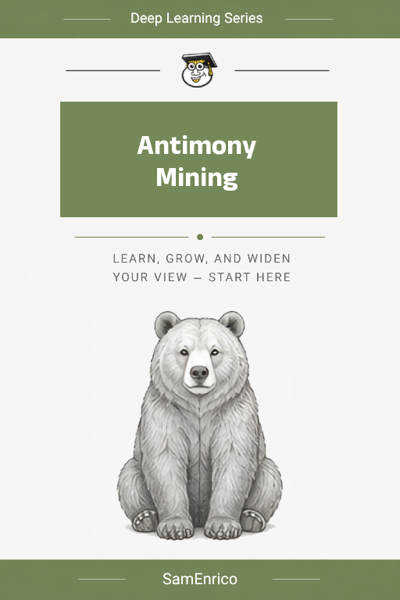
Non-FictionInformativeEducational
Antimony Mining eBook
A Coursebook on Antimony Mining
A Coursebook on Antimony Mining
Formats
Free sample
Chapter 1: The Metal You Wear...--You are wearing it right now. Not on your skin, but in the device you hold, the chair you sit on, the clothes on your back, and if you are reading this in a modern building, the very walls around you contain the remains of a metal whose name you have probably never spoken aloud. Antimony is everywhere and nowhere. It is the ghost in the machine of modern life, the silent partner in a five-thousand-year partnership between human civilization and one of the most peculiar elements on the periodic table. It hardens your car battery, protects your television from catching fire, enables the plastic bottle you drank from this morning, and quite possibly helps a soldier see in the dark on the other side of the world.
And yet, ask a hundred people what antimony is, and ninety-nine will give you a blank stare. The hundredth might remember a high school chemistry class and hazard a guess that it has something to do with lead. They would not be entirely wrong, but they would not be close to the whole story.This chapter is not a dry recitation of dates and discoveries. It is the story of how a black powder from ancient Babylon became the most geopolitically contested metal of the twenty-first century. It is a tale of alchemists who poisoned themselves searching for immortality, of industrialists who hardened bullets for world wars, of Chinese miners who toiled in mountains that produced more antimony than all other mines combined, and of Pentagon officials who now lie awake worrying about a supply chain they never knew existed.
By the time you finish this chapter, you will understand why antimony has been called the most important metal you have never heard of. And you will begin to see why the events of August 2024—when China slammed the door on antimony exports—may mark a turning point in global industrial strategy as significant as the 1970s oil embargo.The Black Powder of Babylon Long before anyone knew what an element was, before the periodic table was a glint in Dmitri Mendeleev's eye, human beings were digging antimony out of the ground and rubbing it on their faces. The earliest known use of antimony dates to approximately 3000 BCE in ancient Mesopotamia and Egypt, where powdered stibnite—antimony sulfide, Sb₂S₃—was ground into a fine black paste and applied as kohl around the eyes. This was not merely cosmetic. In the blazing sun of the Nile Valley, the dark pigment reduced glare, repelled insects, and was believed to ward off evil spirits.
The Egyptian word for this substance, mesdemet, appears in medical papyri as a treatment for eye infections. Whether it worked or simply looked impressive, the practice spread across the ancient world. The Bible mentions eye paint in the book of Kings. The prophet Ezekiel describes a woman who "painted her eyes and adorned herself with jewels." That paint was antimony.The ancient Greeks called it στίμμι (stimmi), a word the Romans later Latinized to stibium. From that root we get the modern chemical symbol Sb, a quiet linguistic fossil that reminds us of how old this relationship truly is.
The Roman scholar Pliny the Elder devoted several passages of his Natural History to the substance, noting that it came in two varieties: a male form that was hard and shiny, and a female form that was softer and preferred for cosmetic use. Pliny also recorded a startling observation: when stibnite was heated in a certain way, it produced a strange, brittle metal that seemed to resist being worked. He had accidentally discovered metallic antimony, though he did not know what to make of it. That discovery would have to wait for another civilization entirely.The Monks Who Poisoned Themselves The medieval alchemists of Europe inherited the knowledge of antimony from Arabic sources. The great Persian physician Avicenna (Ibn Sina) wrote extensively about stibnite in his Canon of Medicine, cautioning that while it was useful for certain ailments, it could be deadly in excess.
That warning went largely unheeded. The most famous—or infamous—figure in the alchemical history of antimony is a shadowy character known as Basil Valentine. Whether he was a real person (a 15th-century Benedictine monk) or a pseudonym used by a network of alchemists, his writings transformed antimony from a minor curiosity into a legendary substance.Valentine's book, The Triumphal Chariot of Antimony, published around 1604, sang the praises of the metal in language that bordered on religious ecstasy. He claimed that antimony could cure almost any disease, purify base metals into gold, and even extend human life indefinitely. The alchemists of the era were desperate for any substance that might unlock the secrets of the philosopher's stone, and antimony seemed promising.
It was strange, unpredictable, and vividly reactive. When heated, it produced white smoke that could be condensed into a crystalline powder. When alloyed with lead, it created a metal harder and more castable than either alone. When ingested in small doses, it caused violent purging—which alchemists interpreted as "cleansing the humors." When ingested in larger doses, it killed you.And kill it did. The historian of science John Read documented dozens of cases of monastic poisonings from the 15th and 16th centuries, as monks experimented with antimony preparations in their quest for medicinal panaceas.
The metal earned the nickname "Monks' Bane," and a Benedictine monastery in Saxony was said to have lost half its brethren to a single enthusiastic round of antimony experimentation. Yet the metal also had genuine therapeutic effects. Antimony potassium tartrate, known as tartar emetic, became a standard treatment for schistosomiasis (a parasitic disease) and remained in the pharmacopoeia into the 20th century. Even today, pentavalent antimony compounds like sodium stibogluconate are frontline drugs for leishmaniasis, a devastating parasitic disease that affects millions of people in tropical regions. Antimony, it turns out, occupies a strange pharmacological space: trivalent antimony (Sb III) is toxic, while pentavalent antimony (Sb V) is therapeutic.
This distinction, known as speciation, is one of the most important concepts in understanding the metal's behavior, and we will return to it throughout this book.The alchemists also gave antimony its more benign nickname, "Cupid of Lead," because of its remarkable affinity for that metal. A small amount of antimony added to molten lead produces an alloy that is harder, stronger, and more dimensionally stable. This property would prove to be the key to antimony's industrial future. But in the alchemical era, it was mostly a curiosity. The monks did not know that they were laying the groundwork for the printing press, the musket ball, and the lead-acid battery.
They were just trying not to die.The Metal That Printed the Modern World The Industrial Revolution was built on many materials: iron, coal, steel, copper. But a quiet, unsung enabler was antimony. Its first great industrial application came from an unlikely source: the printing press. Johannes Gutenberg's movable type, invented around 1450, was made of a lead-antimony-tin alloy. The antimony content, typically 10-15%, was the secret ingredient.
Pure lead is too soft; type cast from lead alone would deform after a few impressions. Adding tin improves fluidity but…
This is the end of the free sample. Get the eBook to keep going. Buy now
About this book
Details
- Author
- Chappell Kathrine
- Publisher
- SamEnrico
- Language
- English
- Genre
- Non-Fiction, Informative, Educational
- Released
- 2026-05-11
- Pages (approx.)
- 150
- Available as
- eBook, Audiobook

Read better in the ZLOADR app
Your eBooks on your phone or tablet. Sign in with your SamEnrico account and start reading.
More by Chappell Kathrine
 Insomnia Relief Sleep CourseChappell Kathrine$11.99
 Email Automation Workflow GuideChappell Kathrine$11.99
 Chronic Illness LonelinessChappell Kathrine$11.99
 Standing Stretching RoutineChappell Kathrine$11.99
 The Dragon’s Lament: The Ballad of Saint George and the Beast of CappadociaChappell Kathrine$11.99
 The Anthrax Letters: A Deadly Shadow in the MailChappell Kathrine$11.99
 Ultimate Handbook Guide to Vaduz : (Liechtenstein) Travel GuideChappell Kathrine$11.99
 Supply Chain Control Tower AIChappell Kathrine$12.99
 Employer Remote Compliance WorkbookChappell Kathrine$12.99
 Understanding Hypohidrotic Ectodermal DysplasiaChappell Kathrine$17.99
You may also like
 Hong Kong Handover 1997Dunn Johnnie$11.99
 Zumba For Postnatal Recovery CourseNeal Christian$11.99
 Zumba for BeginnersLadner Nikia$11.99
 YouTube Comment Mining GuideHumes Pandora$12.99
 Worry Box MeditationCarlin Rudy$11.99
 Workplace Stress MeditationNguyen Lynn$11.99
 Workplace Stress and Sleep RepairHawley Ivory$11.99
 Workplace Perfectionism CureDelaney Jeffry$11.99
 Workplace Injustice Anger GuideWallen Isabelle$11.99
 Work Addiction and Burnout LinkGreenwood Ester$11.99
 Women in Yoga and WellnessBeattie Galina$11.99
 Women in Stand Up ComedyChun Evangeline$11.99