
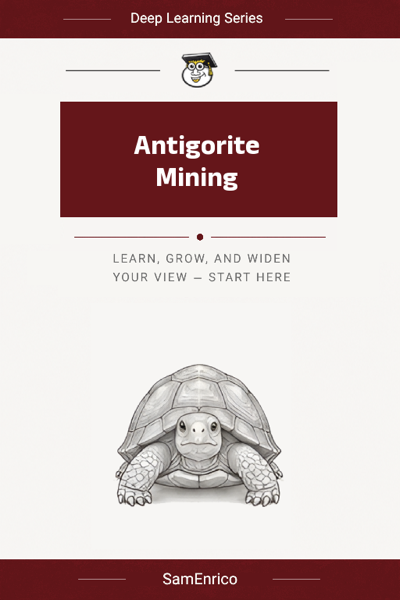
Antigorite Mining
A Coursebook on Antigorite Mining
by Baumann Lyn
A Coursebook on Antigorite Mining
Formats
About this book
Free sample
Chapter 1: The Serpentine Trio–- The first problem any mining geologist encounters when searching for antigorite is not how to find it, but how to recognize it as something distinct from its two closest relatives. Lizardite, chrysotile, and antigorite share the same chemical formula, arise from the same parent rocks, and often occur within the same outcrop. Yet their differences in structure, stability, and safety determine the difference between a valuable industrial mineral and a regulated hazard. This chapter establishes the taxonomic and industrial foundations for everything that follows—from exploration to processing to economic evaluation.1.1 The Serpentine Group: Three Polymorphs, One Formula The serpentine group consists of three polymorphs: lizardite, chrysotile, and antigorite. All share the ideal chemical formula (Mg,Fe)₃Si₂O₅(OH)₄, with magnesium partially substituted by iron in natural samples.
The term “polymorph” means that these three minerals have identical chemistry but different crystal structures—arrangements of atoms that produce radically different physical properties.Lizardite is the low-temperature platy form, typically occurring as fine-grained, hexagonal plates that give serpentinite its characteristic scaly or slickensided appearance. It is the most common serpentine mineral in near-surface environments, forming at temperatures below approximately 350°C during the early stages of serpentinization.Chrysotile is the fibrous form, with crystals growing as flexible, silky fibers that can be woven into cloth. Its fibrous habit, combined with its chemical stability in biological environments, makes it hazardous when inhaled—the fibers lodge in lung tissue and cause asbestosis, mesothelioma, and lung cancer. For this reason, chrysotile mining has been banned or severely restricted in most industrialized nations, and its international trade is regulated under the Rotterdam Convention.Antigorite is the high-temperature modulated form, characterized by a wavy or corrugated crystal structure. Unlike lizardite’s flat plates or chrysotile’s cylindrical fibers, antigorite’s structure oscillates periodically along the crystal axis, producing a distinct “modulated” pattern visible under transmission electron microscopy.
This modulation gives antigorite its characteristic greasy luster, its slightly higher hardness (3.5–4 on the Mohs scale compared to 2.5–3 for lizardite), and most importantly, its thermal stability up to approximately 600°C.The key distinction…
This is the end of the free sample. Get the eBook to keep going. Buy now
Contents
- Chapter 1
- Chapter 2
- Chapter 3
- Chapter 4
- Chapter 5
- Chapter 6
- Chapter 7
- Chapter 8
- Chapter 9
- Chapter 10
- Chapter 11
- Chapter 12
Details
- Author
- Baumann Lyn
- Publisher
- SamEnrico
- Language
- English
- Genre
- Non-Fiction, Informative, Educational
- Released
- 2026-06-02
- Pages (approx.)
- 158
- Available as
- eBook, Audiobook

Read better in the ZLOADR app
Your eBooks on your phone or tablet. Sign in with your SamEnrico account and start reading.
More by Baumann Lyn
 John the Baptist AccountBaumann Lyn$11.99
 The Clothing and Body Image Healing GuideBaumann Lyn$11.99
 Burnout Prevention for Veterinarians CourseBaumann Lyn$11.99
 Mindful Waiting MBSR PracticeBaumann Lyn$11.99
 Lying Detection Nonverbal GuideBaumann Lyn$11.99
 The Curse of the Black PharaohBaumann Lyn$11.99
 Understanding Kousseff–nichols SyndromeBaumann Lyn$17.99
 SaaS Renewal Management GuideBaumann Lyn$12.99
 Buffer AI Post SchedulerBaumann Lyn$12.99
 How to Start a Balances and Scales (wholesale) Business (Beginners Guide)Baumann Lyn$11.99