
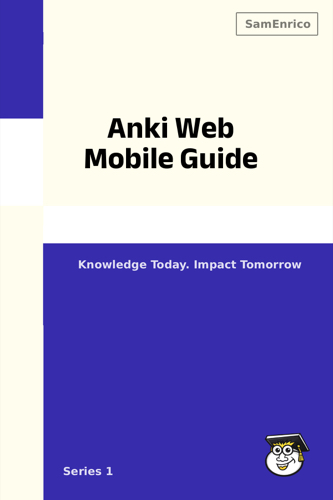
Non-FictionSelf-HelpMobile Learning
Anki Web Mobile Guide eBook
Teaches using AnkiWeb and mobile apps for review o
by Lay Alonso
Teaches using AnkiWeb and mobile apps for review on the go.
Formats
Free sample
Chapter 1: The Forgetting Epidemic--–- In 1885, a German psychologist named Hermann Ebbinghaus did something both tedious and brilliant. He taught himself hundreds of nonsense syllables—three-letter combinations like "ZOF" and "WUX" that had no meaning whatsoever—and then tested himself on them at regular intervals. He wanted to measure something invisible: how fast a human being forgets.What he discovered was devastating. Within one hour of learning something new, you have already forgotten 50 percent of it. Within 24 hours, you have forgotten 70 percent.
Within one week, unless you have done something to intervene, 90 percent is gone. This is the Forgetting Curve, and it is one of the most replicated findings in the history of psychology. It applies whether you are a medical student memorizing pharmacology, a lawyer learning case law, a musician practicing scales, or a grandparent trying to remember grandchildren's names.But here is what Ebbinghaus also discovered, and what most people never learn: the curve is not destiny. Every time you successfully recall a piece of information—not re-read it, not highlight it, not listen to a lecture about it, but actively pull it from your memory—you reset the forgetting curve. Better than reset it: you make the next curve shallower.
Each successful recall strengthens the neural pathway, making the memory more durable and easier to retrieve next time.This is the science of spaced repetition. And for 130 years, it remained a laboratory curiosity—beautiful in theory, nearly impossible to practice. To do it manually, you would need to track thousands of individual items, each with its own optimal review schedule, and then actually execute those reviews at precisely the right moments. No human can do this. No human has to anymore.Because in 2006, a computer programmer named Damien Elmes, frustrated with his own inability to learn Japanese, built a free, open-source application that automated the entire process.
He called it Anki—the Japanese word for "memorization." Today, Anki is used by over 100 million people worldwide. Medical students swear by it. Polyglots have used it to learn thousands of vocabulary words. Pilots memorize flight procedures with it. Lawyers, engineers, and bar exam candidates have made it their secret weapon.And yet, despite its power, most people abandon Anki within weeks.
They open the app, see a queue of 500 cards, feel a wave of shame, and close it. Or they force themselves through an hour-long review session, feel exhausted, and never return. Or they set up a complicated system on their desktop, forget to sync to their phone, and lose momentum.The problem is not Anki. The problem is the way most people are taught to use it.This book exists because there is a better way. A way that does not require hours at a desk.
A way that fits into the cracks of your existing day—the five minutes waiting for coffee, the ten minutes on the train, the two minutes in the elevator. A way that turns your phone from a distraction device into the most powerful learning tool you have ever owned.This is the Anki Web Mobile Guide. And this first chapter is where we bury the old way of studying forever.The Myth of the Marathon Study Session Let us name the enemy. The enemy is the marathon study session—the belief that learning requires you to block out three hours, brew a pot of coffee, sit at a desk, and "get through" your material. This belief is not just inefficient.
It is actively harmful to your memory.Consider two students. Student A studies for three hours straight on a Sunday afternoon, reviewing 180 flashcards in one marathon session. Student B studies for six ten-minute sessions spread across Monday through Saturday, also reviewing 180 total cards. Who remembers more one week later?The research is unequivocal: Student B will remember dramatically more. Not a little more.
Up to three times more, depending on the material and the spacing intervals.Why? Because the act of forgetting is not your enemy—it is your teacher. When you review a card just as you are about to forget it, your brain works harder to retrieve it. That effort, that slight struggle, is what strengthens the memory. If you review a card too soon (three hours into a marathon session), you have not given the forgetting curve time to do its work.
The retrieval feels easy, and your brain learns nothing new.Ebbinghaus called this the "spacing effect." Modern neuroscientists have observed it directly with f MRI scans: the hippocampus—the brain's memory center—shows greater activation during spaced retrieval than during massed practice. Your brain is literally working differently when you study in short, spaced sessions versus long, crammed ones.The marathon session is a lie sold to you by a culture that confuses effort with effectiveness. Sitting at a desk for three hours feels virtuous. It feels like work. But feeling like work is not the same as producing results.
The most effective studying often feels too easy, too short, too fragmented. That is not a bug. That is the feature.The Mobile Advantage: Why Your Phone Beats Your Laptop Here is a confession that most productivity experts will not admit: your laptop is a terrible study environment. It lives on a desk, requires you to sit in a specific posture, demands that you close other tabs, and—most critically—requires you to decide to study. That decision is a massive barrier.Every time you choose to open your laptop for a study session, you have to overcome inertia.
You have to close social media. You have to silence notifications. You have to find a quiet space. You have to get into "the zone." For most people, this friction is enough to prevent studying from happening at all. They intend to study.
They plan to study. They feel guilty about not studying. But they do not study, because the cost of starting is too high.Your phone is the opposite. Your phone is always with you. It lives in your pocket, on your kitchen counter, on your nightstand.
It does not require a decision to "start studying." It requires only the decision to open an app—a decision that takes less than two seconds.This is not a small difference. This is the difference between a habit that sticks and a habit that dies.Consider the mathematics. The average person has 47 minutes of "dead time" every day: waiting in line, riding the bus, standing in an elevator, sitting in a waiting room, microwaving food, boiling water, waiting for a website to load. That is 47 minutes that are currently wasted on scrolling, staring, or daydreaming.Now imagine capturing just half of that dead time. Twenty-four minutes per day.
At six seconds per card (a typical review speed), that is 240 cards per day. In one week, that is 1,680 cards. In one month, over 7,000 cards. In one year, nearly 90,000 cards.No one needs to review 90,000 cards. But the point is this: you are not lacking time.
You are lacking a system that fits into the time you already have.The mobile advantage is not about convenience. It is about consistency. A five-minute review on your phone every day will outperform a…
This is the end of the free sample. Get the eBook to keep going. Buy now
About this book
Details
- Author
- Lay Alonso
- Publisher
- SamEnrico
- Language
- English
- Genre
- Non-Fiction, Self-Help, Mobile Learning
- Released
- 2026-06-06
- Pages (approx.)
- 149
- Available as
- eBook, Audiobook

Read better in the ZLOADR app
Your eBooks on your phone or tablet. Sign in with your SamEnrico account and start reading.
More by Lay Alonso
 Child Loss And Social LifeLay Alonso$11.99
 Self Hypnosis VisualizationLay Alonso$11.99
 Paint Chip Trace EvidenceLay Alonso$11.99
 Financial Burnout Recovery GuideLay Alonso$11.99
 The Micronutrient Hope GuideLay Alonso$11.99
 Single Parent Infant LossLay Alonso$11.99
 Agostinho Neto Angola MPLALay Alonso$11.99
 The Vanishing of El Presidio: Argentina's Forgotten Prison UprisingLay Alonso$11.99
 Hippocrates and the Birth of Medicine: The Western Healing RevolutionLay Alonso$11.99
 Lowchen: Little LionLay Alonso$11.99
 How to Produce FlockingLay Alonso$11.99
 How to Produce a Scouring PadLay Alonso$11.99
You may also like
 Hong Kong Handover 1997Dunn Johnnie$11.99
 Zumba For Postnatal Recovery CourseNeal Christian$11.99
 Zumba for BeginnersLadner Nikia$11.99
 YouTube Comment Mining GuideHumes Pandora$12.99
 Worry Box MeditationCarlin Rudy$11.99
 Workplace Stress MeditationNguyen Lynn$11.99
 Workplace Stress and Sleep RepairHawley Ivory$11.99
 Workplace Perfectionism CureDelaney Jeffry$11.99
 Workplace Injustice Anger GuideWallen Isabelle$11.99
 Work Addiction and Burnout LinkGreenwood Ester$11.99
 Women in Yoga and WellnessBeattie Galina$11.99
 Women in Stand Up ComedyChun Evangeline$11.99