
Non-FictionSelf-HelpStudy Skills
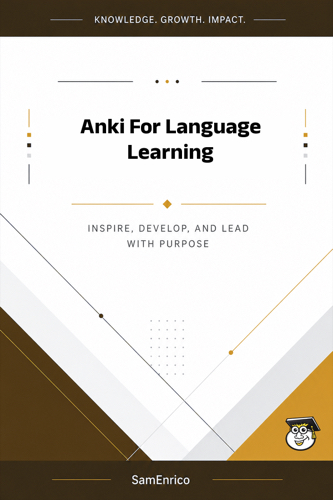
Anki For Language Learning eBook
Build massive vocabulary and grammar recognition w
by Maness Ka
Build massive vocabulary and grammar recognition with spaced repetition.
Formats
Free sample
Chapter 1: The Forgetting Trap--–- You have already wasted hundreds of hours studying vocabulary. That statement may sound like an exaggeration, but if you have ever reread a word list, reviewed a textbook chapter multiple times, or highlighted vocabulary in a language app only to forget everything a week later, you have experienced exactly what cognitive scientists call the "illusion of competence." The feeling of familiarity—seeing a word and thinking "oh yes, I know that one"—is one of the most dangerous traps in all of language learning. It feels like progress. It feels like knowledge. But it is neither.
It is a mirage.This book exists because that mirage has convinced millions of language learners that they are studying effectively when they are not. The gap between "this looks familiar" and "I can retrieve this word from my own memory without any cues" is the single greatest obstacle between you and fluency. And closing that gap is not a matter of studying harder or spending more hours with your nose in a book. It is a matter of understanding how memory actually works—and then using that understanding to build a system that works with your brain instead of against it.Welcome to the first chapter of Anki For Language Learning. By the time you finish this chapter, you will understand exactly why most vocabulary study methods fail, why your brain is wired to forget almost everything you learn within hours, and how a free piece of software called Anki uses the science of memory to turn forgetting from an enemy into an ally.
You will also learn the critical distinction that separates successful language learners from those who plateau and quit: the difference between productive struggle and futile struggle. This distinction will shape every card you create and every review session you complete for the rest of your language learning journey.The Science You Were Never Told In 1885, a German psychologist named Hermann Ebbinghaus did something no one had done before. He decided to study memory scientifically—not through philosophy or introspection, but through careful measurement. He created lists of nonsense syllables (meaningless three-letter combinations like "ZOF" and "WUX") and tested himself on them at various intervals. Why nonsense syllables?
Because he wanted to measure pure memory, uncontaminated by existing knowledge or meaning. He discovered something startling.Within one hour of learning a list of nonsense syllables, Ebbinghaus forgot roughly 50 percent of them. Within 24 hours, he had forgotten up to 70 percent. The pattern was so consistent that he was able to draw a curve—the now-famous Forgetting Curve—that predicts exactly how much information a person will retain based on how much time has passed since they last studied it.The Forgetting Curve is exponential. It drops steeply at first, then levels off.
Most forgetting happens in the first hour. By the time you close your textbook and walk away, the clock is already ticking. This is not a flaw in your brain. It is a feature. Your brain is designed to prioritize information that is relevant to your survival and well-being, and discard information that seems unimportant.
A vocabulary word from a foreign language, encountered once in a textbook, looks to your brain exactly like unimportant information. Your brain is doing its job when it forgets it.But here is the problem. Language learners are rarely taught this science. Instead, they are given textbooks, word lists, and apps that present information once and assume that exposure equals learning. A typical language learner opens a chapter, reads twenty new words, writes them down, and moves on.
A week later, they cannot remember any of them. They feel frustrated. They think they are bad at languages. But the truth is much simpler: they were never taught how to study.The Illusion of Competence The most dangerous study habit in all of education is also the most common: re-reading. When you re-read a vocabulary list, a textbook chapter, or your own notes, the words feel familiar because they are right in front of your eyes.
That familiarity creates a feeling of knowing. Your brain mistakes the ease of recognition for the depth of true learning. This is the illusion of competence, and it is seductive because it feels productive. You close the book thinking, "I've got this." But you do not.Here is a simple experiment you can try right now. Think of the last ten new words you tried to learn in your target language.
Without looking at your notes, write down as many as you can. How many did you get? Most learners get fewer than half. Now look at your notes. Recognize the words you missed?
Of course you do. That recognition feels like knowledge. But if you cannot produce the word from memory without the cue of seeing it written down, you do not truly know it. You are suffering from the illusion of competence.Re-reading is comforting. It is easy.
It requires no struggle. But comfort is the enemy of learning. Decades of cognitive science research have shown that the study methods that feel most effective in the moment are often the least effective for long-term retention. Re-reading feels productive because it is easy and familiar. But it is almost useless for moving information into long-term memory.
It is a waste of time dressed up as studying.Enter Spaced Repetition If the Forgetting Curve describes the problem, spaced repetition describes the solution. The insight is almost embarrassingly simple: if you review information just before you would have forgotten it, you strengthen the memory and reset the forgetting curve. Each successful review makes the memory stronger and the curve shallower. After enough reviews, the curve becomes so flat that the memory is effectively permanent.This is not theoretical. The spacing effect—the finding that distributed practice produces superior retention compared to massed practice—is one of the most replicated findings in all of cognitive psychology.
It has been demonstrated in hundreds of studies across every imaginable domain: vocabulary learning, medical education, flight training, even sports skills. The effect size is enormous. A student who reviews information at spaced intervals will retain several times more than a student who studies the same total amount of time in a single block.But here is the catch. The optimal spacing interval depends on the individual learner and the specific information being learned. A word that is easy for you (perhaps a cognate similar to a word in your native language) needs longer intervals than a word that is difficult.
A word you keep forgetting needs shorter intervals. The spacing needs to be personalized and dynamic. That is where Anki comes in.Anki's Goldilocks Moment Anki is a flashcard program, but calling it a flashcard program is like calling a spaceship a bicycle. Anki does not simply show you cards. It tracks every answer you give, calculates the probability that you are about to forget each card, and schedules the next review precisely at the Goldilocks Moment—not too soon (which would waste your time) and not too late (which would mean you have already forgotten).
When you answer a card, Anki uses your response (Again, Hard, Good, or Easy) to adjust the interval up or…
This is the end of the free sample. Get the eBook to keep going. Buy now
About this book
Details
- Author
- Maness Ka
- Publisher
- SamEnrico
- Language
- English
- Genre
- Non-Fiction, Self-Help, Study Skills
- Released
- 2026-06-11
- Pages (approx.)
- 133
- Available as
- eBook, Audiobook

Read better in the ZLOADR app
Your eBooks on your phone or tablet. Sign in with your SamEnrico account and start reading.
More by Maness Ka
 Spin Class Power GuideManess Ka$11.99
 The Money Talk with KidsManess Ka$11.99
 Road Rage Podcasts GuideManess Ka$11.99
 The OKR JournalManess Ka$11.99
 Open Office Noise ControlManess Ka$11.99
 Mindfulness for CaregiversManess Ka$11.99
 Blockchain Cold Chain GuideManess Ka$11.99
 The Satyrs of Athens: Birth of Improv Comedy in Ancient GreeceManess Ka$11.99
 The Scribe of Alexandria: Apollonius the Mathematician and His LegacyManess Ka$11.99
 The Essential Guide to Indie PopManess Ka$11.99
 How to Produce End TablesManess Ka$11.99
 Sugar Beet For Fodder: Livestock Feed RootManess Ka$11.99
You may also like
 Hong Kong Handover 1997Dunn Johnnie$11.99
 Zumba For Postnatal Recovery CourseNeal Christian$11.99
 Zumba for BeginnersLadner Nikia$11.99
 YouTube Comment Mining GuideHumes Pandora$12.99
 Worry Box MeditationCarlin Rudy$11.99
 Workplace Stress MeditationNguyen Lynn$11.99
 Workplace Stress and Sleep RepairHawley Ivory$11.99
 Workplace Perfectionism CureDelaney Jeffry$11.99
 Workplace Injustice Anger GuideWallen Isabelle$11.99
 Work Addiction and Burnout LinkGreenwood Ester$11.99
 Women in Yoga and WellnessBeattie Galina$11.99
 Women in Stand Up ComedyChun Evangeline$11.99