
Non-FictionSelf-HelpCrowdsourced
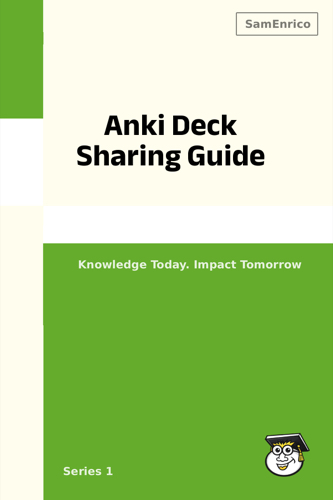
Anki Deck Sharing Guide eBook
Teaches finding and importing shared decks from An
Teaches finding and importing shared decks from AnkiWeb and Reddit.
Formats
Free sample
Chapter 1: The 1,000-Hour Lie--–- Sarah was a second-year medical student with a problem she didn’t know she had. She woke at 5:00 AM every day, brewed coffee that went cold on her desk, and spent two hours hand-crafting flashcards from her lecture slides. By the end of her first semester, she had created 4,700 cards of her own. She was proud of them. They were color-coded, meticulously sourced, and organized into folders she’d named after each exam block.
There was just one problem: she was failing.Not spectacularly. Not “academic probation” failing. But she was consistently below the class average on every single exam, and she couldn’t understand why. She was doing everything right. She was making her own cards.
She was reviewing daily. She wasn’t cheating or taking shortcuts. And yet her classmates—the ones who seemed to study less, who actually went to social events, who never seemed to be hunched over Anki at 2:00 AM—were scoring higher than her.One afternoon, she broke down in the library and admitted her routine to a friend. Her friend looked confused. “Why are you making your own cards?” he asked.
“Just download the An King deck like everyone else.”Sarah felt a flash of indignation. “That’s cheating,” she said. “You don’t learn if you don’t make the cards yourself.”Her friend laughed—not cruelly, but with the exhausted knowingness of someone who had already fought this same battle and won. “That’s the 1,000-hour lie,” he said. “And you’re its victim.”That conversation changed everything.
Within three months, Sarah had deleted most of her hand-made cards, downloaded three shared decks, and climbed from the bottom quartile of her class to the top twenty percent. She wasn’t studying harder. She was studying smarter. And the only thing that had changed was her willingness to use what others had already built.This book exists because Sarah’s story is not an exception. It is the rule.
Over the past decade, a quiet revolution has transformed how top students, language learners, and professionals master complex information. The revolution is called shared Anki decks. And the lie that making your own flashcards is the only path to mastery has probably cost you hundreds of hours already.The Origin of the Lie The belief that you must create your own flashcards to learn effectively didn’t come from nowhere. It came from a well-intentioned but widely misunderstood interpretation of learning science. The original research on the “generation effect”—the finding that people remember information better when they actively produce it rather than passively read it—was conducted in the 1970s using simple word pairs and lists.
Researchers gave participants a list of related words (e.g., “hot” and “cold”) and asked some to generate the second word themselves while others simply read both. The generators remembered more. The conclusion was sound: active generation improves memory.But somewhere along the way, this finding was stretched into an absolute commandment: “Always make your own flashcards.” Textbooks repeated it. Study skills blogs evangelized it. Well-meaning teachers required it.
And for simple, declarative knowledge—vocabulary lists, capital cities, historical dates—it’s not terrible advice. The problem is that most of what we actually need to learn today is not simple. It is interconnected, hierarchical, and voluminous. Medical students need to learn 15,000 discrete facts for Step 1 alone. Law students need thousands of case precedents.
Language learners need 5,000 to 10,000 words for fluency.The generation effect has diminishing returns. Making your own 10,000-card deck is not ten times more effective than using a shared deck. It is often less effective, because the cognitive load of card creation steals mental energy from actual retrieval practice. You cannot spend 400 hours building cards and then claim those hours were “studying.” Most of that time was formatting, typing, and decision-making—not learning.This book will teach you how to reclaim those hundreds of hours without sacrificing retention. The secret is not to stop creating entirely.
The secret is to create only what is necessary and use the collective work of thousands of other learners for the rest.The Minimum Information Principle Before we go further, we need to understand why well-designed shared decks often outperform personal ones. The answer lies in a concept called the Minimum Information Principle, which was first articulated by Piotr Wozniak, the creator of the Super Memo spaced repetition system. The principle is deceptively simple: one card, one fact.That’s it. Every flashcard should ask exactly one thing, and that thing should be answerable in a few seconds. If your card asks “What are the causes, symptoms, and treatments of diabetes?” you have already lost.
That’s three separate cards masquerading as one. A well-constructed deck would split it into:Front: “What is the primary cause of Type 1 diabetes?” Back: “Autoimmune destruction of pancreatic beta cells.”Front: “What are three classic symptoms of untreated diabetes?” Back: “Polyuria, polydipsia, polyphagia.”Front: “What is first-line pharmacotherapy for Type 2 diabetes?” Back: “Metformin.”The Minimum Information Principle works because it aligns with how human memory actually functions. Your brain does not store facts in large, narrative chunks. It stores them in sparse, interconnected networks. Each atomic card strengthens one node in that network.
When you combine multiple facts into a single card, you create a “balloon card”—too much information to lift into long-term memory in one attempt. The card will feel impossible, you will fail it repeatedly, and eventually you will suspend it in frustration.Here’s the crucial insight: well-designed shared decks already follow the Minimum Information Principle. The An King deck, for example, has been refined over years by thousands of medical students who flagged ambiguous cards, split compound facts, and rewrote confusing phrasing. The Core 2000 Japanese deck was professionally designed by linguists who understand frequency and atomicity. When you use these decks, you inherit not just the facts but also the collective wisdom of their designers.Your homemade deck, by contrast, is probably violating the Minimum Information Principle in ways you don’t even notice.
You are too close to the material. You know what you meant when you wrote “What is the deal with the thing about the heart?” The shared deck, vetted by strangers, has no such charity. It must be clear to anyone. And that clarity makes it better for your learning, not worse.Case Study 1: The An King Deck (400,000 Medical Students)No discussion of shared Anki decks is complete without the An King deck. Named for its primary curator, Nick “The An King” (a medical student who started the project as a personal resource), this deck has become the gold standard for medical education.
As of 2025, it contains over 35,000 cards covering the entirety of the USMLE Step 1 and Step 2 exams, organized into a hierarchical tag system that mirrors First Aid for the USMLE, Pathoma, Sketchy Medical, and other major resources.But the numbers alone don’t tell the story. What makes the An King deck transformative is its tagging system. Each card is tagged with every possible context: the organ system (e.g., Cardio::Valves), the source textbook (First Aid::Cardio), the exam topic (USMLE::Pathology), and even the specific…
This is the end of the free sample. Get the eBook to keep going. Buy now
About this book
Details
- Author
- Rector Chanel
- Publisher
- SamEnrico
- Language
- English
- Genre
- Non-Fiction, Self-Help, Crowdsourced
- Released
- 2026-06-05
- Pages (approx.)
- 130
- Available as
- eBook, Audiobook

Read better in the ZLOADR app
Your eBooks on your phone or tablet. Sign in with your SamEnrico account and start reading.
More by Rector Chanel
 Social Media And LonelinessRector Chanel$11.99
 Forensic Hair ComparisonRector Chanel$11.99
 The Senior Micronutrient GuideRector Chanel$11.99
 Emotional Reconnection GuideRector Chanel$11.99
 Crossfit Athlete HypnosisRector Chanel$11.99
 Partner Grief After Infant LossRector Chanel$11.99
 Infant Loss Survival GuideRector Chanel$11.99
 The Spy in the Wire: How a Rogue Intelligence Officer Stole Millions with High-Tech TricksRector Chanel$11.99
 Samuel Coleridge-Taylor: The African Messiah of MusicRector Chanel$11.99
 How to Start a Coupling for Articulated Motor Vehicle Business (Beginners Guide)Rector Chanel$11.99
 How to Produce Flashlights and HeadlampsRector Chanel$11.99
 Great Pyrenees: Independent GuardianRector Chanel$11.99
You may also like
 Hong Kong Handover 1997Dunn Johnnie$11.99
 Zumba For Postnatal Recovery CourseNeal Christian$11.99
 Zumba for BeginnersLadner Nikia$11.99
 YouTube Comment Mining GuideHumes Pandora$12.99
 Worry Box MeditationCarlin Rudy$11.99
 Workplace Stress MeditationNguyen Lynn$11.99
 Workplace Stress and Sleep RepairHawley Ivory$11.99
 Workplace Perfectionism CureDelaney Jeffry$11.99
 Workplace Injustice Anger GuideWallen Isabelle$11.99
 Work Addiction and Burnout LinkGreenwood Ester$11.99
 Women in Yoga and WellnessBeattie Galina$11.99
 Women in Stand Up ComedyChun Evangeline$11.99