
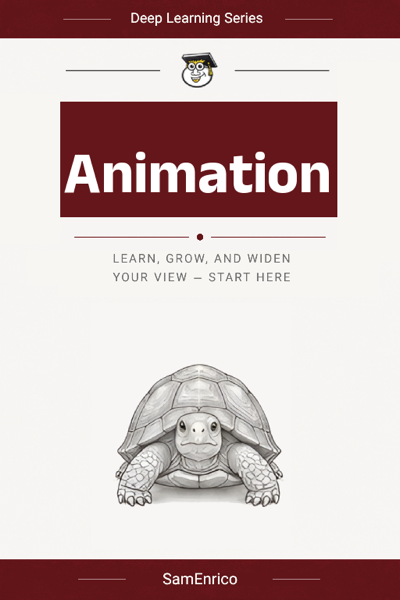
Non-FictionInformativeEducational
Animation eBook
A Coursebook on Animation
A Coursebook on Animation
Formats
Free sample
Chapter 1: The Empty Frame...--Animation is the only art form that exists in the space between things. A painter gives you the canvas, full and finished. A sculptor gives you the stone, carved and complete. A photographer captures the single instant, frozen forever. But an animator gives you nothing — nothing except the promise that if you watch closely enough, the empty frame will fill, the still drawing will move, and the silence will speak.
This is not a metaphor. It is a technical reality. Every animated film you have ever loved began as a void: blank paper, unrendered pixels, a timeline with no marks on it. Your job, as an animator, is to step into that void and convince an audience that something is there.Before you draw a single line, before you open a single software application, before you even choose a character or a story, you must understand what animation actually is. The word comes from the Latin animare — to give life to.
Not to copy life. Not to record life. To give life. This is a profound distinction. A live-action film records what already exists in front of the camera.
An animated film creates what never existed at all. The difference between a bouncing ball and a ball that wants to bounce is the difference between physics and animation. The first follows rules. The second follows desire.This book will teach you both. But before we get to desire — before we get to character, emotion, story, and soul — you must master the rules.
You cannot break what you do not understand. You cannot exaggerate what you have never observed. You cannot give life to a drawing until you understand why dead things fall the way they do.The Two Great Lies About Animation There are two lies about animation that every beginner hears, and both of them are dangerous. The first lie is that animation is about drawing well. The second lie is that animation is about software mastery.Let me be clear: drawing helps.
Software helps. But neither is animation.Animation is about movement. And movement — real, believable, emotionally resonant movement — has nothing to do with how beautifully you render a nostril or how many nodes you can place in a rig. Movement is about time. It is about weight.
It is about the space between one pose and the next. A stick figure animated with perfect timing will move an audience more deeply than a photorealistic dragon that floats through its frames without conviction.The greatest animators in history were not necessarily the greatest draftsmen. They were the greatest observers of motion. They watched how a heavy man shifted his weight before standing up. They studied how a child's arm moved differently from an old woman's.
They noticed that a genuine smile reaches the eyes a full six frames after the mouth opens, while a fake smile never reaches the eyes at all. These are not drawing skills. These are seeing skills.So here is your first assignment, before you even finish this chapter: stop reading for thirty seconds and watch your own hand as you turn the page. Notice the arc of your wrist. The micro-hesitation before your fingers grip.
The way your thumb anticipates the edge of the paper. You have just performed an animation — a sequence of poses, connected by spacing and timing, driven by intention. If you can see that, you can animate it.The Empty Frame: A Philosophy of Beginnings Every animated film, no matter how complex, begins with a single empty frame. This frame is the animator's equivalent of the writer's blank page or the musician's silent bar. It is terrifying.
It is also the only place where infinite possibility exists.Consider what happens when you look at an empty frame. Your mind, hungry for pattern, immediately begins to fill it. You imagine where a character might stand. You feel the weight of the space. This is not weakness — it is the beginning of vision.
Professional animators learn to see the empty frame as a container, not an absence. It has dimensions (width, height, depth if you are working in 3D). It has a duration (measured in frames per second, typically 24 for film, 30 for television, 60 for some games). It has a relationship to every other empty frame that will come before and after it.The empty frame is also honest in a way that no other artistic medium is. In painting, you can hide a mistake under layers of pigment.
In writing, you can bury confusion in elegant sentences. In animation, the frame does not lie. If your timing is wrong, the audience will feel it before they can name it. If your spacing is uneven, the motion will stutter. If your weight is inconsistent, the character will seem to float through a dream, disconnected from any physical reality.This is why animation is so hard.
And this is why animation, when done well, is so powerful. The audience does not merely watch an animated film — they trust it. They trust that the bouncing ball will hit the ground at the right moment. They trust that the character's sadness will manifest in the slump of a shoulder. When that trust is honored, the audience forgets they are watching drawings.
They see life.The Timeline: Your True Canvas A painter's canvas is measured in inches. A sculptor's stone is measured in pounds. An animator's canvas is measured in frames — the individual still images that, when played in sequence, create the illusion of motion. If you are working at the standard film rate of 24 frames per second, then every second of your animation contains 24 distinct drawings (or computer-generated images). A ten-second shot contains 240 frames.
A ninety-minute feature film contains approximately 129,600 frames.Stop and let that number land. A hundred and twenty-nine thousand frames. Each one slightly different from the one before. Each one a deliberate choice about where a character stands, how their weight is distributed, what their face is doing. This is not a medium for the impatient.
This is a medium for people who understand that small differences, accumulated over time, create the illusion of life.The timeline — that horizontal strip of numbered frames that runs across the bottom of every animation software — is where you will spend most of your working life. It is not a technical nuisance. It is the musical score of your visual symphony. Each frame is a note. Some notes hold longer (slow motion).
Some notes are staccato (fast action). Some notes are silent (holds and pauses). Learning to read and write on the timeline is the single most important technical skill you will acquire.Let us practice right now, with your mind alone. Imagine a ball dropping from the top of the frame to the bottom. If you have 24 frames to work with (one second of screen time), the ball will fall quickly, with perhaps a brief pause at the bottom.
If you have 48 frames (two seconds), the ball will fall slowly, as if through water or under low gravity. If you have 12 frames (half a second), the ball will crash down violently, barely visible as a discrete object. The same…
This is the end of the free sample. Get the eBook to keep going. Buy now
About this book
Details
- Author
- Quinn Colleen
- Publisher
- SamEnrico
- Language
- English
- Genre
- Non-Fiction, Informative, Educational
- Released
- 2026-06-03
- Pages (approx.)
- 153
- Available as
- eBook, Audiobook

Read better in the ZLOADR app
Your eBooks on your phone or tablet. Sign in with your SamEnrico account and start reading.
More by Quinn Colleen
 Stress To Strength GuideQuinn Colleen$11.99
 Mental Health Crisis De escalationQuinn Colleen$11.99
 Front Running CasesQuinn Colleen$11.99
 The Powerlifter Psych UpQuinn Colleen$11.99
 Antwerp Diamond Heist Fake Security DetailQuinn Colleen$11.99
 Bread and Bullets: The 1911 Triangle Shirtwaist Fire and the Rise of LaborQuinn Colleen$11.99
 The Cartographers' Gambit: Mapping the Atlantic's Hidden DesertsQuinn Colleen$11.99
 Understanding Dibasic Aminoaciduria 2Quinn Colleen$17.99
 Ultimate Handbook Guide to Rotterdam : (Netherlands) Travel GuideQuinn Colleen$11.99
 Partnership BOI GuideQuinn Colleen$12.99
 German Opportunity Card GuideQuinn Colleen$12.99
You may also like
 Hong Kong Handover 1997Dunn Johnnie$11.99
 Zumba For Postnatal Recovery CourseNeal Christian$11.99
 Zumba for BeginnersLadner Nikia$11.99
 YouTube Comment Mining GuideHumes Pandora$12.99
 Worry Box MeditationCarlin Rudy$11.99
 Workplace Stress MeditationNguyen Lynn$11.99
 Workplace Stress and Sleep RepairHawley Ivory$11.99
 Workplace Perfectionism CureDelaney Jeffry$11.99
 Workplace Injustice Anger GuideWallen Isabelle$11.99
 Work Addiction and Burnout LinkGreenwood Ester$11.99
 Women in Yoga and WellnessBeattie Galina$11.99
 Women in Stand Up ComedyChun Evangeline$11.99