
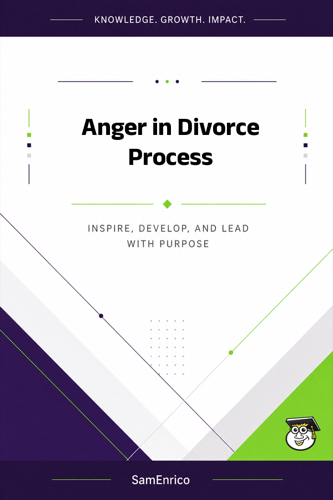
Free sample
Chapter 1: The Iceberg Lies--The moment you realized your marriage was truly over, something cracked open inside you. It wasn't just the loss of a spouse. It was the loss of a future you had been promised, a story you had been telling yourself, a mirror that had been reflecting back a version of yourself you actually liked. And then, in the space of a conversation, a text message, a document served by a stranger, that mirror shattered.What came next, for most people, was not primarily sadness. It was not grief, not at first.
It was rage. A hot, blinding, teeth-clenching rage that seemed to come from somewhere outside yourself, as if someone had opened a door in your chest and unleashed an animal you did not recognize. You have said things you never thought you would say. You have typed emails at 2:00 AM that you deleted—or worse, sent. You have sat in a parked car outside your own home, hands shaking on the steering wheel, unable to go inside because the thought of seeing their face made you want to break something.Here is what no one told you: that rage is not your enemy.
It is not a sign that you are broken, or unstable, or unworthy of love in the future. It is not something to be ashamed of, suppressed, or medicated away. That rage is the most honest thing about you right now. It is the part of you that still knows, with absolute certainty, that you deserved better.The problem is not that you are angry. The problem is where you are pointing that anger.
And the problem is that you have been given a map that is completely wrong.Welcome to the first chapter of a book that will not tell you to "let go" of your anger, breathe deeply until it disappears, or forgive your way to freedom. Those approaches work for some people, at some stages, in some divorces. But they do not work for the kind of anger that comes from betrayal, abandonment, financial destruction, or the slow erasure of your identity by someone who once promised to love you forever.This book operates on a single, counterintuitive premise: your anger is information. It is a smoke alarm. And you have been spending all your energy trying to smash the alarm instead of looking for the fire.The Anatomy of Divorce Rage Let us begin by distinguishing between two very different kinds of anger.
Most people, including many therapists, treat all anger as if it were the same substance, varying only in volume. This is a catastrophic error.Situational anger is what you feel when something specific, discrete, and time-limited happens. Your ex shows up forty-five minutes late to pick up the children without calling. You discover they withdrew money from a joint account you were told was frozen. They send a text message on your birthday that reads only "per the decree, please confirm receipt of this message." Situational anger has a clear trigger.
It rises quickly, burns hot, and—if you handle it reasonably well—subsides once the situation is addressed. This kind of anger is not pleasant, but it is manageable. It responds well to breathing exercises, time-outs, and the tactical communication tools we will cover in later chapters.Deep-seated fury is something else entirely.Deep-seated fury is not about any single event. It is a pervasive, atmospheric sense of having been erased, abandoned, or unjustly blamed for the entire failure of the marriage. It is the feeling that your history has been rewritten without your consent, that your contributions have been forgotten, that your suffering has been minimized, and that you are now being asked to sign a legal document that codifies this false narrative into law.
Deep-seated fury does not respond to a single conversation or a fair settlement offer. It is not about the money, not really. It is about the story. Someone took the story of your life and changed the ending without telling you.This is the anger that wakes you at 3:00 AM. This is the anger that makes you want to burn it all down.
This is the anger that, if channeled correctly, can rebuild you from the ground up—and if channeled incorrectly, can destroy everything you have left, including your relationship with your children, your financial future, and your own mental health.Which kind of anger are you dealing with? Most people in divorce are dealing with both. The situational anger arrives daily, like waves. The deep-seated fury is the tide itself.Ambiguous Loss: Why Divorce Grief Is Different To understand divorce rage, you must first understand a concept that grief psychologists call "ambiguous loss." This term was coined by Dr. Pauline Boss to describe a loss that is not clean, not final, not accompanied by the rituals and social support systems that help human beings heal.When someone dies, you grieve.
You have a funeral. People bring casseroles. There is a shared social script: you are sad, you are allowed to be sad, and over time, the sadness changes shape. The person is gone. You do not get angry texts from them on the anniversary of the death.
You do not have to negotiate Thanksgiving visitation with their ghost. You do not run into them at the grocery store with a new partner and a new baby and a new life while you are still wearing sweatpants and crying in the frozen food aisle.Divorce is the opposite of all of that.Your ex is not dead. They are very much alive, and they continue to have opinions about you, access to your financial information, and legally enforceable rights to your time and attention. They appear at school plays. They text you about dental appointments.
They have a new key to your children's hearts, and possibly a new person sleeping in the bed you used to share.This is ambiguous loss. You have lost someone who is still present. You cannot fully grieve because the person keeps reappearing. You cannot fully move on because the legal system, and often your children, require ongoing contact. And every time that contact happens, it rips the scab off the wound and invites fresh anger to flood in.No wonder you are furious.
Your brain is being asked to do something impossible: treat someone as simultaneously gone and present, irrelevant and essential, dead to you and alive in your living room. This cognitive dissonance is exhausting. And exhaustion, over time, becomes rage.Betrayal as the Engine of Divorce Anger In her landmark book Crazy Time, Abigail Trafford studied hundreds of divorcing individuals and identified a pattern that has held up across decades of subsequent research: anger in divorce almost always stems from a sense of betrayal. Not merely the betrayal of a marital vow, though that is painful enough. Deeper than that is the betrayal of a shared narrative.You and your spouse, at some point, told each other a story about your future.
Maybe it was simple: we will grow old together, we will watch our children graduate, we will retire somewhere warm. Maybe it was more complicated: we will survive…
This is the end of the free sample. Get the eBook to keep going. Buy now
About this book
Details
- Author
- Moreland Herlinda
- Publisher
- SamEnrico
- Language
- English
- Genre
- Non-Fiction, Self-Help / Divorce
- Released
- 2026-06-08
- Pages (approx.)
- 150
- Available as
- eBook, Audiobook

Read better in the ZLOADR app
Your eBooks on your phone or tablet. Sign in with your SamEnrico account and start reading.
More by Moreland Herlinda
 Stevie Wonder InnervisionsMoreland Herlinda$11.99
 Self Doubt In Caregiving GuideMoreland Herlinda$11.99
 Housing Preference Contrast StudyMoreland Herlinda$11.99
 The Interruption Buffer ZoneMoreland Herlinda$11.99
 Sleep Memory For College StudentsMoreland Herlinda$11.99
 Low Carb Snacks HandbookMoreland Herlinda$11.99
 Long Term Care FundingMoreland Herlinda$11.99Long Term Care FundingMoreland Herlinda$11.99
 The Phantom of the Andes: A Dog’s Hunt for Peru’s Greatest HoaxMoreland Herlinda$11.99
 The Battle of Talikota: The Fall of VijayanagaraMoreland Herlinda$11.99
 Understanding Head InjuryMoreland Herlinda$11.99
 A Collector's Handbook to the Buick SkylarkMoreland Herlinda$11.99
You may also like
 Affirmations for Divorce RecoveryLaplante Eulalia$11.99
 Divorce Conversations GuideGalvez Jerrie$11.99
 Divorce Recovery HandbookTorres Elsie$11.99
 Child Loss and DivorceBowles Shemika$11.99
 Pet Loss After DivorceMonson Taneka$11.99
 Stress and Divorce ManagementLedbetter Dell$11.99
 Empathy for DivorceKincaid Kathey$11.99