
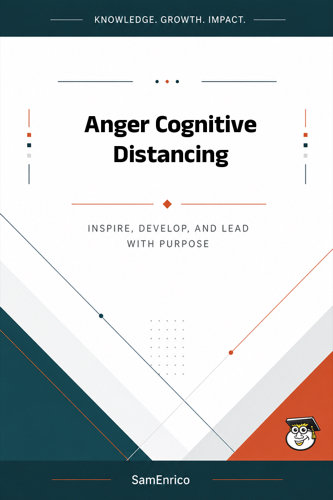
Anger Cognitive Distancing
Observe angry thoughts as mental events, not facts
by Yoo Mellisa
Observe angry thoughts as mental events, not facts.
Formats
About this book
Free sample
Chapter 1: The Shape of a Lie–- The first time David yelled at his wife, he didn't feel like a monster. He felt like a victim. The thought arrived fully formed, wrapped in the warm blanket of justification: She knew this mattered to me. She did this on purpose. Anyone would be furious.
These thoughts did not feel like thoughts. They felt like gravity—undeniable, physical, true. His voice rose. His chest tightened. The words left his mouth before he could catch them, and in the silence that followed, he watched his wife's face crumple.
He told himself he was justified. He told himself she had pushed him. He told himself that if she had just been on time, none of this would have happened. Every thought felt like a mirror reflecting reality exactly as it was.David was wrong. Not about being angry—the emotion was real.
Not about feeling hurt—that was real too. He was wrong about the relationship between his thoughts and the truth. He had committed the most common, most seductive, and most destructive error in human emotional life: he had mistaken a thought for a fact.This is the illusion of the justified explosion. It is the belief that because a thought feels true, it is true, and therefore acting on it is not only permissible but necessary. It is the psychological mechanism that allows a reasonable person to become unreasonable, a loving person to become cruel, a patient person to become a stranger to themselves.
And it is not a character flaw. It is not a failure of willpower. It is a predictable, biological, and psychological process called cognitive fusion—and once you understand how it works, you can learn to break its grip.The Architecture of Belief Every angry thought arrives with a peculiar authority. Unlike a passing daydream or a momentary worry, an angry thought announces itself as a verdict. He disrespected me.
She took advantage. This is unfair. They should know better. These statements do not present as hypotheses. They present as findings.
The brain, when angry, does not say, "I am having a thought that I have been wronged." It says, "I…
This is the end of the free sample. Get the eBook to keep going. Buy now
Contents
- Chapter 1
- Chapter 2
- Chapter 3
- Chapter 4
- Chapter 5
- Chapter 6
- Chapter 7
- Chapter 8
- Chapter 9
- Chapter 10
- Chapter 11
- Chapter 12
Details
- Author
- Yoo Mellisa
- Publisher
- SamEnrico
- Language
- English
- Genre
- Non-Fiction, Self-Help, Cognitive Distancing
- Released
- 2026-06-06
- Pages (approx.)
- 160
- Available as
- eBook, Audiobook

Read better in the ZLOADR app
Your eBooks on your phone or tablet. Sign in with your SamEnrico account and start reading.
More by Yoo Mellisa
 Diabetes and Depression GuideYoo Mellisa$11.99
 Medically Supervised Stimulant DetoxYoo Mellisa$11.99
 House Cleaning Routine HackYoo Mellisa$11.99
 SRS for Speech PreparationYoo Mellisa$11.99
 Pet Loss for Seniors GuideYoo Mellisa$11.99
 Paleo Diet BasicsYoo Mellisa$11.99
 Blue Zone Breakfast GuideYoo Mellisa$11.99
 Love on the Edge: Travis Pastrana and Lyn-Z Adams' High-Flying RomanceYoo Mellisa$11.99
 The Poisoner of Rio: Maria da Fofoca and the Shadows of 19th-Century BrazilYoo Mellisa$11.99
 Service Providers Guide to Title CompaniesYoo Mellisa$11.99
 A Collector's Handbook to the Graham Custom SuperchargerYoo Mellisa$11.99
 Mercury Bank Remote Account GuideYoo Mellisa$12.99