
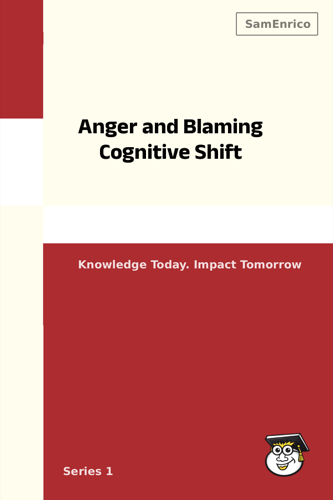
Anger and Blaming Cognitive Shift
Move from assigning blame to problem-solving by ch
Move from assigning blame to problem-solving by changing your attribution style.
Formats
About this book
Free sample
Chapter 1: The Attribution Trap--Most people live their entire lives believing a lie about anger. The lie is this: that events cause emotions. Your partner forgets your anniversary, and you feel angry. A driver cuts you off, and you rage. A colleague misses a deadline, and you seethe.
The sequence seems so obvious, so immediate, so causal, that questioning it feels like questioning whether the sun will rise tomorrow. Of course the event caused the anger. What else could it be?Everything, it turns out. Everything.The truth—discovered through decades of research in social psychology and cognitive neuroscience—is that events do not cause emotions. Attributions cause emotions.
An attribution is the story you tell yourself about why something happened. And here is the trap that catches almost everyone: once your brain identifies a cause, it automatically begins searching for a culprit. This search is so fast, so automatic, so neurologically efficient that you never see it happening. You only feel the result: the hot rush of anger, the satisfying clarity of knowing exactly who is to blame, the righteous certainty that someone deserves to suffer for what they have done.This chapter is about dismantling that illusion. It is about understanding the cognitive machinery behind blame so that you can finally see it for what it is—not a window into moral truth, but a shortcut.
A shortcut that evolved to protect you from predators and cheaters, yes, but a shortcut that routinely misfires in the modern world, turning minor frustrations into relationship-wrecking conflicts and small misunderstandings into grudges that last decades.By the end of this chapter, you will understand Bernard Weiner’s foundational theory of social motivation, the critical distinction between cold judgments and hot emotions, and the precise mechanism by which your brain turns a neutral observation into a burning need for punishment. You will also take a self-assessment that will reveal your default attribution style—the particular way you habitually explain the behavior of others. And perhaps most importantly, you will begin to see the trap before it snaps shut.The Man Who Didn't Respond to a Text Let…
This is the end of the free sample. Get the eBook to keep going. Buy now
Contents
- Chapter 1
- Chapter 2
- Chapter 3
- Chapter 4
- Chapter 5
- Chapter 6
- Chapter 7
- Chapter 8
- Chapter 9
- Chapter 10
- Chapter 11
- Chapter 12
Details
- Author
- Chilton Jocelyn
- Publisher
- SamEnrico
- Language
- English
- Genre
- Non-Fiction, Self-Help, Blame
- Released
- 2026-06-06
- Pages (approx.)
- 155
- Available as
- eBook, Audiobook

Read better in the ZLOADR app
Your eBooks on your phone or tablet. Sign in with your SamEnrico account and start reading.
More by Chilton Jocelyn
 Parent Caregiver Of Disabled AdultChilton Jocelyn$11.99
 Walking Meditation For Yoga Practitioners GuideChilton Jocelyn$11.99
 Unexplained Infertility WorkbookChilton Jocelyn$11.99
 The Neill's March Atrocities GuideChilton Jocelyn$11.99
 The Clown’s Shadow: The Dark Legacy of John Wayne Gacy’s SonChilton Jocelyn$11.99
 How to Become a Turning Lathe TenderChilton Jocelyn$11.99
 China Scholarship Personal StatementChilton Jocelyn$12.99
 Production Leveling with Safety StockChilton Jocelyn$12.99
 Understanding Oculocerebral Syndrome With HypopigmentationChilton Jocelyn$17.99
 Yahoo AnswersChilton Jocelyn$11.99
You may also like
 Hong Kong Handover 1997Dunn Johnnie$11.99
 Zumba For Postnatal Recovery CourseNeal Christian$11.99
 Zumba for BeginnersLadner Nikia$11.99
 YouTube Comment Mining GuideHumes Pandora$12.99
 Worry Box MeditationCarlin Rudy$11.99
 Workplace Stress MeditationNguyen Lynn$11.99
 Workplace Stress and Sleep RepairHawley Ivory$11.99
 Workplace Perfectionism CureDelaney Jeffry$11.99
 Workplace Injustice Anger GuideWallen Isabelle$11.99
 Work Addiction and Burnout LinkGreenwood Ester$11.99
 Women in Yoga and WellnessBeattie Galina$11.99
 Women in Stand Up ComedyChun Evangeline$11.99