
Non-FictionSelf-HelpAction Planning
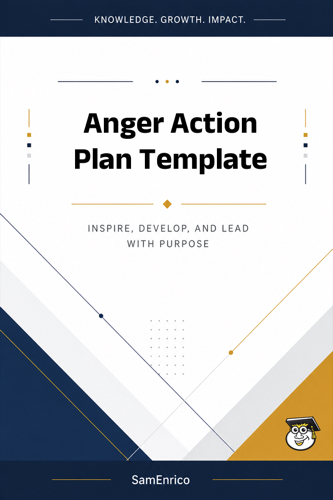
Anger Action Plan Template eBook
Fill in the blank crisis plan for when you feel ra
Fill in the blank crisis plan for when you feel rage escalating.
Formats
Free sample
Chapter 1: The Leash on the Lion–- Most people believe that anger is a sudden, uncontrollable explosion—a landmine buried in the nervous system that detonates without warning. They describe it as “seeing red,” “losing it,” or “snapping.” And because they believe anger arrives like a lightning strike, they also believe there is nothing they can do to stop it once it starts. This belief is wrong, and it is expensive. It costs relationships, jobs, physical health, and the quiet dignity of knowing you are in charge of yourself. The truth, which this entire book is built upon, is that anger does not strike from nowhere.
It escalates along a predictable, observable path. And on that path, there are doors. This chapter is about finding those doors before you need them.Anger is not the enemy. Unmanaged escalation is. Every person who has ever regretted an angry outburst—every slammed door, every shouted word, every broken object, every silent treatment that lasted too long—wishes they had seen the warning signs five minutes earlier.
But you cannot see what you have not trained yourself to look for. This chapter transforms you from a passive passenger inside your own rage into an active observer of its earliest movements. You will build something simple but profound: a personalized anger profile. Not a theory. Not a lecture.
A practical, fill-in-the-blank map of exactly how anger moves through your particular body and mind. By the end of this chapter, you will know your top three triggers, your unique physical warnings, your personal escalation timeline, and—most importantly—the exact level at which you must activate your crisis plan. No guesswork. No abstract advice. Just your data, written in your words, ready to save you from your next explosion.The Myth of the Sudden Explosion Let us start with a metaphor that will appear throughout this book.
Imagine a lion in a cage. The lion is powerful, dangerous, and capable of tremendous destruction. Most people think anger is the lion suddenly breaking free—one moment calm, the next moment carnage. But that is not how anger works. Anger is not the lion.
Anger is the temperature rising in the room before the lion even stirs. It is the keeper noticing the cage door left unlocked. It is the first low growl that says, “Pay attention.” By the time the lion charges, there have already been a dozen signals. The problem is not that the signals were absent. The problem is that most people have never learned to read them.Research from the field of affective neuroscience confirms this.
Brain imaging studies show that the amygdala—the brain’s threat detection center—activates within milliseconds of a trigger. But the prefrontal cortex, which governs impulse control and rational decision-making, takes several seconds longer to engage. That gap, that tiny window of neural lag, is where rage is born. If you do nothing during those seconds, the amygdala continues to fire, adrenaline floods your system, and your body prepares for attack. But if you have pre-trained yourself to recognize the first signal—a change in breathing, a tension in the jaw, a specific thought pattern—you can interrupt that cascade before it reaches full force.This is not optimism.
This is neurobiology. The brain is plastic. It can be rewired. But rewiring requires repetition, and repetition requires a plan. That plan begins with self-knowledge.
Not vague self-knowledge like “I have a temper,” but precise, granular knowledge: What exactly does my anger look like at level 3 versus level 7? How many minutes pass between irritation and explosion? Which physical sensation always appears first? These are not academic questions. They are the difference between catching your anger when it is a manageable spark and fighting it when it is a five-alarm fire.Your Personal Anger Profile: A Diagnostic Tool This chapter provides the foundational document for your entire Anger Action Plan.
Everything that follows—every script, every pause protocol, every escape hatch—depends on the accuracy of what you write here. Do not rush. Do not guess. Take time to remember real episodes from your past. If you cannot recall specific details, carry this book with you for a few days and make notes when anger arises at even low levels.
The more honest and specific you are, the more useful this profile will be.The profile consists of four interconnected sections. Each section builds on the previous one. By the end, you will have a single-page reference that tells you: what to watch for, when to act, and how much time you have.Section One: Your Top Three Rage Triggers A trigger is any event, situation, person, or internal state that reliably provokes an anger response. Triggers are not random. They follow patterns.
Most people have two or three primary triggers that account for eighty percent of their rage episodes. Identify yours.To do this, think back over the past three to six months. Recall three specific moments when you felt anger rise beyond a level 5 on a 1-to-10 scale (where 1 is completely calm and 10 is an explosive outburst). For each moment, ask yourself: What was happening immediately before I felt the first twinge of anger? Be as specific as possible.
Do not write “people disrespect me.” Write “when my partner interrupts me while I am speaking, especially if I have already asked them not to.” Do not write “traffic.” Write “when I am already running late and the car in front of me slows down without signaling.”Write your three triggers in the spaces below. Use pencil or pen. This is not permanent; you will revise it as you learn more.Trigger 1: _________________________________________________________________Trigger 2: _________________________________________________________________Trigger 3: _________________________________________________________________Now, add detail. For each trigger, note:Does it happen more often at a particular time of day?Is it worse when you are tired, hungry, or already stressed?Does it involve a specific person, or could anyone do the same action?Example: *“Trigger 1: When my teenage son says ‘whatever’ and walks away while I am mid-sentence. Worse at 7 PM after work.
Much worse if I haven’t eaten since noon.”*Detail for Trigger 1: _________________________________________________________________Detail for Trigger 2: _________________________________________________________________Detail for Trigger 3: _________________________________________________________________These triggers are not your fault. They are data. They tell you where your anger lives. Later chapters will teach you how to respond to them. For now, simply name them.Section Two: Your Physical Warning Signs Before your anger reaches your voice or your hands, it arrives in your body.
The body is honest. It never lies. If you learn to listen to it, you will gain a fifteen-to-sixty-second advantage over your rage. That advantage is enough time to activate your plan.Physical warning signs vary from person to person. Some people feel heat in their chest or face.
Others notice their jaw clenching or their fists balling. Some experience tunnel vision, rapid heartbeat, shallow breathing, or a sensation of pressure behind their eyes. A few notice their shoulders rising toward their ears or their stomach tightening. None of these are random. They are the autonomic nervous system preparing for perceived threat.Complete the body scan below.
Sit quietly for two minutes. Close your eyes if that helps. Imagine yourself in one of your trigger situations from…
This is the end of the free sample. Get the eBook to keep going. Buy now
About this book
Details
- Author
- Malcolm Misha
- Publisher
- SamEnrico
- Language
- English
- Genre
- Non-Fiction, Self-Help, Action Planning
- Released
- 2026-06-06
- Pages (approx.)
- 146
- Available as
- eBook, Audiobook

Read better in the ZLOADR app
Your eBooks on your phone or tablet. Sign in with your SamEnrico account and start reading.
More by Malcolm Misha
 Romania Remote Work PlaybookMalcolm Misha$11.99
 IBS Food Journal MethodMalcolm Misha$11.99
 Postpartum Depression and Emdr TherapyMalcolm Misha$11.99
 Cocaine Recovery Financial Recovery CourseMalcolm Misha$11.99
 The Peer Review DiscussionMalcolm Misha$11.99
 Artistic Teen Self EsteemMalcolm Misha$11.99
 Foot and Ankle Pain Exercise ManualMalcolm Misha$11.99
 Construction Zone PatienceMalcolm Misha$11.99
 The Vanishing Doctor: The Unsolved Mystery of Dr. William PalmerMalcolm Misha$11.99
 The First Lady Who Wrote Her Own Rules: Hillary Clinton’s Unseen DiplomacyMalcolm Misha$11.99
 Love Letters from the Spice Route: A Portuguese Cartographer’s Secret AffairMalcolm Misha$11.99
 Understanding Angiosarcoma of The LiverMalcolm Misha$17.99
You may also like
 Hong Kong Handover 1997Dunn Johnnie$11.99
 Zumba For Postnatal Recovery CourseNeal Christian$11.99
 Zumba for BeginnersLadner Nikia$11.99
 YouTube Comment Mining GuideHumes Pandora$12.99
 Worry Box MeditationCarlin Rudy$11.99
 Workplace Stress MeditationNguyen Lynn$11.99
 Workplace Stress and Sleep RepairHawley Ivory$11.99
 Workplace Perfectionism CureDelaney Jeffry$11.99
 Workplace Injustice Anger GuideWallen Isabelle$11.99
 Work Addiction and Burnout LinkGreenwood Ester$11.99
 Women in Yoga and WellnessBeattie Galina$11.99
 Women in Stand Up ComedyChun Evangeline$11.99