
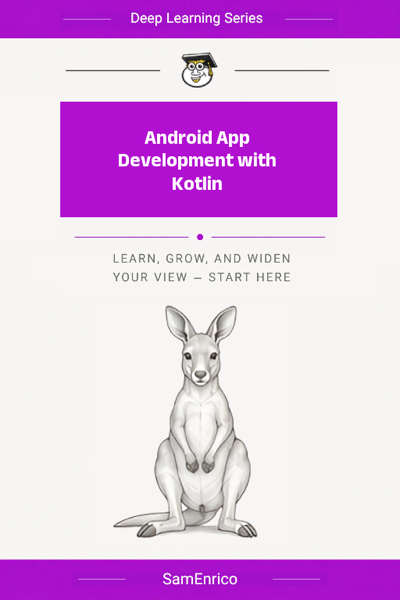
Android App Development with Kotlin eBook
A Coursebook on Android App Development with Kotli
A Coursebook on Android App Development with Kotlin
Formats
Free sample
Chapter 1: The Invisible Continent...---- Every time you unlock your phone, you step onto an invisible continent. It has no physical geography, no rivers or mountain ranges, yet more than 2.5 billion people inhabit it. Its cities are apps. Its roads are navigation stacks. Its economy moves faster than any nation’s on Earth. This continent is the Android ecosystem, and by the time you finish this chapter, you will not only understand its terrain—you will begin building your own settlement upon it.Welcome to Android App Development with Kotlin: A Modern Coursebook. This is not a reference manual you keep on a shelf, dust gathering on its spine while you desperately search Stack Overflow for the third time this hour. This is a working book, a field guide for digital explorers, and the first chapter of a journey that will take you from absolute beginner to competent, employable Android developer. We will build a single, cohesive application called Wander Log—a travel journal app—across twelve chapters, adding features, fixing bugs, and learning the rhythms of real development along the way.Before we write a single line of code, however, you need to understand the land you are about to settle. Where did Android come from? Why does Kotlin matter? What is this thing called Jetpack Compose, and why has it turned the old way of building apps upside down? And most importantly: how do you navigate the economic and technical realities of building software that might one day reach millions of users?Let us begin.The Birth of an Operating System In 2005, a small startup called Android Inc. did something unremarkable on paper and world-changing in retrospect. Google acquired them for an estimated $50 million. At the time, Android had produced little more than some promising ideas about mobile software. The smartphone market belonged to Black Berry, Nokia’s Symbian, and the rising tide of Apple’s soon-to-be-announced i Phone. Google’s acquisition seemed like a footnote.It was anything but.Google saw what others missed: mobile phones would become the primary computing device for most humans on the planet. And if Google’s services—search, maps, email, advertising—were going to thrive in that future, Google needed a say in how those phones worked. But instead of building a phone themselves (that would come later, clumsily, with the Nexus and Pixel lines), Google did something audacious. They made Android open source.On November 5, 2007, the Open Handset Alliance announced Android. The source code would be freely available under the Apache License. Any manufacturer—Samsung, LG, HTC, Motorola, even a startup in Shenzhen—could take Android, modify it, and put it on their hardware without paying Google a cent. This was the nuclear option in a market dominated by proprietary systems. And it worked.By 2011, Android was the best-selling smartphone operating system globally. By 2017, it had over two billion active devices. Today, Android runs on more than three billion devices worldwide: phones, tablets, watches, TVs, car dashboards (Android Auto), refrigerators, point-of-sale terminals, and even some airplane entertainment systems. Android is the Windows of mobile—ubiquitous, slightly messy, endlessly customizable, and absolutely everywhere.The Open Source Question: AOSP vs. Google Mobile Services Here is where many beginners get confused. When people say "Android is open source," they are technically correct but practically incomplete. The Android Open Source Project (AOSP) is indeed free. You can download it, compile it, and install it on a compatible device without signing any agreement with Google. This is how Amazon built Fire OS for its Kindle tablets. This is how Chinese manufacturers ship phones in markets where Google is blocked.But the Android you know—the one with the Play Store, Google Maps, Gmail, Chrome, and push notifications—is not AOSP. It is AOSP plus Google Mobile Services (GMS). GMS is proprietary software that Google licenses to manufacturers. It includes the Play Store, Google Play Services (a background library that handles authentication, location, ads, and countless other features), and a suite of Google apps. If you want your phone to have the familiar Android experience, you need a license from Google.Why does this matter to you, a budding app developer? Because your app will almost certainly depend on Google Play Services. Crash reporting, in-app updates, location services, push notifications, and map integrations all flow through that proprietary layer. Unless you are building for the Chinese market or a specialized device, you are building for the Google-licensed version of Android. Understanding this distinction early will save you confusion when you read about "custom ROMs" or see developers debating the ethics of Google's control over the ecosystem.The Tech Stack War: Kotlin vs. Java vs. C++Android is written in multiple languages, and the choice of which one to learn can feel paralyzing. Here is the simple truth for a new developer in 2025: Kotlin is your primary language. Java is legacy but unavoidable. C++ is optional and specialized.Let me explain each.Java: The Old King When Android launched, its only official language was Java. Developers wrote Android apps using Java syntax, compiled to bytecode, ran on a custom virtual machine called Dalvik (later replaced by ART, the Android Runtime). For nearly a decade, Java was Android. You can still write Android apps in Java today. Most of the Android framework’s internal code is written in Java. Countless corporate codebases—some powering banks, airlines, and government services—remain entirely in Java.But Java has warts. Its null safety is a joke: every object reference can be null, and the compiler does nothing to stop you from dereferencing a null pointer until your app crashes at runtime. Its verbosity is legendary: getters, setters, constructors, and boilerplate that makes simple classes balloon into pages of code. And its evolution, while solid, has been slower than developers wanted.You will encounter Java code. You will maintain Java codebases. You will even call Java libraries from Kotlin seamlessly. But you will write new features in Kotlin.Kotlin: The Bright Future In 2017, Google announced first-class support for Kotlin. In 2019, they declared it preferred for Android development. What took them so long? Kotlin, created by Jet Brains (the company behind Intelli J IDEA, Google’s Android Studio is built on top of it), fixed nearly every major complaint developers had about Java.Consider this Java class:java Copy Downloadpublic class User {
private String name; private int age;
public User(String name, int age) { this.name = name; this.age = age; }
public String get Name() { return name; }
public void set Name(String name) { this.name = name; }
public int get Age() { return age; }
public void set Age(int age) { this.age = age; } }Now consider the same class in Kotlin:kotlin Copy Downloaddata class User(val name: String, val age: Int)That is it. One line. The Kotlin version automatically generates a constructor, getters, equals(), hash Code(), to String(), and a copy() method. It is null-safe by default: unless you explicitly mark a type as nullable (with a ?), the compiler guarantees it will never be null. This single feature eliminates an entire category of crashes that plagued Java Android apps for years.Google cited studies showing that teams using Kotlin saw a 21% reduction in crash rates and…
This is the end of the free sample. Get the eBook to keep going. Buy now
About this book
Details
- Author
- Murphy Arlene
- Publisher
- SamEnrico
- Language
- English
- Genre
- Non-Fiction, Informative, Educational
- Released
- 2026-05-09
- Pages (approx.)
- 146
- Available as
- eBook, Audiobook

Read better in the ZLOADR app
Your eBooks on your phone or tablet. Sign in with your SamEnrico account and start reading.
More by Murphy Arlene
 Mortician Embalmer StressMurphy Arlene$11.99
 Body Scan For Multiple SclerosisMurphy Arlene$11.99
 Body Image In Intimate Relationships GuideMurphy Arlene$11.99
 Overstimulation Anger GuideMurphy Arlene$11.99
 Madagascar Spiny Forest TraverseMurphy Arlene$11.99
 Client Bankruptcy Cash ReserveMurphy Arlene$11.99
 Carlsbad Caverns VanishedMurphy Arlene$11.99
 RuPaul Drag RaceMurphy Arlene$11.99
 Byzantium's Shield: The Plague Doctors of ConstantinopleMurphy Arlene$11.99
 The Beast of Gévaudan: France’s Phantom WolfMurphy Arlene$11.99
 The Mineral Guide to AntitaeniteMurphy Arlene$11.99
 Middle East Sales Account PlanningMurphy Arlene$12.99