
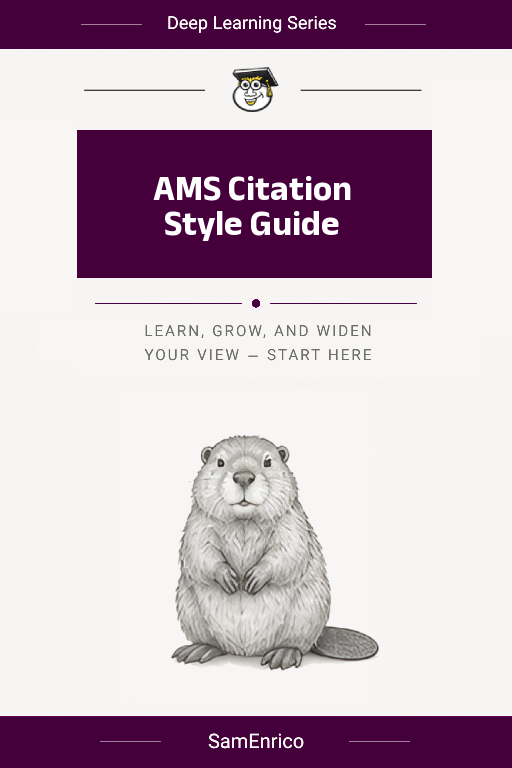
Non-FictionStudent's ShortcutAMS
AMS Citation Style Guide
Cite mathematical sources using American Mathemati
Cite mathematical sources using American Mathematical Society citation format.
Formats
About this book
Free sample
Chapter 1: Beyond Brackets...–- Every mathematical proof, no matter how elegant, stands on the shoulders of those who came before. Yet for centuries, mathematicians argued more about theorems than about how to credit them. The humble citation—that bracketed number tucked between equations—seems almost invisible. But its invisibility is precisely the point. When a citation works perfectly, you do not notice it.
When it fails, your reader stumbles, your argument weakens, and your credibility suffers. This book exists because mathematical writing demands something that general citation styles like APA, MLA, or Chicago cannot provide: a system designed for symbols, not sentences; for theorems, not paragraphs; for preprints, not print-bound traditions.The American Mathematical Society (AMS) citation format emerged not from arbitrary committee decisions but from the lived reality of mathematical research. Mathematicians cite differently because they think differently. A historian might cite a dozen sources per page. A mathematician might cite a hundred in a single paper, often numbering them sequentially and referring to specific equations or theorems within those sources.
Try doing that smoothly with parenthetical author names. (Smith, 2021, Theorem 4.2), x = 2 becomes a jumble of parentheses that compete with the mathematics itself. The AMS solution—bracketed numbers—separates citation from calculation, allowing each to breathe.But the AMS style is more than a formatting preference. It is a philosophy of scholarly communication that prioritizes clarity, brevity, and precision. This chapter introduces that philosophy, explains why mathematics needs its own citation rules, and sets the stage for every practical rule that follows.
By the end, you will understand not just how to cite in AMS style, but why each rule exists. And that understanding will make you a better mathematical writer, not just a more compliant one.Why General Citation Styles Fall Short for Mathematics Imagine writing a paper that includes the following sentence: "By applying the central limit theorem (Smith, 2020) to the function f(x) = x² (see Jones, 2019, for a similar approach), we obtain the estimate (2.3)." A statistician might find this acceptable. A mathematician would cringe. The problem is not the content but the typography. Parentheses…
This is the end of the free sample. Get the eBook to keep going. Buy now
Contents
- Chapter 1
- Chapter 2
- Chapter 3
- Chapter 4
- Chapter 5
- Chapter 6
- Chapter 7
- Chapter 8
- Chapter 9
- Chapter 10
- Chapter 11
- Chapter 12
Details
- Author
- Tice Natashia
- Publisher
- SamEnrico
- Language
- English
- Genre
- Non-Fiction, Student's Shortcut, AMS
- Released
- 2026-05-30
- Pages (approx.)
- 139
- Available as
- eBook, Audiobook

Read better in the ZLOADR app
Your eBooks on your phone or tablet. Sign in with your SamEnrico account and start reading.
More by Tice Natashia
 Emergency Fund For StartupsTice Natashia$11.99
 Emotion Regulation For EducatorsTice Natashia$11.99
 Calming Bodily Formation BreathTice Natashia$11.99
 Louise Hay HealTice Natashia$11.99
 Hypopressive Exercise HandbookTice Natashia$11.99
 Self Esteem After Partner SuicideTice Natashia$11.99
 The ABCDE Daily RankingTice Natashia$11.99
 Antwerp Heist AppealTice Natashia$11.99
 The Corsair of the Adriatic: Rome's Pirate Scourge and the Rise of Pompey the GreatTice Natashia$11.99
 Shadows of the Spanish Armada: The Ghosts of Philip II's Lost FleetTice Natashia$11.99
 How to Produce Stock Photographs and Video FootageTice Natashia$11.99
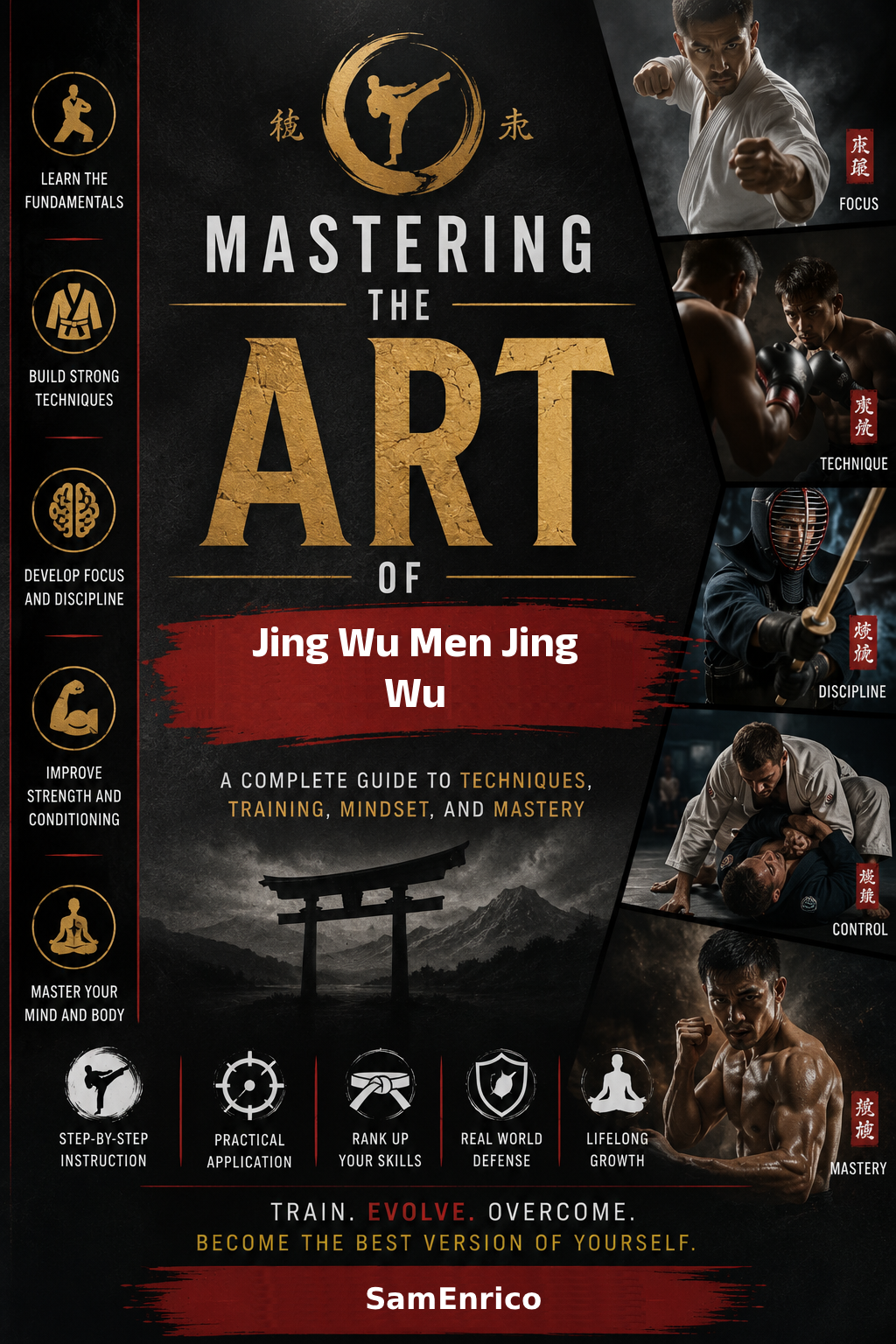 Mastering The Art of Jing Wu Men (精武門) Jing Wu, a Famous School Founded In Shanghai That Teaches Several Different Styles.Tice Natashia$11.99
You may also like
 Hong Kong Handover 1997Dunn Johnnie$11.99
 Zumba For Postnatal Recovery CourseNeal Christian$11.99
 Zumba for BeginnersLadner Nikia$11.99
 YouTube Comment Mining GuideHumes Pandora$12.99
 Worry Box MeditationCarlin Rudy$11.99
 Workplace Stress MeditationNguyen Lynn$11.99
 Workplace Stress and Sleep RepairHawley Ivory$11.99
 Workplace Perfectionism CureDelaney Jeffry$11.99
 Workplace Injustice Anger GuideWallen Isabelle$11.99
 Work Addiction and Burnout LinkGreenwood Ester$11.99
 Women in Yoga and WellnessBeattie Galina$11.99
 Women in Stand Up ComedyChun Evangeline$11.99