
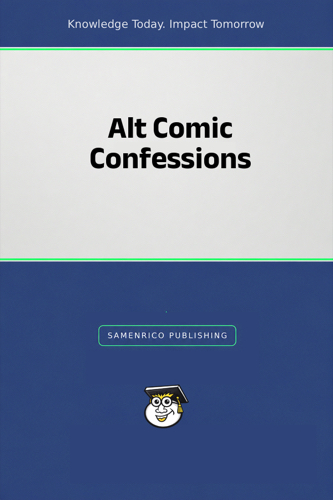
Non-FictionBiographyAlternative Comedy
Alt Comic Confessions eBook
The eccentric world of experimental comedy and the
The eccentric world of experimental comedy and the misfits who thrive in it.
Formats
Free sample
Chapter 1: The Shadow Class Clown--–- When I was twelve years old, I laughed at the wrong moment. It was a Tuesday in April, Mrs. Kovacs’s seventh-grade social studies class, and we were watching a documentary about the Black Death. The screen showed a medieval painting of plague victims—twisted bodies, swollen lymph nodes, faces frozen in agony. The class was silent.
Some kids looked away. One girl started crying. And I laughed. Not a nervous chuckle. A full, uncontainable, snorting laugh that echoed off the cinderblock walls.
Mrs. Kovacs stopped the tape. Thirty-two heads turned toward me. “Something funny about mass death, Mr. Henderson?” she asked.
I had no answer. I didn’t know why I laughed. I only knew that the painting—with its grotesque exaggeration, its medieval cartoonist’s hand—had struck me as absurd. Not the suffering. The drawing.
The way the artist had made death look like a slapstick villain. I was not a cruel kid. I was not indifferent to pain. But something in my brain had misfired, swapped wires, turned horror into humor. That was my first clue that I was not wired for normal comedy.
That was the day I became the shadow class clown.This chapter is for everyone who has ever laughed at a funeral, found the wrong thing funny, or realized that the “class clown” label never quite fit because you weren’t performing for approval—you were performing because the world looked fundamentally strange to you. We are going to dismantle the myth of the class clown, introduce the concept of “punching sideways,” and begin the argument that runs through this entire book: the alternative comedian is not a failed mainstream comedian. They are a different species entirely.The Myth of the Class Clown Every school has one. The class clown. The kid who cracks jokes during roll call, does impressions of the principal, and can reliably get a laugh by falling off a chair.
Teachers roll their eyes but secretly enjoy them. Peers vote them “most likely to be on Saturday Night Live.” They are charming, confident, and—here is the crucial detail—they are performing for approval. The class clown wants to be liked. They want the laugh because the laugh is a hug, a gold star, a signal that they belong.The future alternative comedian is not this kid.Let me be precise. There are certainly alt comics who were class clowns.
Comedy is a big tent. But the origin story that appears again and again in interviews, memoirs, and oral histories is not the popular funny kid. It is the shadow class clown. The kid who sat in the back, not the front. The kid who drew disturbing cartoons in notebook margins instead of raising their hand with a pun.
The kid who laughed too loudly at the teacher’s unintentional innuendo—not because they were trying to be cool, but because the accidental double meaning genuinely destroyed them. The kid who found John Waters funnier than Jerry Seinfeld, who preferred The State to Friends, who recorded The Kids in the Hall on VHS and watched it alone in the basement.I interviewed forty-seven alternative comedians for this book. Thirty-nine of them described a version of the same story: they were not the most popular funny kid. They were the weirdest funny kid. And often, they were not recognized as funny at all until much later.“I didn’t know I was funny until I was twenty-two,” one comic told me.
“In high school, I was just the quiet kid who drew monsters. People thought I was creepy. And then I got on stage and did a five-minute set about the sexual tension between a Roomba and a toaster, and people lost their minds. That was the first time I realized that my brain worked differently. The stuff that made people uncomfortable in homeroom made them laugh in a club.”This is the first clue.
The shadow class clown’s comedy does not translate to the cafeteria. It requires a different container—a stage, a permission structure, an audience that has chosen to be there. In the uncontrolled environment of school, the alt comic’s instincts read as wrong. Off. Disturbing, even.
Not until they find the alt room do those same instincts become genius.Punching Sideways: A New Taxonomy To understand why the shadow class clown’s comedy feels different, we need a new vocabulary. Traditional comedy criticism distinguishes between “punching up” and “punching down.”Punching up means targeting those with more power: politicians, bosses, the wealthy, authority figures. It is the default mode of late-night monologues and political satire. The audience feels righteous.Punching down means targeting those with less power: the poor, the disabled, marginalized groups, the vulnerable. It is the domain of shock jocks and cruel roast comics.
The audience feels superior, then vaguely guilty.But there is a third direction, and it is where alternative comedy lives. Punching sideways.Punching sideways means aiming at neither the powerful nor the vulnerable. It means aiming at the absurd, the awkward, the uncomfortable void between people. It means laughing at the social scripts that govern all of us equally—not because we are victims or oppressors, but because we are all trapped in the same bewildering performance of being human.Consider these classic setups for sideways jokes:Why do we say “we should get coffee” to someone we have no intention of seeing again?Why do funerals have catered finger sandwiches?Why does eye contact have unspoken duration limits?Why do we clap when a plane lands?Why does the phrase “How are you?” require the answer “Good, you?” regardless of actual condition?These are not political questions. They are not about power.
They are about the sheer, glorious, maddening weirdness of social reality. The mainstream comedian might turn these observations into a tight ten minutes with a clear punchline. The alternative comedian might stretch them into a thirty-minute meditation that ends with a sweat-soaked confession about their own inability to perform “fine.”Here is the distinction that matters: punching up is about justice. Punching down is about cruelty. Punching sideways is about confusion.The shadow class clown grows up in a state of perpetual low-grade confusion.
Why does everyone pretend to like each other? Why are there so many unspoken rules? Why does no one else seem to notice that the emperor has no clothes? That confusion is not a bug. It is the engine.The Social Radar Misfire Let me get a little technical.
Psychologists use the term “theory of mind” to describe the ability to attribute mental states—beliefs, intentions, desires—to oneself and others. Most humans develop this automatically. You know that other people have different knowledge than you. You know that they might be lying, or joking, or confused. You can predict their reactions.The future alternative comedian often has a hyper-developed theory of mind—but with a crucial twist.
They are too aware of the gap between internal experience and external performance. They see the performance as performance. While the mainstream class clown instinctively knows how to play the social game for maximum approval, the…
This is the end of the free sample. Get the eBook to keep going. Buy now
About this book
Details
- Author
- Zielinski Ellie
- Publisher
- SamEnrico
- Language
- English
- Genre
- Non-Fiction, Biography, Alternative Comedy
- Released
- 2026-06-07
- Pages (approx.)
- 114
- Available as
- eBook, Audiobook

Read better in the ZLOADR app
Your eBooks on your phone or tablet. Sign in with your SamEnrico account and start reading.
More by Zielinski Ellie
 The Executive Chef Stress GuideZielinski Ellie$11.99
 Micronutrients For Nail Health GuideZielinski Ellie$11.99
 The Frozen Lake StillnessZielinski Ellie$11.99
 The Award Acceptance SpeechZielinski Ellie$11.99
 The IBS Research UpdateZielinski Ellie$11.99
 Caregiver Financial Stress GuideZielinski Ellie$11.99
 Eviction Process GuideZielinski Ellie$11.99
 Hildegard of Bingen: The Prophetess of the RhineZielinski Ellie$11.99
 Anansi's Golden Web: The Trickster’s Grand DesignZielinski Ellie$11.99
 The Last Broadcast of Radio EcoshockZielinski Ellie$11.99
 Prompting for Lookbook and Style CreationZielinski Ellie$11.99
 International Crisis PR GuideZielinski Ellie$12.99
You may also like
 Hong Kong Handover 1997Dunn Johnnie$11.99
 Zumba For Postnatal Recovery CourseNeal Christian$11.99
 Zumba for BeginnersLadner Nikia$11.99
 YouTube Comment Mining GuideHumes Pandora$12.99
 Worry Box MeditationCarlin Rudy$11.99
 Workplace Stress MeditationNguyen Lynn$11.99
 Workplace Stress and Sleep RepairHawley Ivory$11.99
 Workplace Perfectionism CureDelaney Jeffry$11.99
 Workplace Injustice Anger GuideWallen Isabelle$11.99
 Work Addiction and Burnout LinkGreenwood Ester$11.99
 Women in Yoga and WellnessBeattie Galina$11.99
 Women in Stand Up ComedyChun Evangeline$11.99