
Non-FictionHealth & WellnessEcology
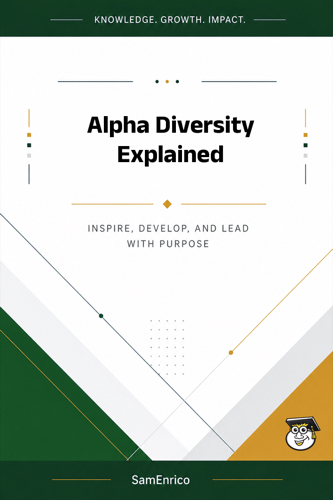
Alpha Diversity Explained eBook
Teaches species richness within a sample.
Teaches species richness within a sample.
Formats
Free sample
Chapter 1: The Paradox of Presence...--–- On a humid morning in the Brazilian Amazon, a field ecologist finishes laying out her fourth 50-meter transect. She has recorded 237 individual beetles from 89 distinct morphospecies. A colleague working 200 meters away, in what appears to be identical forest, has collected 312 individuals but only 67 species. Who has found the more diverse community? The answer, as this chapter will reveal, is neither simple nor obvious—and that uncertainty is precisely why alpha diversity demands rigorous attention.This book opens with a fundamental paradox: we cannot count every species on Earth, yet local species counts (alpha diversity) are the primary currency for assessing ecosystem health, tracking extinction rates, testing ecological theory, and allocating conservation resources.
Every day, ecologists, conservation biologists, and environmental managers make decisions based on comparisons of species richness between sites, before and after disturbances, or across management treatments. But what does it actually mean for one site to have "more species" than another? And when should we trust those comparisons?The paradox deepens when we recognize that a species count is never a neutral fact plucked from nature. It is always the product of choices: where to sample, how to define a species, how many individuals to collect, which statistical methods to apply, and whether to count rare singletons as signal or noise. Two researchers studying the exact same patch of forest could emerge with radically different alpha diversity estimates simply because they made different decisions along this chain.
This does not mean alpha diversity is arbitrary or useless. Rather, it means that measuring alpha diversity is an act of interpretation embedded within a scientific framework—and the quality of that framework determines the reliability of the conclusions.This chapter establishes the conceptual foundations for everything that follows. It defines the hierarchy of diversity (alpha, beta, gamma), distinguishes species richness from species diversity, introduces the crucial difference between descriptive and inferential uses of alpha diversity, and situates these measurements within the broader biodiversity crisis. By the end, you will understand why counting species is simultaneously indispensable and treacherous—and why the remaining eleven chapters are necessary to do it right.The Whittaker Hierarchy: Alpha, Beta, Gamma In 1960, the ecologist Robert Whittaker proposed a elegant solution to the problem of scaling biodiversity across space. He recognized that biodiversity could be partitioned into three hierarchical components, each answering a different question:Alpha diversity (α) : the number of species within a single sample or habitat patch.
This is the focus of this book. Alpha diversity answers the question: "How many species are here, in this specific place, at this specific time?"Beta diversity (β) : the rate of species turnover between patches. Beta diversity answers the question: "How different is the species composition of this site from that site?"Gamma diversity (γ) : the total number of species across a landscape or region. Gamma diversity answers the question: "How many species exist across all the patches in this larger area?"The relationship among these three components is beautifully simple: gamma diversity is the product of alpha diversity and beta diversity, or more formally, γ = α × β. If you have a landscape with high alpha diversity (each patch contains many species) and low beta diversity (all patches contain the same species), gamma diversity will be moderate.
If you have low alpha diversity (each patch contains few species) but high beta diversity (patches are very different from one another), gamma diversity can still be high. This decomposition is not merely academic. It has profound practical implications: conserving gamma diversity might require protecting many small, distinct patches (if beta diversity is high) or a single large, species-rich patch (if alpha diversity is high and beta diversity is low).Consider two hypothetical forest fragments. Fragment A contains 50 species on every 100m² plot, and all plots contain roughly the same 50 species. Fragment B contains only 20 species per plot, but each plot contains a completely different set of 20 species, such that across 10 plots, 200 species are present.
Which fragment is more valuable for conservation? The answer depends entirely on whether you prioritize alpha diversity (Fragment A) or gamma diversity (Fragment B). There is no universally correct answer—only answers that align with specific conservation goals.This book focuses on alpha diversity, but we will return to beta and gamma diversity in Chapter 11, where we explore how nestedness and turnover partition gamma diversity into its alpha and beta components. For now, the key insight is that alpha diversity is always a local measurement, and its interpretation changes dramatically when placed in a broader spatial context.Species Richness vs. Species Diversity: A Critical Distinction One of the most common and damaging confusions in ecology is treating "species richness" and "species diversity" as synonyms.
They are not. Understanding the difference is essential for choosing the right measurement for your research question.Species richness is simply the number of species in a sample. If your sample contains 15 species, the species richness is 15. That is it. Richness says nothing about how individuals are distributed among those species.
A community where one species dominates 99% of individuals and the other 14 species share the remaining 1% has exactly the same species richness as a community where all 15 species have roughly equal abundances. Richness is blind to evenness.Species diversity , in contrast, incorporates both richness and evenness. The most common diversity indices (Shannon, Simpson, and others) weight species by their relative abundances. A community with 15 equally abundant species will have higher Shannon diversity than a community with 15 species where one dominates. Diversity indices answer a different question: not just "how many species?" but "how are the individuals distributed among them?"When should you use richness versus diversity?
The answer depends on your research question. If you are asking whether a disturbance causes local extinctions (species disappearing entirely), species richness is the appropriate metric. If you are asking whether a disturbance alters community structure (making it more dominated by a few common species), a diversity index that incorporates evenness is more informative. Many studies report both, but they are not interchangeable, and interpreting them requires different ecological reasoning.A worked example makes this concrete. Imagine two grassland plots, each with 10 plant species.
In Plot 1, one grass species covers 90% of the ground, and the other nine species share the remaining 10%. In Plot 2, all 10 species cover roughly 10% of the ground each. Both plots have species richness = 10. But the Shannon diversity index (H') is approximately 0.53 for Plot 1 and 2.30 for Plot 2. The difference is enormous, and it reflects a real ecological difference: Plot 1 is dominated by a single competitor, while Plot 2 supports a more even coexistence.
Reporting only richness would miss this entirely.This book emphasizes species richness, as promised by the title Alpha Diversity Explained. But we will return to evenness and species abundance distributions in Chapter 7, where the full shape of community structure becomes visible.Descriptive vs. Inferential Uses of Alpha Diversity A central distinction runs through every chapter of this book, and misunderstanding it has produced countless flawed studies. The distinction is between descriptive and inferential uses of alpha diversity.Descriptive uses report alpha diversity as a factual observation about a particular place and time, without making claims about larger populations or causal processes. Examples include: "The 2023 survey of Muir Woods recorded 127 species…
This is the end of the free sample. Get the eBook to keep going. Buy now
About this book
Details
- Author
- Mojica Michelina
- Publisher
- SamEnrico
- Language
- English
- Genre
- Non-Fiction, Health & Wellness, Ecology
- Released
- 2026-06-06
- Pages (approx.)
- 149
- Available as
- eBook, Audiobook

Read better in the ZLOADR app
Your eBooks on your phone or tablet. Sign in with your SamEnrico account and start reading.
More by Mojica Michelina
 Emergency Room Nurse TraumaMojica Michelina$11.99
 The PLEASE Skills WorkbookMojica Michelina$11.99
 The CPR Emergency Call GuideMojica Michelina$11.99
 Self Hypnosis for Fear of HomelessnessMojica Michelina$11.99
 British Somaliland IndependenceMojica Michelina$11.99
 Non Alcoholic Drink GuideMojica Michelina$11.99
 Child Loss And Pet GriefMojica Michelina$11.99
 The Phantom of the Rhine: Europe's Most Audacious Insurance FraudMojica Michelina$11.99
 The Magnificent Merchants: How Black Industrialists Built Global EmpiresMojica Michelina$11.99
 How to Produce Flow Measuring InstrumentsMojica Michelina$11.99
 How to Start a Exterior Painting of Buildings Business (Beginners Guide)Mojica Michelina$11.99
 A Collector's Handbook to the Austro-daimler AdrMojica Michelina$11.99
You may also like
 Hong Kong Handover 1997Dunn Johnnie$11.99
 Zumba For Postnatal Recovery CourseNeal Christian$11.99
 Zumba for BeginnersLadner Nikia$11.99
 YouTube Comment Mining GuideHumes Pandora$12.99
 Worry Box MeditationCarlin Rudy$11.99
 Workplace Stress MeditationNguyen Lynn$11.99
 Workplace Stress and Sleep RepairHawley Ivory$11.99
 Workplace Perfectionism CureDelaney Jeffry$11.99
 Workplace Injustice Anger GuideWallen Isabelle$11.99
 Work Addiction and Burnout LinkGreenwood Ester$11.99
 Women in Yoga and WellnessBeattie Galina$11.99
 Women in Stand Up ComedyChun Evangeline$11.99