
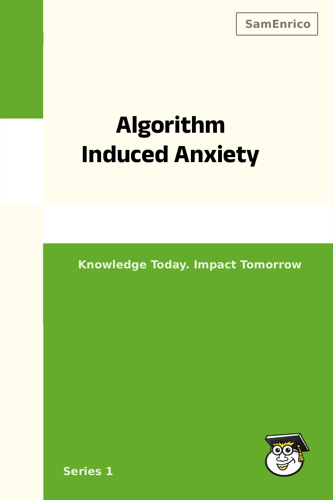
Algorithm Induced Anxiety eBook
How recommendation engines feed comparison by show
by Poland Darci
How recommendation engines feed comparison by showing you idealized content.
Formats
Free sample
Chapter 1: The Lena Problem...--The first time Lena cried because of her phone, she was twenty-four years old, sitting on her bathroom floor at eleven-thirty on a Tuesday night. She had spent the previous two hours watching Tik Tok videos of women her age who seemed to own skincare fridges, wake up at five in the morning to journal, make six figures from something called “passive income,” and still have time for romantic partners who looked like they had been generated by artificial intelligence. Lena did not own a skincare fridge. She woke up at seven forty-five, often after hitting snooze three times. She made sixty-two thousand dollars a year as a marketing coordinator, a job she did not hate but also did not love.
Her last serious relationship had ended nine months ago, and she had not told her mother because she was tired of explaining things she did not understand herself.The crying did not come from a single video. It came from the cumulative weight of hundreds of them, stacked like bricks inside her chest. She had not noticed the wall being built. She had only noticed, somewhere around the two-hour mark, that she could not breathe properly and that her face was wet.Lena is not a real person. She is a composite of more than two hundred interviews conducted with young adults between the ages of eighteen and thirty-five who reported symptoms that did not have a name until very recently.
Their stories are remarkably similar. They describe opening an app to relax, to distract themselves, to fill five minutes while waiting for coffee or a bus or a friend who is running late. They describe closing that same app feeling worse than when they opened it—more anxious, more inadequate, more exhausted. They describe knowing, in some abstract way, that their phones are making them unhappy. They describe being unable to stop.This book is for Lena.
And if you are reading this, this book is for you.The Paradox of Digital Comfort We have been told, repeatedly and by people who should know better, that technology connects us. It brings us closer to the people we love. It gives us access to information, entertainment, and community. It makes our lives more convenient, more efficient, more optimized. These things are not entirely false.
I can video call my sister across the country. I can find a recipe for dinner in thirty seconds. I can listen to almost any song ever recorded while walking to the grocery store. These are genuine benefits, and I do not wish to dismiss them.But there is another story, one that technology companies do not tell in their marketing materials. It is the story of what happens after the convenience fades and the connection becomes a comparison.
It is the story of millions of people who open their phones to feel better and close them feeling worse, who scroll not because they want to but because they cannot seem to stop, who have noticed that their relationship with technology has become something closer to a dependency than a choice.This is the central paradox of modern digital life. We seek comfort from our devices, and our devices deliver the opposite. We reach for our phones to escape anxiety, and we find anxiety waiting for us, curated and personalized and optimized for maximum impact. The machine is not broken. The machine is working exactly as designed.
We have simply misunderstood what it is designed to do.Defining Algorithm Induced Anxiety Before we go any further, we need a name for what Lena experienced on her bathroom floor. I call it Algorithm Induced Anxiety, or AIA for short.Algorithm Induced Anxiety is a specific form of distress caused by predictive models—recommendation engines, personalized feeds, algorithmic ranking systems—that show users a curated, statistically optimized version of reality that they cannot attain. It is not the same as generalized anxiety disorder, which does not require digital triggers. It is not the same as social media anxiety, which can include fear of direct social judgment, harassment, or exclusion from events. AIA is narrower and, in some ways, more insidious.
It is the anxiety of being shown, again and again, a version of life that is just out of reach.Let me be precise about the distinction. General social media anxiety often involves what psychologists call FOMO: fear of missing out on events, experiences, or social connections. You see photos of friends at a party you were not invited to, and you feel excluded. This is painful, but it is also straightforward. The source of the pain is social exclusion, a threat humans have evolved to take seriously.AIA operates differently.
When Lena watches a video of a woman her age who appears to have a perfect life, Lena does not know that woman. They are not friends. Lena has not been excluded from anything. The anxiety Lena feels is not about missing a party or a conversation. It is about the gap between her actual life and a curated, filtered, statistically improbable version of life that the algorithm has decided she should see.
Lena is not afraid of missing out on something real. She is afraid that her real life is not enough.This distinction matters because the solutions are different. If your anxiety comes from missing social events, the solution might involve strengthening your social connections or changing your relationship with peer acceptance. If your anxiety comes from algorithmic comparison, the solution must involve understanding how the machine works, why it shows you what it shows you, and how to break the feedback loop that keeps you scrolling.Algorithmic FOMO: A Subtype There is one more distinction to make before we proceed. Within AIA, there is a specific subtype that I call Algorithmic FOMO.
It is related to traditional FOMO but different in crucial ways.Traditional FOMO is social and event-based. You fear missing a concert, a wedding, a casual hangout, a conversation. The object of your fear is a real thing that happened in the physical world, involving real people you know.Algorithmic FOMO is different. It is the fear of missing out on cultural consensus—on knowing what everyone else seems to know. You see a video that is labeled “trending” or “viral,” and you feel a spike of anxiety not because you missed the content itself but because the machine has told you that everyone else has seen it.
You are not anxious about a missed experience. You are anxious about being out of sync with an invisible, algorithmically constructed crowd.This distinction will become important in Chapter Seven, when we examine how ranking and virality systems exploit social proof to keep you scrolling. For now, it is enough to know that AIA includes both the anxiety of upward comparison (the gap between you and idealized strangers) and the anxiety of algorithmic consensus (the fear that you are the only one who has not seen what everyone else has seen).You Are Not Broken Before we go any further, I need to say something directly to you, the reader.If you recognize yourself in Lena’s story, you might be tempted to…
This is the end of the free sample. Get the eBook to keep going. Buy now
About this book
Details
- Author
- Poland Darci
- Publisher
- SamEnrico
- Language
- English
- Genre
- Non-Fiction, Self-Help, Algorithm Psychology
- Released
- 2026-06-09
- Pages (approx.)
- 142
- Available as
- eBook, Audiobook

Read better in the ZLOADR app
Your eBooks on your phone or tablet. Sign in with your SamEnrico account and start reading.
More by Poland Darci
 Urinary Incontinence ExercisesPoland Darci$11.99
 Walk Every Day For LongevityPoland Darci$11.99
 Stress Hydration LinkPoland Darci$11.99
 The Engineering Team EngagementPoland Darci$11.99
 The Yellow Wall of Buenos Aires: The Untold Story of Maradona's Most Loyal FansPoland Darci$11.99
 The Breeder's Guide to Black TurkeysPoland Darci$11.99
 Chess CoachPoland Darci$11.99
 Facebook Ad Relevance ScorePoland Darci$12.99
 Cape Town Startup EcosystemPoland Darci$12.99
 How to Start a Boat Kits for Assembly Business (Beginners Guide)Poland Darci$11.99