
Non-FictionSelf-HelpCreator Mental Health
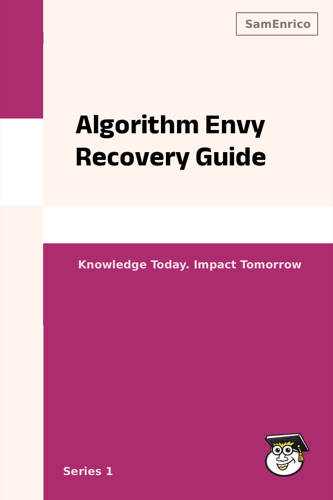
Algorithm Envy Recovery Guide eBook
Stop comparing your engagement rates to accounts t
Stop comparing your engagement rates to accounts that went viral.
Formats
Free sample
Chapter 1: The Dirty Laundry Principle--–- You spend three hours crafting a thoughtful post. You pour your heart into the caption, select the perfect filter, and time your publish for peak hours according to every “best time to post” guide you have ever read. You hit publish. Six hours later, you have forty-seven likes and two comments—one from your mom and one from a bot selling Instagram followers.Then you scroll. Thirty seconds.
A blurry photo of a cat with a misspelled word has eight hundred and forty-seven thousand likes and twelve thousand shares. Your chest tightens. Your throat constricts. You refresh your post. Still forty-seven.
You refresh the cat. Eight hundred and fifty-one thousand now.That feeling—the hot flush of inadequacy, the quiet whisper that says “you are not enough,” the urge to delete everything and start over or quit entirely—has a name. It is called Algorithm Envy.This book is not about teaching you to beat the algorithm. This book is about teaching you to stop needing to.The Anatomy of Algorithm Envy Algorithm envy is not jealousy in the traditional sense. Jealousy fears losing what you have.
Envy covets what someone else has. Algorithm envy is a specific, modern subspecies of envy that emerges when you compare your organic engagement rates—the honest, hard-won attention you earn post by post—to accounts that have gone viral. It is the gap between your real, messy, human-sized growth and the exponential, seemingly magical explosion of someone else’s content.Every creator knows this feeling. The writer whose newsletter has three hundred subscribers who actually open every issue feels a pang seeing a Substack influencer with thirty thousand subscribers who never click anything. The artist who sells at local markets feels a sting watching a Tik Tok creator sell three hundred digital prints in an hour.
The podcaster with a loyal following of five hundred feels a knot in their stomach seeing a clip from a stranger’s show rack up two million views.Here is what no one tells you about that feeling: it is not a sign of weakness. It is not a character flaw. It is a predictable, engineered response to a system designed to make you feel exactly this way.False Scarcity: The Engine of Envy The primary mechanism driving algorithm envy is what behavioral economists call false scarcity. False scarcity occurs when a system creates the illusion that resources—attention, engagement, followers, opportunities—are more limited than they actually are, triggering fear-driven behavior.Social media platforms are masters of false scarcity. Every time you open an app, you are shown a curated stream of the most successful, most viral, most attention-grabbing content from millions of users.
You are not shown the ninety-nine percent of posts that performed normally. You are shown the one percent that exploded. The platform aggregates the outliers and presents them to you as the baseline.This phenomenon has a name in academic literature. Researchers at the University of North Carolina (Anderson & Kilduff, 2009, “Why Do Social Network Users Share?”) demonstrated that social proof—the sheer volume of likes, shares, and comments—is the primary driver of engagement, not actual quality, usefulness, or creativity. In other words, things go viral not because they are good but because they are already viral.Consider the “Book Tok effect.” In 2020 and 2021, a handful of book creators on Tik Tok exploded seemingly overnight.
Videos with the hashtag #Book Tok accumulated billions of views. Books that had been published years earlier suddenly shot to the top of bestseller lists. The narrative that emerged was one of magical, democratic discovery: unknown creators, authentic recommendations, overnight success.But this narrative concealed the mechanism. The algorithm did not randomly elevate the best content. It identified a few early outliers and then continued to show them to more users because they were already being shown to many users.
This is the rich get richer dynamic of social proof. The viral accounts are not necessarily better than you. They are simply already viral.The Dirty Laundry Principle Here is the truth that platforms do not want you to internalize: viral content is not reality. It is a stage production.The term “dirty laundry” comes from the old saying about airing your dirty laundry in public—revealing your flaws, mistakes, and struggles. The Dirty Laundry Principle is this: What you see in viral content is the curated highlight reel.
What you live is the messy, unfinished, human reality. You are comparing your dirty laundry to someone else’s staged photography.This chapter introduces a distinction that will run throughout this book: the difference between actual community and performative competition.Actual community is slow, reciprocal, and messy. It is built on shared struggles, honest mistakes, and genuine vulnerability. In an actual community, members show their failures. They engage with comments meaningfully, even the critical ones.
They would matter to you even if they had one hundred followers because the connection is about substance, not status.Performative competition is fast, one-directional, and polished. It is built on curated highlights, manufactured scarcity, and the constant implicit message that you are falling behind. In performative competition, creators show only their wins. They engage primarily with comments that reinforce their success. They would not matter to you if they had one hundred followers because their value is entirely in their perceived status.Most viral accounts are not malicious.
They are simply playing a different game. The game of performative competition is about extracting attention at scale. The game of actual community is about exchanging value at depth. You cannot win at a game you refuse to define, and you cannot play two games at once.The Three-Question Test How can you tell the difference? This chapter provides a simple diagnostic tool that you will use throughout your recovery: the Three-Question Test for any account that triggers your algorithm envy.Ask yourself these three questions about the account:One: Do they show their failures?
Look for posts that document things that did not work. A recipe that flopped. A launch that underperformed. A mistake they made publicly. A moment of doubt or insecurity.
If every post is a highlight reel—perfect lighting, perfect results, perfect attitude—you are looking at performative competition.Two: Do they engage with comments meaningfully? Scroll through their replies. Are they actually responding to questions? Are they acknowledging criticism? Are they having conversations, or are they dropping emoji replies on the top comments and ignoring the rest?
Meaningful engagement takes time. Accounts optimized for scale often sacrifice depth for breadth.Three: Would they matter to you if they had one hundred followers? This is the most revealing question. Imagine the exact same content, the exact same personality, the exact same value—but with one hundred followers instead of one hundred thousand. Would you still follow them?
Would you still admire them? Would you still feel that pang of envy? If the answer is no, you are envious of their status, not their substance.The Dirty Laundry Challenge Every chapter in this book includes one core exercise. The optional deep dives and supplementary exercises are collected in the Appendix. For this chapter, complete the Dirty…
This is the end of the free sample. Get the eBook to keep going. Buy now
About this book
Details
- Author
- Danielson Alla
- Publisher
- SamEnrico
- Language
- English
- Genre
- Non-Fiction, Self-Help, Creator Mental Health
- Released
- 2026-06-09
- Pages (approx.)
- 116
- Available as
- eBook, Audiobook

Read better in the ZLOADR app
Your eBooks on your phone or tablet. Sign in with your SamEnrico account and start reading.
More by Danielson Alla
 DTaP Vaccine GuideDanielson Alla$11.99
 Gambling Addiction Warning Signs GuideDanielson Alla$11.99
 Exposure Therapy for DreamsDanielson Alla$11.99
 The Birthday Forgotten WoundDanielson Alla$11.99
 Relationship Comparison OnlineDanielson Alla$11.99
 Parent Resilience GuideDanielson Alla$11.99
 Attorney Imposter SyndromeDanielson Alla$11.99
 Stillbirth Sibling Explanation GuideDanielson Alla$11.99
 The Great Moon Hoax: When a Newspaper Tricked the WorldDanielson Alla$11.99
 The Hollow Lance: Camelot’s Forgotten OathDanielson Alla$11.99
 The Silent Strategist: Scipio Africanus and the Fall of CarthageDanielson Alla$11.99
 Growing SinojackiaDanielson Alla$11.99
You may also like
 Hong Kong Handover 1997Dunn Johnnie$11.99
 Zumba For Postnatal Recovery CourseNeal Christian$11.99
 Zumba for BeginnersLadner Nikia$11.99
 YouTube Comment Mining GuideHumes Pandora$12.99
 Worry Box MeditationCarlin Rudy$11.99
 Workplace Stress MeditationNguyen Lynn$11.99
 Workplace Stress and Sleep RepairHawley Ivory$11.99
 Workplace Perfectionism CureDelaney Jeffry$11.99
 Workplace Injustice Anger GuideWallen Isabelle$11.99
 Work Addiction and Burnout LinkGreenwood Ester$11.99
 Women in Yoga and WellnessBeattie Galina$11.99
 Women in Stand Up ComedyChun Evangeline$11.99